



Could earlier police access to info on disputes save lives?
CORAL SPRING, Trelawny — Justice Minister Delroy Chuck has signalled a willingness to examine whether police should be granted early access to information on disputes that could help prevent violent escalations, responding to concerns raised by St James Police Division commander, Senior Superintendent of Police Eron Samuels about the moral implications of making such information available to law enforcement.
Speaking during the question-and-answer segment of last Friday’s Alternative Dispute Resolution Policy Development and Estate Planning Public Education Forum at Ocean Coral Spring in Trelawny, held under the theme ‘Resolving Disputes, Securing Legacy’, SSP Samuels questioned whether there are restrictions, on moral grounds, that might prevent the police from accessing information that could help avert violence linked to disputes over land and estates.
“What I want to find out is, is there any ethical part that would not allow for police officers to get information about these [disputes] that are going a little overboard?” Samuels asked.
The senior cop cited two recent murders in his division that were allegedly triggered by disputes over land and property and which were before the court.
“Now if we could have gotten wind of that earlier we might have avoided two murders. So, I want to know what would the problem be with the police officers getting that information early?” Samuels questioned.
Samuels also wanted to know whether there would be a registry or database established to track and document these disputes. He suggested that such a system could record the individuals involved and maintain reports of incidents so that if issues arise in the future, or in a worst-case scenario, there would be an official record showing that a dispute or concern had previously been identified.
The justice minister said SSP Samuels “brought up a very important point”.
“And the information you’re giving, I think a policy needs to be organised from the Administrator General’s Department,” Chuck said. “That policy at the moment doesn’t allow you to be revealing that sort of information to the police but I think it would be a good idea for us to think about it. Because what Senior Superintendent Samuels is saying, if we were alerted that there’s likely to be conflict in a community or a neighbourhood over a piece of land…we may well pass by and find out what is happening or the administrator general could refer the parties to restorative justice or something.”
However, the justice minister acknowledged the need for further discussions to determine how information could be shared while balancing prevention efforts and privacy concerns.
“What he’s saying, he only knew after the fact, and we will discuss… to find out to what extent will information come to you. And [if] parties come to the administrator general, you anticipate that there could be a conflict and, quietly, we could pass on the information to the police to say, ‘There’s likely to be something in that community,’ ” Chuck said.
“We have to be careful about data protection; but to the extent that we’re talking about preventing violence, it is something we need to discuss. [But] bear in mind the Data Protection Act — when people come to you, we have to be careful how we reveal information. But I think this is important, Senior Superintendent Samuels, because it will avoid a lot of violence in the communities. We will discuss it further,” he added.
The forum formed part of a public education campaign recently launched by the Administrator General’s Department, which is responsible for the administration of estates. The initiative aims to provide simplified information surrounding intestacy and estate planning while increasing awareness of conflict resolution tools.
According to the Ministry of Justice, the campaign was launched amid concerns over “dead lef” disputes which have contributed to conflict and animosity among Jamaicans. Friday’s event marked the first in a series of public fora planned under the campaign.
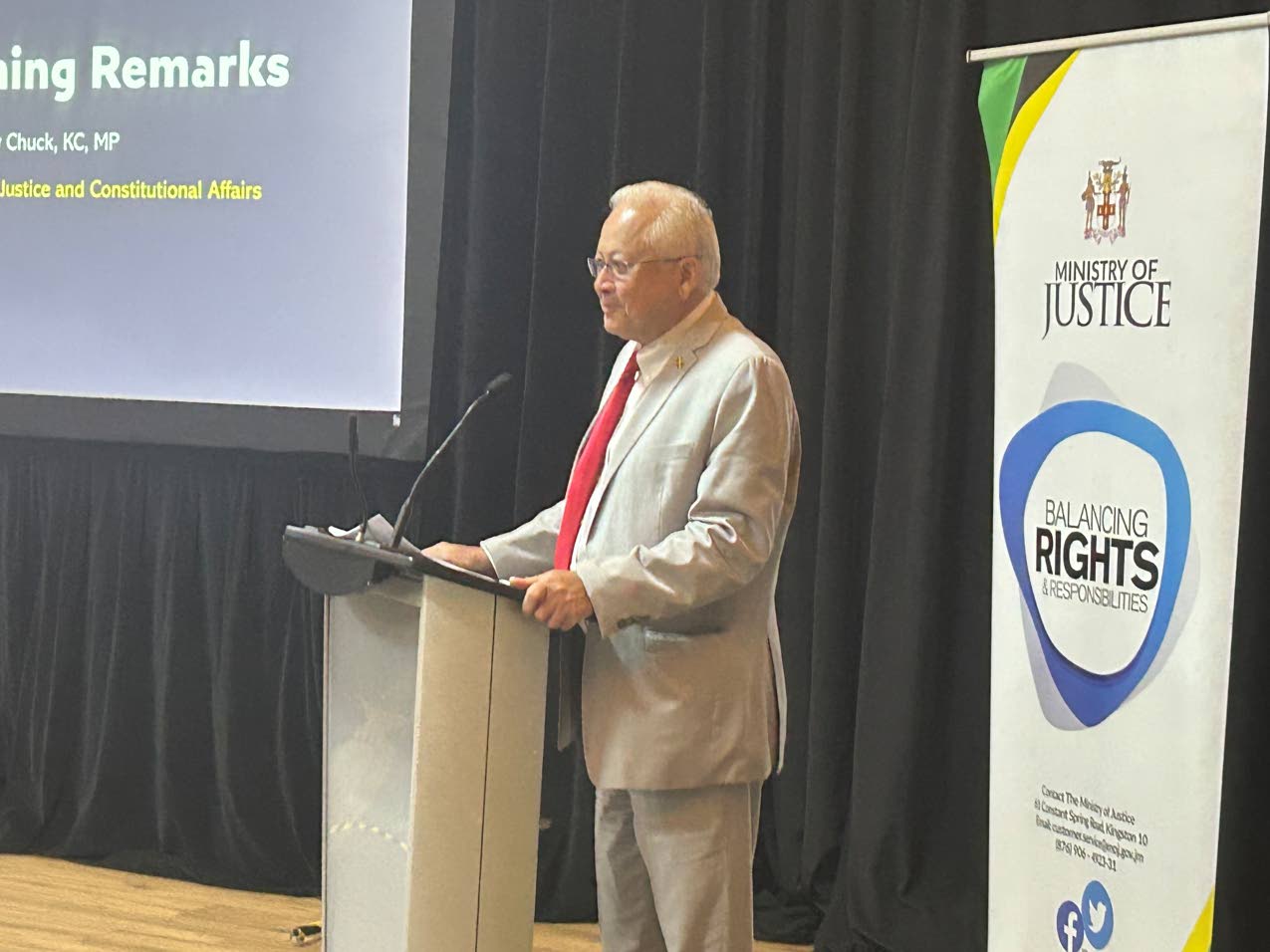
Minister of Justice and Constitutional Affairs Delroy Chuck speaking at Friday’s Alternative Dispute Resolution Policy Development and Estate Planning Public Education Forum, held at Ocean Coral Spring in Trelawny. Photo: Horace Hines


