



PAAC to question SLB and Education Ministry over support for poor students
A review of the Solidarity Programme during Wednesday’s sitting of Parliament’s Public Administration and Appropriations Committee (PAAC) evolved into a wider examination of Jamaica’s tertiary education financing system, with members questioning whether vulnerable students are receiving enough support.
Based on the discussion the committee decided to invite officials of the Students’ Loan Bureau (SLB) and the Ministry of Education to appear before its members who expressed concern over student debt and limited access to funding for poorer Jamaicans.
PAAC chairman Peter Bunting said the discussions surrounding the Solidarity Programme reminded him of the growing financial strain facing families attempting to access tertiary education.
“For certain constituents like mine it is the exception that persons are able to go to tertiary institutions and I am not limiting it to university, I’m talking other training institutions. But those who do [attend universities] make a profound difference to both their and their family’s future,” Bunting told the committee.
He revealed that many people who attended registration drives for the Solidarity Programme at his constituency office believed they qualified for assistance but were later disqualified because they were enrolled in tertiary institutions.
According to Bunting, the response to the Solidarity Programme had been “overwhelming” but he noted that many applicants did not fully understand the criteria, particularly the exclusion of tertiary students.
The programme is a $1.0-billion scheme announced by the Government in June 2025 to provide one-time grants of $20,000 to 50,000 elderly, vulnerable and aspiring Jamaicans who do not currently benefit from and other Government assistance.
But PAAC members were disappointed when acting permanent secretary in the Ministry of Labour and Social Security Dione Jennings reported that only $230.42 million (23 per cent) in approved payments had been disbursed with the remaining $769.58 million returned to the Consolidated Fund at the end of the financial year.
Against that backdrop, Bunting questioned whether the programme’s criteria had been too restrictive, particularly when many financially struggling students were excluded despite the large amount of unused funds.
He also argued that the existing student financing system leaves many Jamaicans burdened by unsustainable debt.
“Right now as far as I can tell the only agency that really addresses it in terms of serious allocations of money is the Students Loan Bureau, but my experience as an MP over years is that for many persons taking the student loans — depending on the degrees that they’re taking it to get — often ends up being a debt trap for them,” Bunting said.
He pointed to cases where former students borrowed relatively modest sums but saw their debt balloon dramatically over time.
“I have cases of persons who originally borrowed a little over a million dollars and today 10 years on — having made hundreds of thousands in payments — now owe over four million and the degrees that they took out these loans to get…it wasn’t a good return on the investment let us just say, certainly not on a loan investment,” he added.
Bunting subsequently proposed inviting representatives of the SLB to appear before the committee to explain the agency’s philosophy and approach to financing tertiary education.
Member of Parliament for St Mary Central Omar Newell supported the proposal and urged the committee to also summon the Ministry of Education to discuss previous initiatives aimed at helping vulnerable students access higher education.
Newell referenced a former programme operated through the National Youth Service, now under HEART/NSTA Trust, which sought to provide fully funded tertiary education to vulnerable students through partnerships with institutions and work-study arrangements.
“The end result of it was that students were able to — through a combination of work and grants — access a fully funded education,” Newell explained.
He said Parliament should revisit whether similar interventions could once again help students from poorer communities.
The concerns emerged after Jennings defended the original structure of the Solidarity Programme, arguing that it was specifically designed to target persons who were outside existing support systems.
However, the combination of the eligibility requirements and the return of hundreds of millions of dollars in unspent funds appeared to leave some legislators questioning whether the programme may have inadvertently excluded vulnerable Jamaicans who still required urgent financial support.
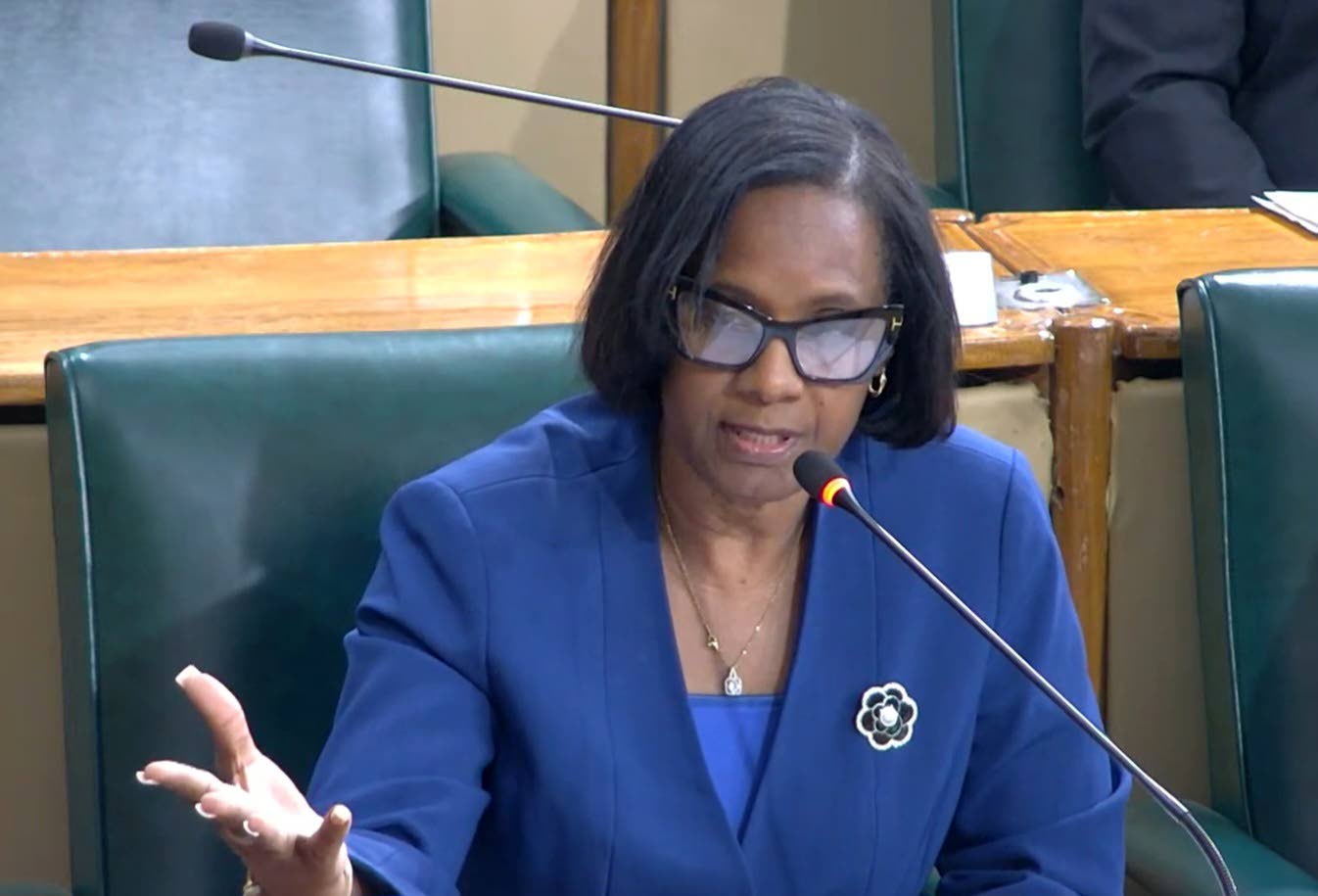
Acting permanent secretary at the Ministry of Labour and Social Security Dione Jennings responds to questions from members of Parliament’s Public Administration and Appropriations Committee on Wednesday.


