



Oil search will take time
United Oil and Gas says Jamaica’s offshore oil search is drawing interest, but remains costly, risky and far from drilling
Key points:
United says Jamaica’s offshore oil search will take time, even as potential partners review the Walton-Morant data.
Drilling remains the major hurdle, with previous estimates putting a future exploration well at roughly US$30 million to US$40 million.
No commercial oil discovery, farm-out agreement, or drilling programme has yet been announced.
UNITED Oil and Gas is telling investors and Jamaicans not to expect a quick answer from the Walton-Morant licence, even as it says potential partners are now taking a closer look at the technical data behind the offshore block south of Jamaica.
In a podcast published Tuesday, Chief Executive Officer and Interim Chairman Brian Larkin said the company still sees Walton-Morant as a major exploration opportunity. But he also sought to cool expectations about how quickly the process can move from geological promise to drilling.
“We’re always very careful to emphasise that exploration does take time,” Larkin said on the company’s latest
On The Rocks podcast. “This is a responsible step-by-step patient process.”
United has already said it is trying to bring in a farm-out partner for Walton-Morant. A farm-out is an oil industry arrangement in which another company takes a stake in a licence in return for helping to pay for the next stage of work.
For United, that is not a small ask. Earlier Walton-Morant marketing material put the cost of drilling a well to test the Colibri prospect at about US$30 million on a dry-hole basis — the cost of drilling even if the well does not lead to a commercial find. Previous public estimates have placed the likely cost of a future exploration well in the US$30 million to US$40 million range.
That helps explain why United is looking for a partner with the financial strength, technical capacity and operating experience to help carry the licence towards drilling.
It also puts the company’s more optimistic language in context. United describes Walton-Morant as a “large, high-impact frontier opportunity”. In plain terms, that means the company believes the block could open a new oil and gas basin if exploration succeeds.
But “frontier” cuts both ways. It points to the size of the possible prize, but also to the level of uncertainty. The area remains underexplored, the risks are high, and the theory still has to be tested by a well.
United holds 100 per cent of the Walton-Morant licence, a 22,400-square-kilometre offshore exploration block. The company estimates that the acreage could contain the equivalent of more than seven billion barrels of oil if exploration proves successful. That is not oil that has been discovered or booked as reserves. It is a company estimate of what may be present in the ground.
No commercial oil discovery has been made. No farm-out agreement has been announced. No drilling programme has been approved.
United’s case for Walton-Morant rests on a mix of well data, oil seeps, offshore slick anomalies, seismic data and more recent seabed sampling.
Paul Ryan, United’s geoscience adviser, said the company is not claiming that any one piece of evidence proves an oil or gas accumulation offshore Jamaica.
“At this stage of an exploration project’s evolution, there isn’t one single data point that proves an oil or gas accumulation is present,” Ryan said.
The wells often cited in Jamaica’s oil story are also historical. According to United’s technical material, 11 exploration wells were drilled in Jamaica between 1955 and 1982. Nine were drilled onshore. Two were drilled offshore: Pedro Bank-1 in 1970 and Arawak-1 in 1982.
Both offshore wells were drilled on Pedro Bank, southwest of the Walton-Morant Basin. That means the modern offshore prospects being promoted by United have not been directly tested by a well.
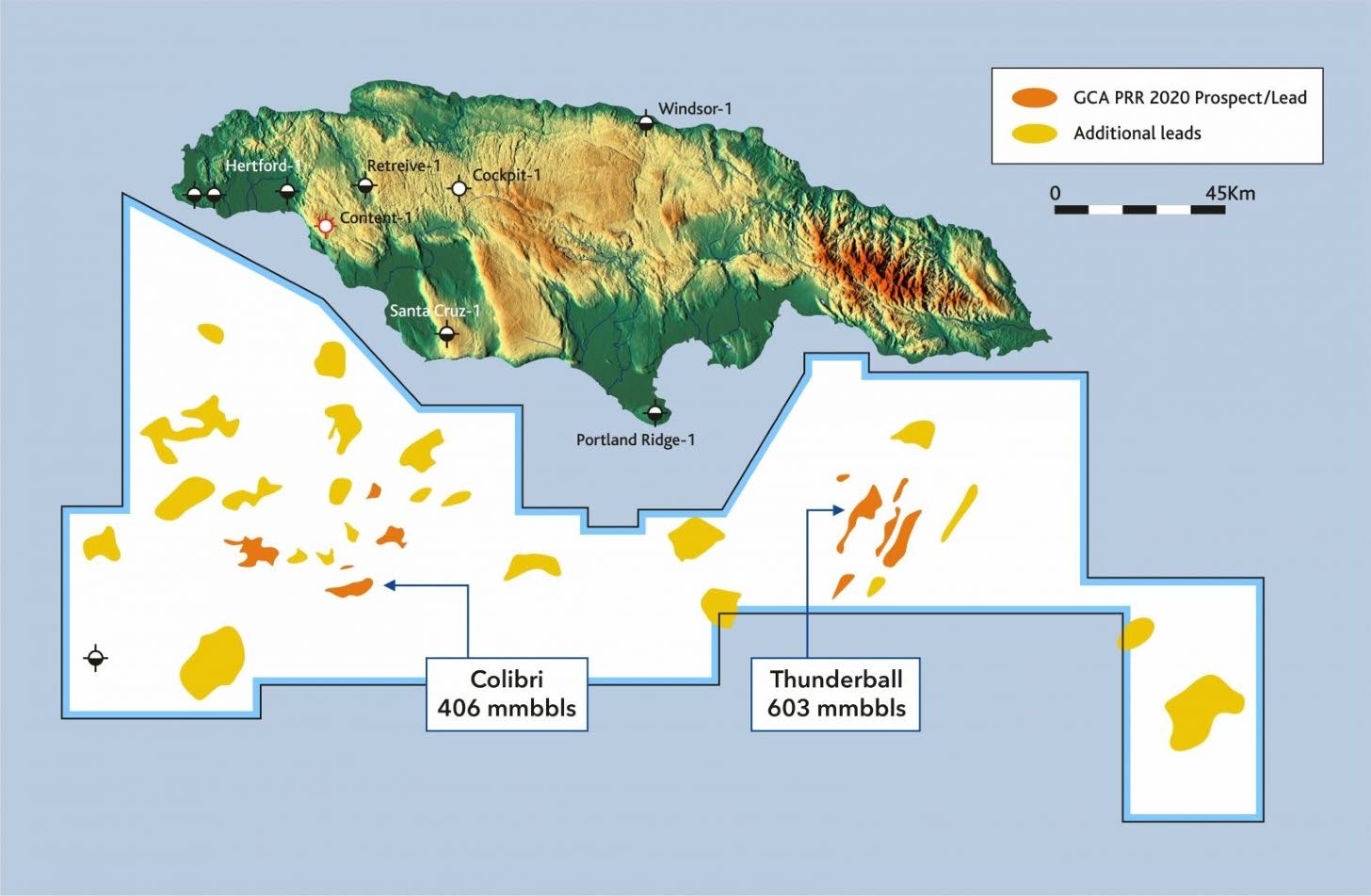
United Oil and Gas’ Walton-Morant licence area, located offshore southern Jamaica. The company says potential partners are reviewing technical data on the block, but no commercial discovery, farm-out deal or drilling programme has yet been announced.
Ryan said those historical wells showed evidence of oil or gas, while oil seeps and offshore slick anomalies add to United’s view that there is an active petroleum system offshore Jamaica.
He also pointed to Blower Rock, south of the licence area, where he said there had been an active and tested oil seep. Repeated slick anomalies within the offshore licence area, he said, may also point to hydrocarbons reaching the seabed.
“Collectively, they support the view that there is an active petroleum system that is yet to be properly tested,” Ryan said.
United completed a surface geochemical exploration survey earlier this year, collecting 42 seabed sediment samples and mapping part of the seafloor. Ryan said the new data is now being worked into the company’s wider geological model and is consistent with the evidence gathered so far.
That technical package is what United is now using to market the licence to possible partners.
Larkin said interested companies first have to sign confidentiality agreements before gaining access to United’s virtual data room. That data room includes seismic data, geological interpretation, survey results, licence information, commercial material and other work needed to assess the licence.
“It’s not just a brochure anymore,” Larkin said. “This is where companies really test the opportunity.”
He said the review process also involves management meetings, technical presentations, questions and answers, and in-person engagements in different parts of the world.
United has made similar confidentiality points before, and Larkin did not name the companies involved or say whether any offer has been made.
He said the company has “multiple credible parties” carrying out detailed technical evaluation of the licence, supported by ongoing technical dialogue with United. But he stopped short of giving names, terms or timelines.
“We can’t discuss names, terms or timelines. That’s not because there’s nothing happening. There clearly is,” he said.
That leaves investors with the same central question: whether United can turn technical interest into a partner deal strong enough to get the licence to drilling.
Larkin said the company is trying to secure the right outcome, not simply rush an announcement.
“What I’d ask shareholders to take from today isn’t what’s the update,” he said. “It’s that this has been run properly with serious partners on a sound technical footing.”
Beyond the farm-out process, United is also framing Walton-Morant in strategic terms. Larkin pointed to Jamaica’s location near the US Gulf Coast and wider Caribbean energy infrastructure, saying that proximity could help with logistics, services, equipment access and possible market routes if exploration ever succeeds.
But he also made clear that Jamaica should not be viewed as an immediate supply story.
“Jamaica is not a near-term supply answer to global market volatility,” Larkin said. “But the broader point is very clear. Secure, diversified future sources of energy remain critically important.”
For Jamaica, a commercial discovery would change the national conversation. Larkin said successful exploration could bring investment, employment, energy-security benefits and long-term revenue.
But the project is not there yet.
United still has to secure a partner willing to spend on a frontier well. Any deal would have to be agreed, financed and taken through the necessary approvals. Drilling would still require environmental and regulatory clearance in Jamaica. And even after that, the well itself would have to prove that oil or gas is present in commercial quantities.
“This is frontier exploration, so there’s always risk and we never lose sight of that,” Larkin said. “But the potential prize is significant.”
For the second half of 2026, he said United’s focus is on securing the right commercial outcome from the farm-out process. The company, he added, will update the market when there is something concrete to say.


