



Container home brings relief to Hurricane Melissa victims
WATERWORKS, Westmoreland — Shermaine Forrest could hardly contain her joy as she celebrated the ‘unboxing’ of her father Glenville’s new Government-provided container home.
“I am so happy. I am so joyful. I know he’s rejoicing, and I know he’s happy, but I’m sorry he can’t be beside me right now because he is unable to move,” she told journalists Tuesday afternoon after watching a crane unfold the metal structure into a solid structure.
The process took less than half an hour and it was secured on a prepared concrete base.
The unit will replace the wooden structure that 74-year-old Glenville once called home. That structure was destroyed by Hurricane Melissa last October, leaving him displaced.
Shermaine lost her own home during the Category 5 storm as well, leaving her unable to assist her father and stepmother.
“Trust me, it’s very, very rough. Sometimes I feel like giving up, but I know Father God is above and I want to give God thanks as well, ‘cause if it was not [for] his mercy and his guidance and protection, we wouldn’t be here today to give Glenville Forrest this nice unit. So I want to say thanks again,” said Shermaine.
“When I say life was rough, it was ugly with my father because… he cannot walk. It was so struggling, especially with my stepmother. It was so rough on her to manage him, to lift him up, to do all of that,” she explained.
The semi-permanent studio unit — often referred to as a containerised housing unit or container home — is valued at a little under $1 million, with a total cost to the government of $2.5 million once additional expenses are factored in. These include a water tank, a sewage system, bathroom fittings, solar electricity generators for select units, furnishings for select units, transportation, and security.
Some units come equipped with bathroom fixtures, a bunk bed, a two-burner stove, a plate set, a pot set, cutlery, and pillows.
The studio units, one of four types of housing solutions being offered to hurricane victims, were purchased by the Ministry of Economic Growth and Infrastructure Development.
Other unit types include a studio solution with a bathroom – gifts from the government and people of China; and a one-bedroom unit that can be converted into a two-bedroom, reserved for families in cluster situations. The fourth solution consists of 300 wooden units donated and managed by the Red Cross.
On Tuesday, minister with responsibility for land titling and land settlements Robert Montague outlined that several factors determined how units were allocated. A popular initial method was to issue a cheque to the beneficiary to independently complete some aspects of the ground work, but this was rejected by another agency. It was later agreed that engaging contractors to build out the base was the best approach.
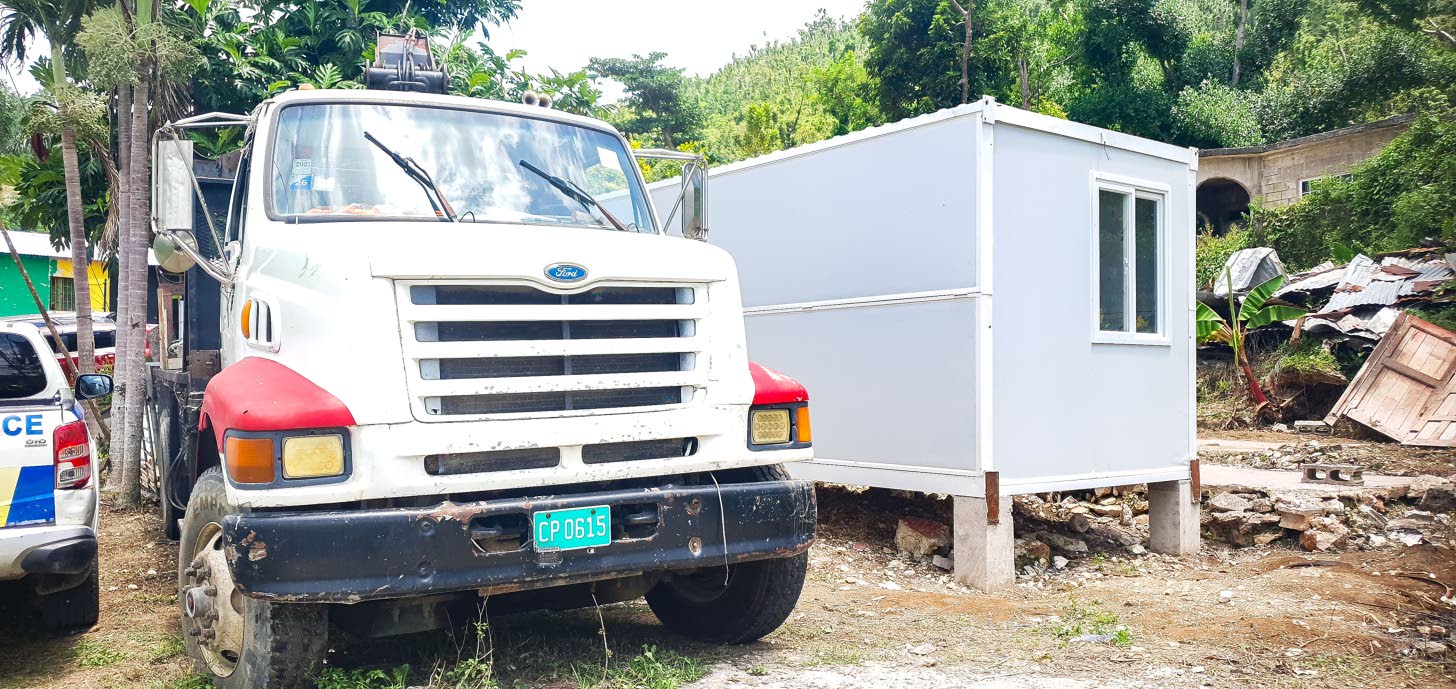
The crane truck that was used to unfold the studio-type, semi-permanent housing unit, seen at right. (Photo: Anthony Lewis)
“That way, you are sure you can give an account, you don’t have to worry or complain… and the quality of the work is ensured, and you can hold somebody to book for it,” explained Montague.
The minister also provided a progress report on the overall project during Tuesday’s handover.
“We have since morning looked at the cluster situation in Shrewsbury where 20 units are being constructed. Ten are already 90 per cent complete. The other 10 will be done in the first phase, and then we’ll be moving up to 50 units at that location on lands leased by the sugar company,” stated Montague.
He further explained the verification process and why it has caused delays.
“This is the first time we are attempting something like this in Jamaica on this scale. And therefore, there are a lot of ‘I’s to dot and ‘T’s to cross because you will always have the set of persons who want to find fault. You cannot get away from those, and they play their part in the governance structure,” stated Montague.
He made it clear that significant efforts were made to ensure selected beneficiaries were properly verified.
“When we started out, we had a lot more, but the verification has reduced the numbers because you also found that more than one person from the same household would have reported the same damage. Then you also have the persons that the Reverend preached about on Sunday: those that are looking for something for nothing. And so, we had to weed out those — weeding out the greedy from the needy,” stated Montague.
The minister noted that the Ministry of Labour and Social Security, the Ministry of Local Government and Community Development, the National Spatial Division, and the Social Development Commission all played a role in the verification process.
Member of Parliament (MP) for Westmoreland Central Dwayne Vaz welcomed the clarification provided by Montague, noting that many people mistakenly believed that MPs or councillors were responsible for selecting beneficiaries.
Vaz emphasised that people in need remain anxious for housing.
“We’re really anticipating the speedy provision of this for all those who would have applied and those who would have been accepted based on their applications. But there are many more who have not been verified as yet, and we really still have to figure out a way how these other persons that are not on the current list that will get [homes] will benefit in some form of way. Because as I said, there are many of them out there; they call and complain every day, and these are people who are really in need of help. So we just really thank you for coming forward and really trying to get this process on the road,” said Vaz.


