



More than money
Holness says reparation fight should be measured by justice, dignity...not just cash payouts
AS global momentum builds behind reparations for slavery, Prime Minister Dr Andrew Holness has argued that the movement should not be measured only by the size of a financial settlement, but by the extent to which it repairs historical injustice.
Speaking on Monday during a media briefing at the Office of the Prime Minister as part of Ghanaian President John Dramani Mahama’s August 2-5 state visit to Jamaica, Holness said reparation should be viewed as a broad campaign to restore dignity, correct historical wrongs, and reshape international systems that continue to reflect the legacy of slavery and colonialism.
His comments came as Jamaica and Ghana reaffirmed their commitment to advancing the global reparation movement, with Mahama reiterating Ghana’s support for Jamaica’s petition to the British monarchy. The Ghanaian leader also pointed to growing international backing for the cause following the adoption earlier this year of a landmark United Nations resolution recognising the transatlantic trafficking and enslavement of Africans as a crime against humanity.
Holness cautioned against reducing reparation amounts to the prospect of direct financial payments, saying that while no amount of money could undo the devastation of slavery, meaningful repair could take many different forms.
“Reparation, it’s not only about or primarily about money return, as some of us would like to think. Reparation is about the acknowledgement of the wrong, that what we see today as morally wrong does apply to the past as wrong, and those of us who are here today have a duty to correct it,” he said.
Holness said Jamaica’s campaign forms part of a wider international effort to secure historical justice, noting that the Government has already approved a parliamentary resolution that will underpin its petition to King Charles III.
He argued that the ultimate goal extends well beyond financial compensation.
“Don’t think of it as getting a cash payment in your pocket as the ultimate of tangible. But look at it from a perspective of respect, dignity, the changing of international institutions operating, the return of artefacts and things that represent our culture to their rightful owner. A change in the flow of investments to support the development of the social infrastructure that is needed to actually repair the damage caused by slavery,” he said.
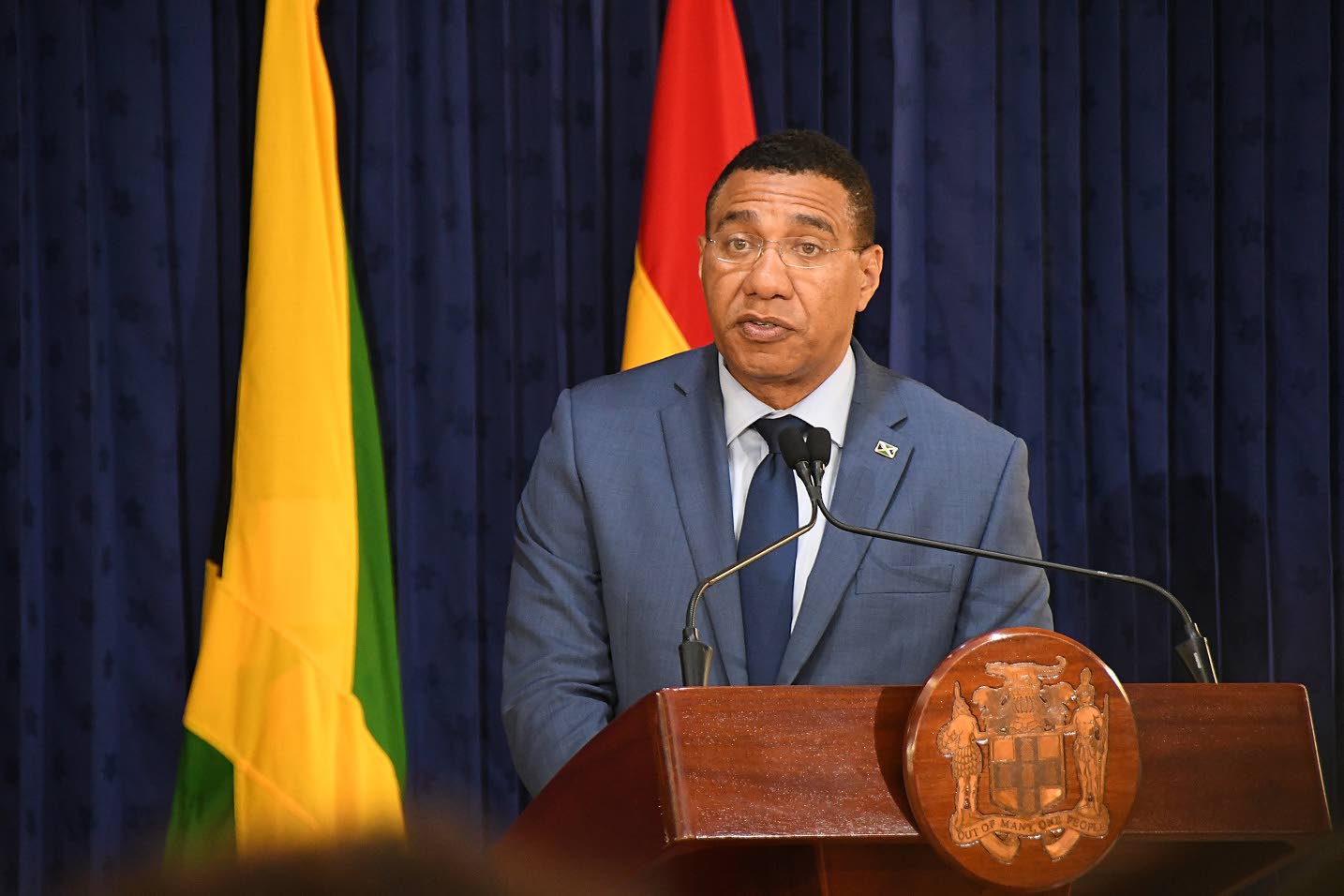
Prime Minister Dr Andrew Holness speaks during a media briefing with Ghanaian President John Dramani Mahama at the Office of the Prime Minister on Monday. (Photo: Karl Mclarty)
Mahama echoed those sentiments, saying Jamaica’s approach complements broader efforts being pursued by African nations and the African Union following the adoption of the United Nations resolution.
He noted that Ghana hosted a “Next Steps Conference” after the vote, bringing together governments, legal experts and international partners to determine how the campaign should advance.
The Ghanaian president said the campaign has already begun to produce tangible results, even among countries that either opposed or abstained from supporting the United Nations resolution.
He pointed to growing engagement from European governments and religious institutions, including commitments to return African artefacts and acknowledge their historical roles in the slave trade.
“There are several European countries that abstained from voting, but after the resolution, they have reached out and said, ‘look, we want a discussion on this, and we want to be a part of what is happening’, and so, I mean, France, for instance, have acted positively…The Dutch were there, and they came and gave us an album of artefacts that they had taken out of Africa during the slavery and colonial period… The Germans, the same, they gave us an album with artefacts that they had found in their archives, that they were willing to return to Africa…The Church of England also offered a restitution of 100 million pounds to be put into a slavery fund,” he noted.
Mahama said those developments demonstrate that the campaign has moved beyond symbolism and is beginning to influence international dialogue.
The Ghanaian leader also sought to place the reparations movement within a broader effort to address the enduring effects of slavery and colonialism, arguing that historical injustice continues to shape inequalities across the world today.
“The combination of the slave trade and colonialism have enduring consequences in the world today and it’s obvious to see what effects those two had, and so like the prime minister said, it’s not only about the cash payment, it’s also about restructuring the global order so that countries that were victimised by these two crimes, colonialism and the transatlantic slave trade, can have a fair chance to be able to create prosperity for their people,” he said.


