



Plan B for September morning
Several schools in Region Four to continue rotation of classes, use temporary structures when new academic year begins
MONTEGO BAY, St James — Faced with the reality that there is no way they will be able to repair all the Hurricane-Melissa-damaged schools in time for the new school year, the education ministry’s Region Four has put contingencies in place to minimise disruptions.
As a result, when classes get under way in September a combination of shift systems, staggered face-to-face classes, and the use of makeshift wooden structures will be used by some schools in St James, Hanover, and Westmoreland. These were among the parishes hardest hit by the Category 5 storm last October.
“There may be some schools that, they’ll definitely open, but we might have to open again with rotation and we have arranged for some temporary classrooms to be available,” the Ministry of Education’s regional director for Region Four Dr Michelle Pinnock said on Monday.
She was speaking with reporters on the margins of a back-to-school event jointly staged at Pier One by the Montego Bay Chamber of Commerce & Industry and Excelerate Energy.
According to figures provided by the Government, Hurricane Melissa inflicted varying degrees of damage — from leaks to destruction — to about 600 educational institutions. During the initial return to face-to-face learning after the storm, tents and other temporary structures were used to accommodate some students. Progress has been made, in some cases, with educators and students no longer having to contend with inconveniences such as muddy floors.
“In some of the schools we’ve put in temporary classrooms; meaning they are timber structures and we are now trying to put ply board along the sides, making sure ventilation is there, that there is shielding from the elements,” Pinnock explained.
“That’s where we are right now. We have taken up some of the tents off of the ground because we had issues with mud, etc. We’ve learned from our experiences last year and where we are not sure that our buildings will be finished and ready for occupying, we are putting in those temporary classrooms,” she added.
The hope had been that damaged schools would have been repaired in time for September, but Pinnock explained that it has been very challenging to meet that target. They are competing with property owners who are also trying to rebuild from Hurricane Melissa. Pinnock said the ministry and regional stakeholders are working to ensure schools have the necessary resources.
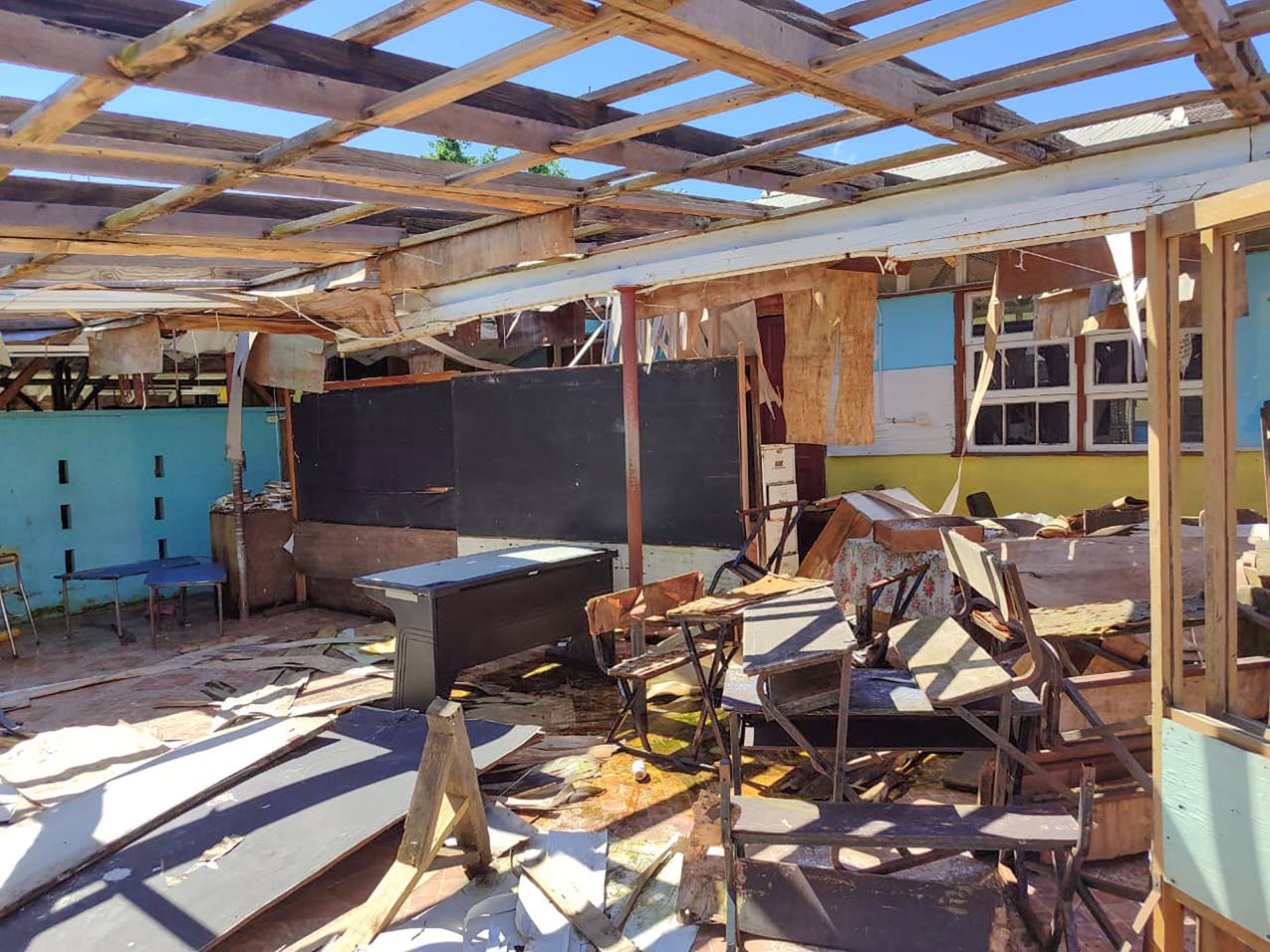
Buckingham Primary School in St James was badly damaged by Hurricane Melissa.
“We are working with the contractors. Of course, you know everybody is building back, so resources are short. We have to now make sure that the materials are on site and the workmen are there and they are there working,” said the Region Four head.
Pinnock insisted that her team and the wider education ministry are doing their best to prepare for the upcoming school year.
“We’re working assiduously to ensure that we are back in school, ready for teaching and learning. But I want to assure our Jamaican public and students that even if the infrastructure is not ready, we’re going to be starting our teaching and learning because we want to ensure that [in] the west, we’re not left behind,” she assured.
The educator said the necessary support will be provided to students, particularly those who may have to spend some days outside the physical classroom. In some cases, students will take turns doing face-to-face classes; a system used during the COVID-19 pandemic.
“We’ll have the rotations where the parents will know: this time we’re doing this grade to that grade. And we’re making sure that the Google classroom is up and we’re hoping that through the Universal Service Fund, persons will have Internet available and students will be able to get on,” Pinnock said.
“Where we are having issues with Internet, we’ll be able to do the photocopying so that we can have worksheets, etc,” she added.
The regional director made it clear that the ministry’s focus is on ensuring that no student is left behind, and all available measures are being pursued to limit the impact of schools not being fully rehabilitated.
“What we don’t want to do is to put a hold on children’s education, so we’re really working hard,” said Pinnock.


