



‘Road to Republic’ not a political contest
Constitutional Reform Committee youth rep sees need for greater bipartisan cooperation
YOUTH representative on the former Constitutional Reform Committee Sujae Boswell is adamant that greater bipartisan cooperation and sustained momentum are needed to prevent further delays in Jamaica’s transition to a republic.
Boswell’s comments came during an interview with the Jamaica Observer as the governing Jamaica Labour Party (JLP) and the Opposition People’s National Party (PNP) continue to point fingers at each other over the stalled constitutional reform process.
He argued that constitutional reform should never become a contest between political parties.
“It is one of the few nation-building projects that belongs equally to every Jamaican. Jamaica has always achieved its greatest progress when we have been willing to place the national interest above partisan interests. Constitutional reform presents another opportunity to do exactly that,” Boswell told the Observer.
“The political credit need not belong to one party or one Administration. It can and should be shared, because the beneficiaries will not be today’s politicians but generations of Jamaicans yet to come. If history remembers anything about this moment, I hope it remembers that we came together to complete one of the final chapters of Jamaica’s constitutional journey,” he added.
Boswell said the greatest value of constitutional reform is that it encourages us to think more deliberately about the kind of country we want to build and the institutions we need to get there as constitutions are not simply legal documents.
“They are the rules by which a nation governs itself. Periodically examining those rules is a healthy exercise for any mature democracy because it forces us to ask difficult but necessary questions: Do our institutions still serve the public well? Are there opportunities to strengthen accountability? Do Jamaicans understand their rights and responsibilities? Are we preparing our constitutional framework for the challenges of the future?”
“In many respects, that national conversation is just as important as the legal changes themselves. A constitution should be a living document that people understand, value, and feel ownership of. If this process leaves Jamaica with a more constitutionally aware and civically engaged population, that will be one of its greatest achievements,” declared Boswell.
He argued that transition to a republic is not simply about changing who occupies one office but strengthening the relationship between the Jamaican people and the Constitution that governs them.
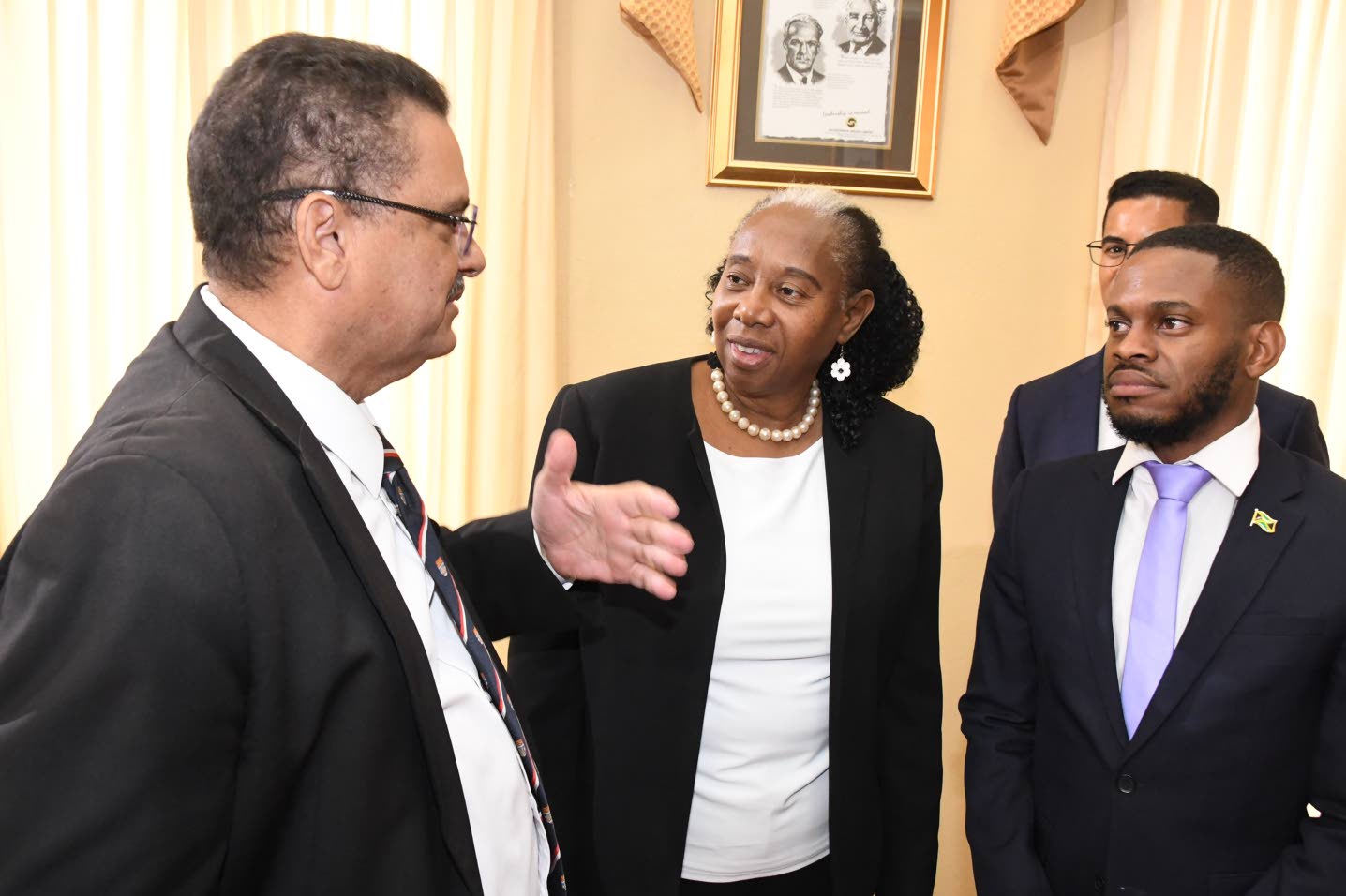
Members of the now-defunct Constitutional Reform Committee (from left) Attorney General Dr Derrick McKoy; chair of the National Committee on Reparations Laleta Davis Mattis; and Sujae Boswell, youth advisor. (Photo: Joseph Wellington)
Boswell pointed out that administrations of different political persuasions — along with constitutional reform bodies dating back to the Constitutional Commission chaired by Justice Lensley Wolfe in the 1990s — have recognised that Jamaica’s constitutional journey should ultimately lead to a Jamaican Head of State.
“Two of the more significant constitutional questions have been the process for appointing a Jamaican president and determining the country’s final court of appeal. These are not minor procedural matters; they go to the heart of Jamaica’s constitutional architecture and naturally require careful consideration and broad consensus,” said Boswell.
He said the Government’s proposal for an indicative referendum on the question of the final court of appeal is, in principle, a constructive one.
Boswell, argued that constitutional reform is strongest when it reflects not only legal and parliamentary consensus but also the informed voice of the Jamaican people.
“While that has extended the timeline, I remain encouraged that there is still broad agreement on where we ultimately need to be as a country. Our responsibility now is to preserve the spirit of collaboration necessary to reach it. Constitutional reform has always been a journey, and I believe Jamaica is capable of completing it,” Boswell told the Observer as he urged that delays in the process not lead to discouragement.
“Jamaica has repeatedly shown that when there is sufficient consensus around issues of national importance, lasting constitutional change is possible. Our generation has inherited this constitutional conversation. My hope is that we also become the generation that completes it,” said Boswell.
He added that, in conversations with youth he found that many young Jamaicans do not necessarily see constitutional reform and economic development as competing priorities and expect Jamaica to pursue both.
“For me, the challenge is not convincing young people that constitutional reform matters. The challenge is ensuring that more of them have meaningful opportunities to engage with it. An informed and engaged citizenry is one of the strongest foundations of any healthy democracy, and young people deserve to be active participants in shaping Jamaica’s constitutional future,” Boswell stressed.


