



Don’t wait for a health scare
Dear Editor,
Last week I had a health scare that forced me to confront a habit that many men have normalised — avoiding the doctor.
During my visit, the doctor asked me a simple but profound question: “Why don’t you like coming to the doctor?” My immediate response was almost instinctive: “Which men like going to the doctor?”
He looked at me and responded, “You must develop the habit of visiting the doctor.”
Those words stayed with me and made me think about how many Jamaican men approach their health and, more importantly, the potential consequences of our reluctance to seek medical attention.
Why do so many men avoid the doctor? Is it because we are afraid of what we might be told? Is it because of the traditional expectation that men must be strong and simply “tough it out”? Or have we become so accustomed to ignoring warning signs that seeking medical attention only becomes a priority when the situation becomes unbearable?
Whatever the reason, we need to change this culture.
There is a long-standing socialisation of boys and men that equates vulnerability with weakness. From childhood, many boys are encouraged to “man up”, suppress pain, and keep their problems to themselves. While there is certainly value in resilience, there is nothing courageous about ignoring a health problem until it becomes an emergency.
Too many men wait until they are seriously ill before seeking medical attention — a persistent headache is ignored; unexplained fatigue is dismissed; weight changes are overlooked; and chest discomfort, shortness of breath, or other unusual symptoms may be rationalised as stress or exhaustion. The problem is that some serious health conditions do not always present with obvious symptoms in their early stages.
High blood pressure, diabetes, and high cholesterol, for example, can exist without noticeable symptoms. Appropriate screening can help identify health risks early and provide an opportunity for intervention before complications develop. This is why we must stop viewing a visit to the doctor as something we do only when we are sick.
Health care should also be about prevention. A regular consultation gives men an opportunity to discuss their blood pressure, blood sugar, cholesterol, weight, diet, physical activity, and other individual risk factors. It also provides an opportunity to discuss mental and emotional health — an area in which many men remain particularly reluctant to seek help.
And perhaps this is when we need to start changing the conversation with our boys. We must teach them that going to the doctor is not a sign of weakness, it is a sign that we understand the value of our lives. We must teach our boys how to work, how to provide, how to defend themselves, and how to be responsible. But are we teaching them how to take care of themselves?
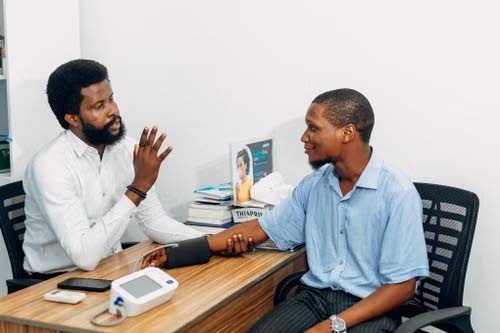
Regular consultation gives men an opportunity to discuss their individual risk factors.
A man cannot effectively provide for his family if he continually neglects his own health. He cannot adequately serve his community if he ignores warning signs from his body, and he cannot be there for his children if he refuses to take his health seriously.
This is not an argument for unnecessary medical testing or constant visits to the doctor. Medical care should always be guided by qualified health-care professionals, and based on an individual’s age, medical history, symptoms, and risk factors.
But there is a significant difference between being cautious about unnecessary medical intervention and avoiding health care altogether.
We also need to move away from the idea that men’s health is simply a once-a-year campaign. Men’s health should not become important only during Men’s Health Month. It should be part of our everyday culture.
Know your numbers. Know your family history. Pay attention to changes in your body. Ask questions. Seek professional advice. Most importantly, develop a relationship with your health-care provider and follow appropriate medical advice.
My recent experience reminded me that sometimes it takes a health scare to make us appreciate something we have taken for granted. The doctor’s question may sound simple, but it is a question worth asking many Jamaican men.
So, instead of pretending nothing is wrong, be strong by taking your health care into your own hands, because strength is not pretending that nothing is wrong. Strength is having the courage to acknowledge when something is wrong and doing something about it.
When you are not well, go see the doctor. Your health is not a weakness to hide, it is a responsibility to protect. After all, good health is one of the greatest forms of wealth.
Ricardo E Smith
Senior educator & social scientist
ricardo.professional.edu@gmail.com


