



Gov’t looking to add speed to school repairs
Overseas contractors being considered as shortage of qualified entities slow post-Melissa reconstruction
THE Government could look overseas for contractors to speed up the repair and rebuilding of schools devastated by Hurricane Melissa last October.
More than 600 educational institutions sustained damage from the Category 5 storm with 309 severely damaged and ranked priority one for repairs and reconstruction.
At a post-Cabinet media briefing at Jamaica House in St Andrew on Wednesday officials of the Ministry of Education said 57 of those severely damaged institutions were fully repaired when the new school year began on Monday. The ministry said another 95 schools will be fully repaired by the end of September, and another 34 repaired by the end of December.
Education Minister Senator Dr Dana Morris Dixon told the media briefing that school repairs were hampered by a shortage of grade one contractors and the ministry will, among other things, explore hiring external contractors to fill gaps while ramping up efforts to upskill local contractors.
Morris Dixon admitted that the current situation is far from perfect and argued that the need for contractors was even more imperative given the mandate placed on the National Reconstruction and Resilience Authority (NaRRA) — the specialised body established to coordinate and accelerate post-disaster rebuilding and long-term infrastructure resilience after Hurricane Melissa.
Education Minister Senator Dr Dana Morris-Dixon (left) engages Permanent Secretary Dr Kasan Troupe in conversation following Wednesday’s post-Cabinet press briefing at Jamaica House in St Andrew. (Photo: Garfield Robinson)
She pointed out that while the Administration is committed to continue the work to rebuild schools it has been constrained by the number of grade one contractors available in Jamaica.
“When the budget for the project is above a particular amount, you have to use a grade one contractor, and we’re limited with the number of grade one contractors, so that’s a constraint,” Morris Dixon explained.
“We need those contractors for the schools, we need them for the homes, we need them for the businesses, we need them for that beautiful vision that Prime Minister [Dr Andrew Holness] laid out in his budget presentation. And so, one of the things that we are working on, separately, in a different part of the ministry on the skills side, is an initiative between HEART NSTA/Trust and the Development Bank of Jamaica (DBJ)…we have to work to get those who are at grade two up to grade one through financing and otherwise, because that’s a key element of it. And so DBJ is at the table with us, trying to work through that, because our goal is to give the money to the Jamaicans,” Morris Dixon disclosed.
“What we’re looking at is, how we can work with young people who want to be contractors, put them in groupings, provide funding, and provide incubation to them so that we can get more in the pipeline of grade one contractors. Using external sources is something that we’ll have to look at. For example, for the STEM (science, technology, engineering, and mathematics) schools, we have done international tenders, and so in some of the big projects, we’ll have to do some international tendering. We’ll see what comes out of that…but right now, our commitment is to our local contractors using them. But of course, they have to show that they can deliver,” Morris Dixon said further.
The education minister, in the meantime, said work was continuing apace to rehabilitate schools listed as priority one which were severely damaged by Melissa with almost continuous afternoon rain in Westmoreland slowing down the process.
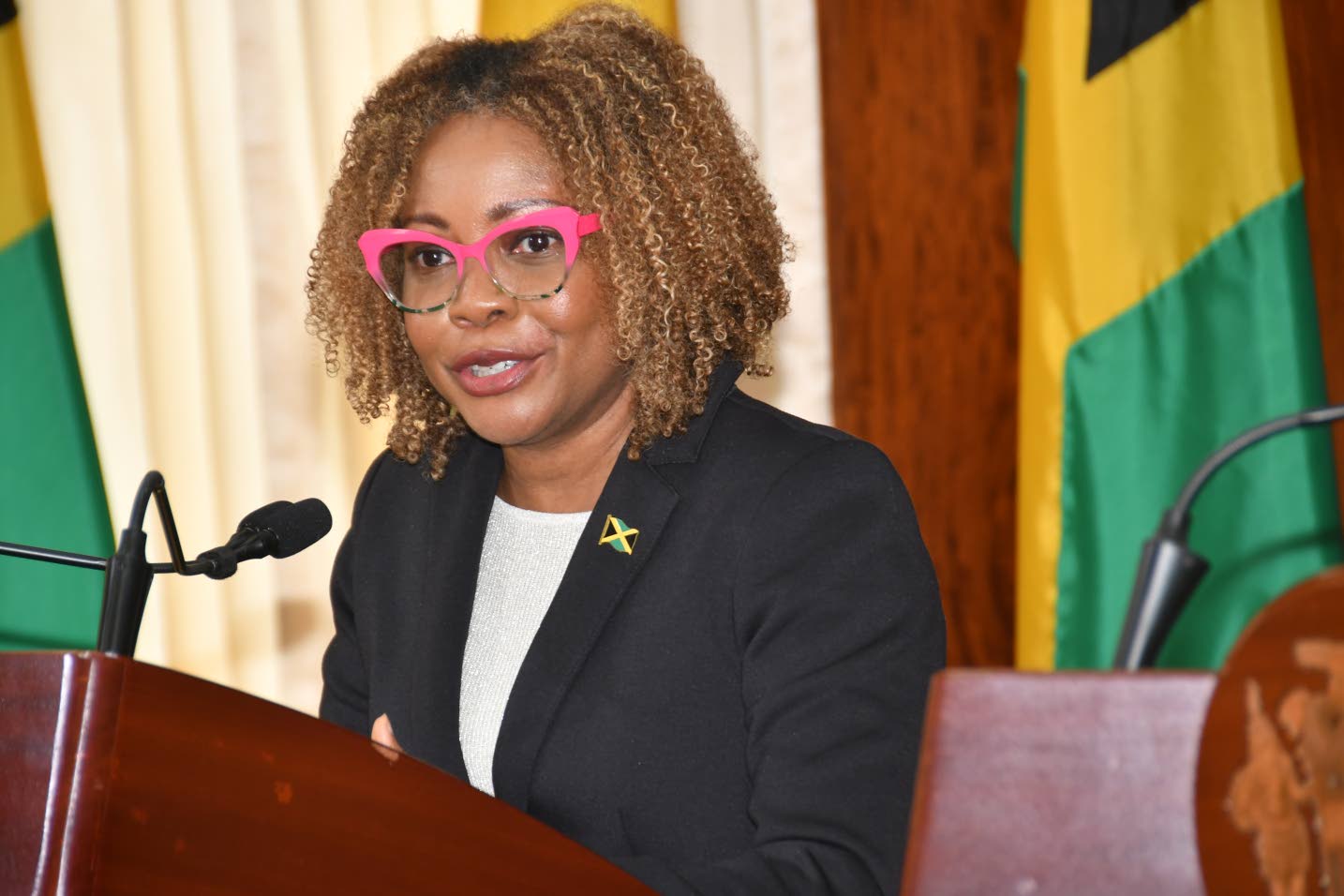
Education Minister Senator Dr Dana Morris Dixon speaking at Wednesday’s post-Cabinet press briefing at Jamaica House in St Andrew. (Photo: Garfield Robinson)
“It’s not perfect. Where we are now is not perfect, and we have a lot of people working. We have many contractors. For our very severely damaged schools, which is about 309 schools that were severely damaged… the bills are high. A lot of them are over $100 million, $200 million, $300 million, a billion dollars almost in some instances,” Morris Dixon said.
According to Morris Dixon, the hurricane is being used as an opportunity “to get better school plants, at least in the west”.
Meanwhile, permanent secretary in the Ministry of Education Dr Kasan Troupe said the new school year got off to a fair start on Monday with 92 per cent of schools having all students while two per cent of schools will have to be augmented with temporary learning spaces and utilise some amount of rotation.
“That’s tremendous given what we have been through, and I want to thank all my principals, all my chairmen and board members, and of course, all the teachers,” Troupe said.
She told the media briefing that the ministry has ensured that all schools have been given their operational funds along with furniture and other resources.
“We sent out 30 per cent of the increased grants into our schools in June. The second tranche of that is due in September, the first Friday in September and two weeks ago, we ensured that all the funds were out in all our schools, so we are ahead of time because we understand what it means for our principals to have monies to get the work done. That amounted to $3.05 billion that we have disbursed to our schools, and that will treat with the operations, that will treat with the nutritional support for the learners, and of course, an additional $75 million we sent out to our schools to impact 275 schools to treat with canteen repairs,” Troupe said.
“As it relates to furniture, 41 schools indicated that they need additional support. We are responding to that, but in preparation for this year, we spent $300 million to get furniture out into our schools. So before we started, we distributed over 17,000 pieces, and whilst we were wrapping up on the last weekend, there were 8,000 pieces that we were distributing across our schools,” added Troupe.
According to the permanent secretary, another 20,000 pieces of furniture are being prepared for distribution to the system.
She said the ministry is spending more than $700 million in resourcing high schools with books and more than $300 million in primary schools, making that approximately $1.1 billion of expenditure in providing books for public schools.


