



Renee Watkis: On security, leadership, and service
SECURITY is often understood through cameras, access controls, guards and gates. For Renee Watkis, however, the deeper lessons are about people behaviour, leadership, judgement and service.
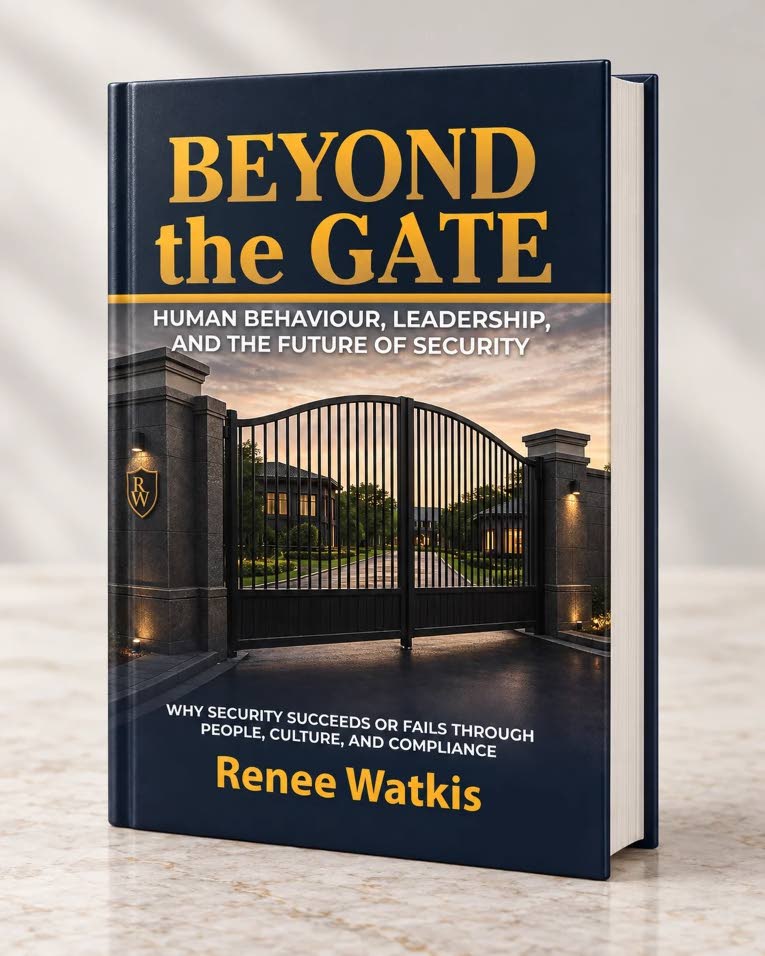
Those ideas sit at the centre of Beyond the Gate: Human Behaviour, Leadership, and the Future of Security, which examines how behaviour, leadership, and organisational culture influence whether security systems work as intended.
Her second book, Standing at the Gate: A Woman’s Journey in Security, Leadership, and Service turns the focus inward, exploring the experiences that shaped the woman behind the professional journey.
Together, the books tell two connected stories: one about the profession and the other about the woman growing within it.
Growing up, Watkis’s family could not afford to send her to university, and at 16 she entered the workforce. She remained with her first employer for 19 years, learning through experience long before university became an option.
Years later, after the death of her stepfather, her younger brother was preparing to enter university. Watkis decided to help finance his education. Not long afterwards, her son was also preparing to enter university.
She was supporting two young men through higher education while still without a degree herself. Then came a realisation: “If I can send two people to university, then I can send myself too.”
At 42, Watkis began pursuing her first degree. By then, she had already spent approximately 11 years in the security industry. University gave her the theory behind much of what she had learned through practice.
Throughout the four-year programme, she took what she was learning back into the workplace, strengthening processes, reconsidering procedures and sharing knowledge with her team.
For Watkis, education was never simply something to place on a résumé. It was something to use.
Her career took another turn when she was offered an operations management position with a security company.
The role broadened her understanding of the industry and allowed her to strengthen policies, processes and organisational structure.
She also became involved in training security officers preparing for their Private Security Regulation Authority licensing requirements and quickly recognised that people learned differently.
A definition in a manual could be correct, but that did not always mean the person hearing it understood how to apply it. “You have to meet people where they are”, became part of her approach.
Realistic scenarios and practical examples often helped people understand security concepts more clearly. That lesson became part of
Beyond the Gate: a policy may be well written and a procedure technically sound, but if the people expected to follow them do not understand them, weaknesses can remain.
After completing her first degree, Watkis moved directly into a Master’s degree in Human Resource Management.
Her studies strengthened the connection between behaviour, communication, leadership and change management.
She had learned that introducing a new process did not automatically mean people would accept or follow it. They needed to understand why change was necessary and how it related to their work.
These experiences helped shape Beyond the Gate. The book explores why human behaviour deserves greater attention in security, how leadership influences security culture and why technology alone cannot solve every problem.

A camera may record an incident, but someone must recognise its significance. Technology can assist with detection and analysis, but people still have to decide what happens next.
While Beyond the Gate reflects what Watkis learned about the profession, Standing at the Gate reflects what those years taught her about herself.
The book reaches back to life before the qualifications and titles, beginning work at 16, supporting family, entering university at 42, and helping others develop. It speaks to women whose lives have not followed the timetable they once imagined.
Watkis believes representation matters, but contribution matters too. Women should have opportunities not only to enter professional spaces, but to develop expertise, influence decisions and lead.
The objective is not simply to be noticed because you are the only woman in the room. It is to be respected because of what you bring to it.
For Watkis, the gate is more than a title connecting two books. In security, a gate represents access, protection and control. In life, it can represent a decision.
Beyond the Gate asks security professionals to look beyond equipment and consider the people, behaviour and leadership behind the system. Standing at the Gate asks women to consider the experiences, barriers and possibilities that shape their own journeys.
One examines the profession. The other examines the woman becoming more fully herself within it. You do not have to know everything before you begin. You do not have to hold the highest title before your contribution has value. And you do not have to wait until every doubt disappears before moving forward.
Sometimes the most important decision is simply to walk through the gate.


