



Faster verdicts, lower backlog
Jamaican judiciary reports multi-year turnaround
FOR the fourth year running, Jamaica’s parish courts have impressively dispatched the criminal cases brought before them, clearing up 103.44 per cent of these matters and whittling down the backlog to just a little over two per cent in 2025.
The data was cited by Dr Denarto Dennis, consultant statistician and associate professor, as part of a wider analysis of the performance of the country’s courts, which was made public by the Judiciary of Jamaica as part of Judiciary Week 2026.
“In practical terms, for every 10,000 new criminal cases entered into the system, the courts disposed of roughly 10,344 matters, successfully absorbing all new incoming demand while resolving long-standing files. This marks four consecutive years above the critical 100 per cent threshold,” he said in an article.
“The parish courts also contained their overall criminal net backlog to an impressive 2.16 per cent, meaning that only about two out of every 100 active pending criminal matters were older than two years, vastly outperforming the international safety limit of 10 per cent,” Dennis added.
For years there has been concern raised about the slow pace of matters before the courts at various levels. Chief Justice Bryan Sykes and former Director of Public Prosecutions Paula Llewellyn have been among those who have spoken of the need to have a more efficient system, which has been plagued by everything from incomplete forensics reports to unavailability of jurors. Despite these shortcomings, they have also noted that Jamaica is punching above its weight, a point also made by Dennis.
“While significant strategic work continues to address ongoing operational frictions, the latest national court performance evaluation reveals that standout parish courts and elite specialised divisions are clearing cases at historic levels, signalling a transforming legal landscape where justice is increasingly delivered swiftly and predictably for all Jamaicans,” he noted.
Among the lower courts, the Corporate Area Coroners Court, Hanover, St James, and Manchester parish courts performed exceptionally well.
“Hanover established a remarkable national benchmark for processing speed by resolving criminal matters in an average of just 87.36 days — drastically lower than the national average — while concurrently achieving a stellar 150.69 per cent civil clearance rate and a near-zero criminal backlog of 0.11 per cent,” said Dennis.
“Meanwhile, St James successfully executed a remarkable operational turnaround to slash historical backlogs, Manchester excelled through rigorous scheduling discipline and swift civil disposition management, and the Corporate Area Coroners Court drove aggressive clearance standards for legacy matters,” he added.
There were also high points from specialised divisions across the higher courts. In the Commercial Division of the Supreme Court, which saw 420 new filings, 558 disputes were resolved, “ensuring that commercial matters are resolved in an average of 22.5 months”. The Estate Division, meanwhile, wrapped up probate and inheritance matters in roughly 19 months and had a 19.49 per cent backlog rate.
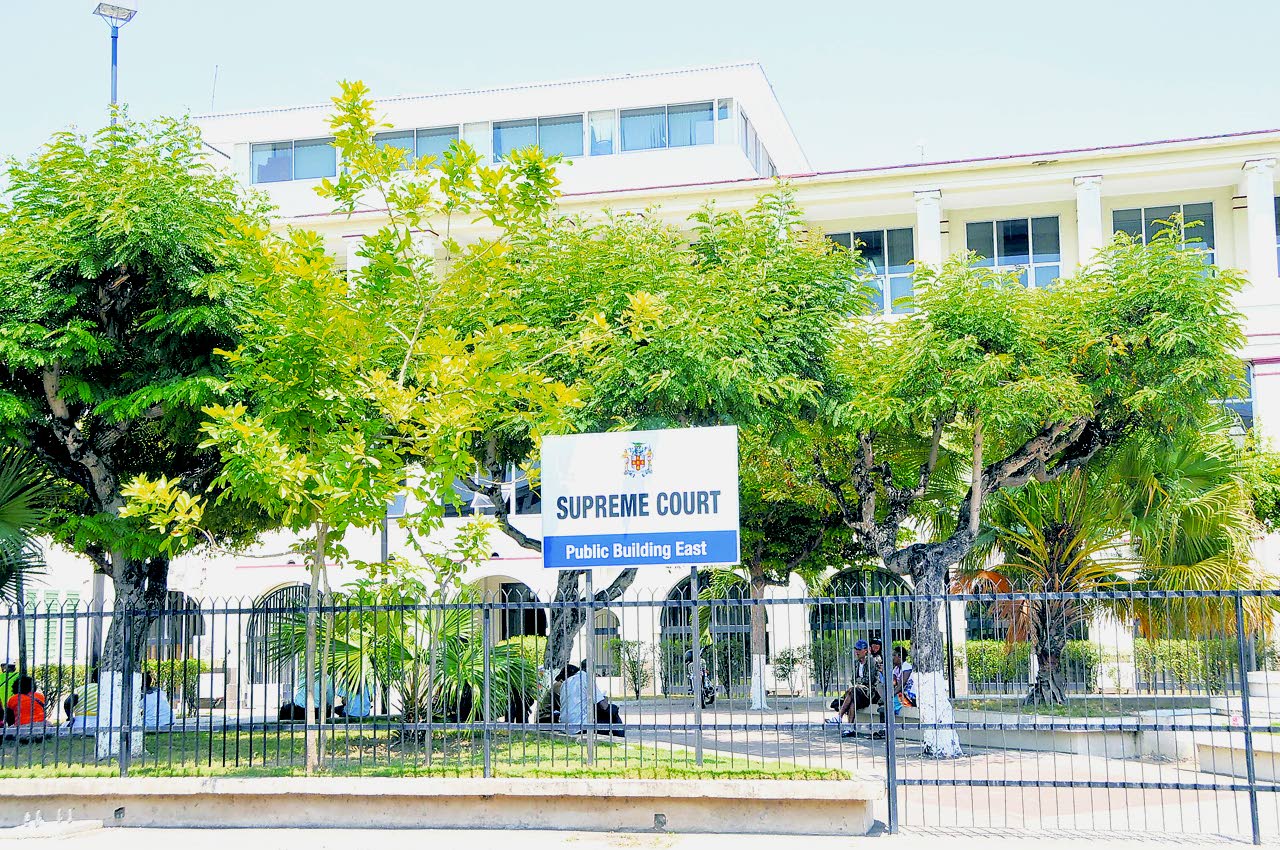
The Supreme Court building in Kingston
“Meanwhile, the Gun Court moved with notable speed, achieving the fastest resolution time in the Supreme Court at an average of 16.57 months. In specialised tribunals, the Special Coroners Court executed an unprecedented clearance drive, reaching a 174.29 per cent clearance rate in 2025 after peaking at 315.22 per cent in recent years, systematically clearing away decades-old legacy inquest files. Grass roots Family Courts in Trelawny and Chapelton delivered rapid resolutions for domestic matters, clearing 121.2 per cent and 104.3 per cent of their respective caseloads while keeping average resolution times below 285 days,” said Dennis.
Referencing data that points to a link between what happens in a country’s courthouses and its economic performance, he stressed the benefits of having a well-oiled justice system.
“For the wider nation, these efficiency gains represent a powerful engine of macroeconomic stability. Rigorous statistical modelling confirms that every 10 per cent increase in national court clearance rates is associated with a 0.82 per cent boost in real GDP growth and measurable improvements in the United Nations Human Development Index. When courts enforce contracts and resolve commercial disputes rapidly, capital is unlocked, investor confidence strengthens, local business expansion accelerates, and public resources are protected from the costly drag of administrative stagnation,” he noted.
He also pointed to the implications for individuals.
“For everyday Jamaicans, an efficient judiciary fundamentally transforms the experience of justice, ensuring that ordinary citizens, witnesses, and victims of crime are no longer forced to endure endless postponements, lost wages, and exhausting courtroom visits just to have their matters heard. Swift resolutions in family and estate courts mean that vulnerable families can access child maintenance support, secure inheritance rights, and settle domestic disputes without months of emotional distress and financial uncertainty,” Dennis added.
He noted, however, areas still in need of improvement such as the High Court Civil Division (almost 64 per cent backlog rate), traffic court (more than 186,000 unresolved matters in 2025), and an average of 1,044 days to dispose of specialised coroner matters.
The hope is that lessons will be learnt from the country’s “high-performing courts”.
“Their success is rooted in proactive docket management, dynamic resource allocation, structured pre-trial case management conferences, and the rigorous monitoring of operational bottlenecks,” he said.
“These operational triumphs are not accidental, nor do they suggest a frictionless system; rather, they are the product of continuous, deliberate effort under targeted policy oversight. The Jamaican judiciary has transitioned from traditional administrative practices to modern, data-driven court management, creating an environment where judges, registrars, and administrative staff operate with shared purpose. However, judicial leaders candidly acknowledge that substantial strategic work remains ahead,” said Dennis.


