



‘I would not leave Cuba without that degree’
Jamaican dental surgeon on navigating blackouts, COVID-19, food shortages in Caribbean country
SHANIQUE Miller never imagined that simple things like an onion, eggs, or electricity could bring her so much joy. But after six years in Cuba, enduring blackouts, water shortages, the COVID-19 pandemic, and days when food was scarce, the Jamaican dental surgeon says she’s returned home with more than the degree she’d set out to earn — she’s back with a transformed perspective on life.
At 32, Miller said there were many moments when she considered giving up, but remained determined to leave the Spanish-speaking country with her degree. The experience, she said, taught her compassion, gratitude for the little things, and that money is not everything. Most importantly, she’s learnt that it is never too late to start over and with God and a strong support system, anything is possible.
Her journey began at The University of the West Indies, Mona, where she initially enrolled in dentistry but soon realised the programme was not the right fit for her. After researching dental programmes in Cuba, she took a leap of faith and left Jamaica in 2020, at the height of the COVID-19 pandemic, to pursue her dream in Havana.
Twenty-six years old at the time, Miller said many of her peers were settling into their careers, but she was starting over. While some questioned her decision, she said she trusted the journey, not knowing what awaited her but believing it would, ultimately, work together for her good.
“It was very difficult to navigate because you’re there trying to just get through, not knowing how to properly communicate because it’s a different language. I remember I came home in December, and as I got back there [Cuba], the entire country was shut down. For a little while, classes were suspended until they came up with the decision to have us have classes under a tree in someone’s backyard. I went there, not expecting all of that to be happening, but in the midst of that, there were food shortages. Everywhere was closed,” she told the Jamaica Observer.
Miller said she spent her first year learning Spanish, a necessity, as all classes, books, and examinations were conducted in the language. She said this made learning even more difficult, but she persevered and officially began dental school in her second year.
She said she moved from rural Cuba to urban Havana, where access to supplies was somewhat easier, though challenges remained. Miller said the experience shaped her character, forcing her to become more independent as she could no longer rely on her parents, who were miles away.
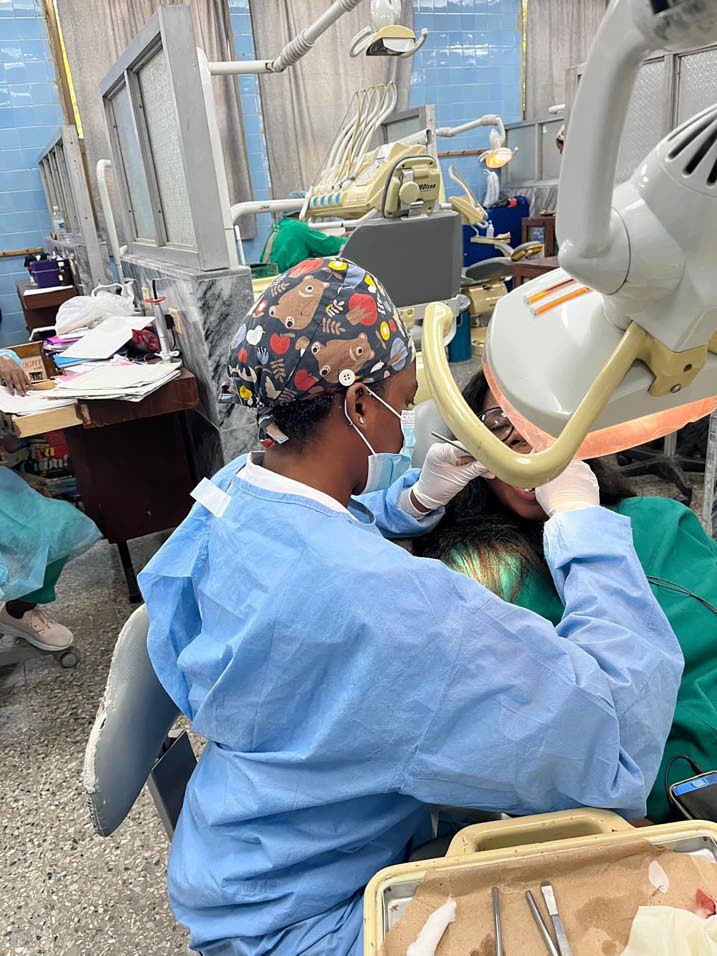
Shanique Miller performs a dental procedure on a patient at a clinic in Cuba while pursuing her degree in dentistry.
“One thing I learned there is that money is good, but money means nothing when you can’t find food…Cuba taught me that there are so many things that we take for granted…Sometimes I would get onions, and I’d be so happy. I’d call mommy, and I’d be like, ‘Mommy, guess what? I got onions at the market today,’ or ‘Guess what? I got tomatoes.’ Any little thing that I’d get, I’d call home in excitement to tell mommy, and they would find it so funny, because even at one point, getting eggs was like a commodity,” she shared, chuckling at the memory.
In 2024, while transitioning from her fourth to fifth year of study, she faced a new challenge when the island started to experience nationwide blackouts following the failure of the Antonio Guiteras Power Plant.
“We started having blackouts for 24 hours or 30 hours at a time. When the light did come back, it was for like three hours…There was no way that I could successfully charge all of my things in three hours, because you’re trying to wash, you’re trying to charge your things, and you’re basically just trying to do everything you need to do before it goes again. That became so difficult, especially having to study in that condition, not knowing what is next tomorrow,” she recalled.
Towards the end of 2025 and into 2026, Miller said conditions became even more difficult. She recalled going to school in wrinkled clothes because of the challenges with electricity, something she said had become almost routine among students. Water shortages also meant that showers could be interrupted without warning, yet she continued to persevere.
Whenever she had the opportunity to return to Jamaica, Miller said she made the most of it, spending time with her family and stocking up on items to take back to Cuba for her teachers and friends who did not have the privilege of travelling.
Shanique Miller (right) poses for a photo with her mother Carolyn Rose Miller and father Herman Miller, moments after her graduation ceremony in Havana, Cuba.
“Mentally, it was hard. I don’t think there are enough words to really describe how hard it was, but I knew that I went there with a goal in mind, and a purpose. I decided that I would not leave without that degree and without having accomplished what I went there for,” she told the Sunday Observer.
Miller said that although the conditions were sometimes unbearable, her educators worked tirelessly to ensure students received the best quality of learning possible. The experience taught her to work with limited resources and without relying heavily on technology, developing the ability to accomplish much with little.
“Being there it has taught me that whatever you do, whatever field you’re in, especially the medical or dental field, one thing that is most important is empathy and being able to be compassionate. Not doing it just because of the money, but doing it because of the love,” she said.
Now that she has successfully completed the programme, Miller said she intends to bring the lessons she learnt in Cuba back to Jamaica, where she hopes to secure a position as a dental surgeon in the public sector. She also plans to give back by organising dental health fairs in rural communities where access to health care is limited, with the long-term goal of opening her own practice.
Reflecting on her journey, Miller said none of it would have been possible without God and the unwavering support of her parents, Carolyn Rose Miller and Herman Miller, who stood by her every step of the way.
“I don’t think I’ve ever prayed that much in life. Outside of that, the prayers of my mother were very important. Sometimes people don’t realise how much the prayer of your parents actually keeps you going, because I am sure if it was not for the prayers of my mother and the prayers I’ve prayed, maybe mentally I’d have lost it as well,” she reasoned.
Miller said Philippians 1:6 was a Bible verse that she held close to her heart, trusting that “whatever God starts in you, he will complete it”.
She said she hopes her story will inspire others to believe there is nothing wrong with starting over.
“Sometimes fear gets in the way of us making big decisions…I cared so much about what people would think about me starting over, and believe me, I’ve lost contacts because of that…Comments often made me question if I made the right decision or if I did the right thing, but the more I accepted my decision, I realised that what people have to say in life means nothing. Do what is best for you and know that there is absolutely nothing wrong with starting over,” she encouraged.


