



We need a plan
Principals’ association wants national model for coping with disasters
MONTEGO BAY, St James — President of the Jamaica Association of Principals of Secondary Schools (JAPSS), Anniona Jones wants the country to move away from reacting to disasters as they come and instead craft a policy that can be applied to every situation — from hurricanes to flood waters to droughts.
“I want to move the conversation from repairing broken buildings to actually producing a national model, a model that is going to keep our children learning when the next shock comes — because it is coming. As a matter of fact, one is here; it is called a drought,” she declared.
Jones was speaking Tuesday during a webinar that looked at lessons the country’s education system can learn from last October’s Hurricane Melissa. It was the fourth in the National Resilience Dialogue Series put on by the Higher Education Task Force for Disaster Resilience’s (HEDE).
HEDE is a collaboration involving The University of the West Indies (The UWI), the University of Technology, Jamaica (UTech), the Caribbean Maritime University (CMU), Northern Caribbean University (NCU), and other higher education partners working to identify research-based solutions, policy responses, and practical actions needed to strengthen Jamaica’s resilience following the Category 5 storm.
Adding her voice to the discussion, Jones called for new strategies to address data protection, a major challenge particularly when documents containing students’ information and other important records are damaged.
“I want you to imagine a school of 120 years old and all of those records being wet and damaged. We have to figure out ways now of how it is we quickly digitise, have cloud storage, all the data protection things in place because we have to account for the people,” she said.
A national policy, the JAPSS president argued, would prevent school administrators from having to bear the burden of bringing school plants, teaching and learning arrangements back to a state of readiness after each event. She said systems can be developed to address a variety of issues before a catastrophe, especially those related to the sustainability of school structures and resources.
“Can boards be encouraged to have a building and facilities subcommittee so that we can get the systems robust enough that when that alert goes off [that says] there’s a hurricane coming, [that says] there are some things that we need to do when it is that we hear drought?” she questioned.
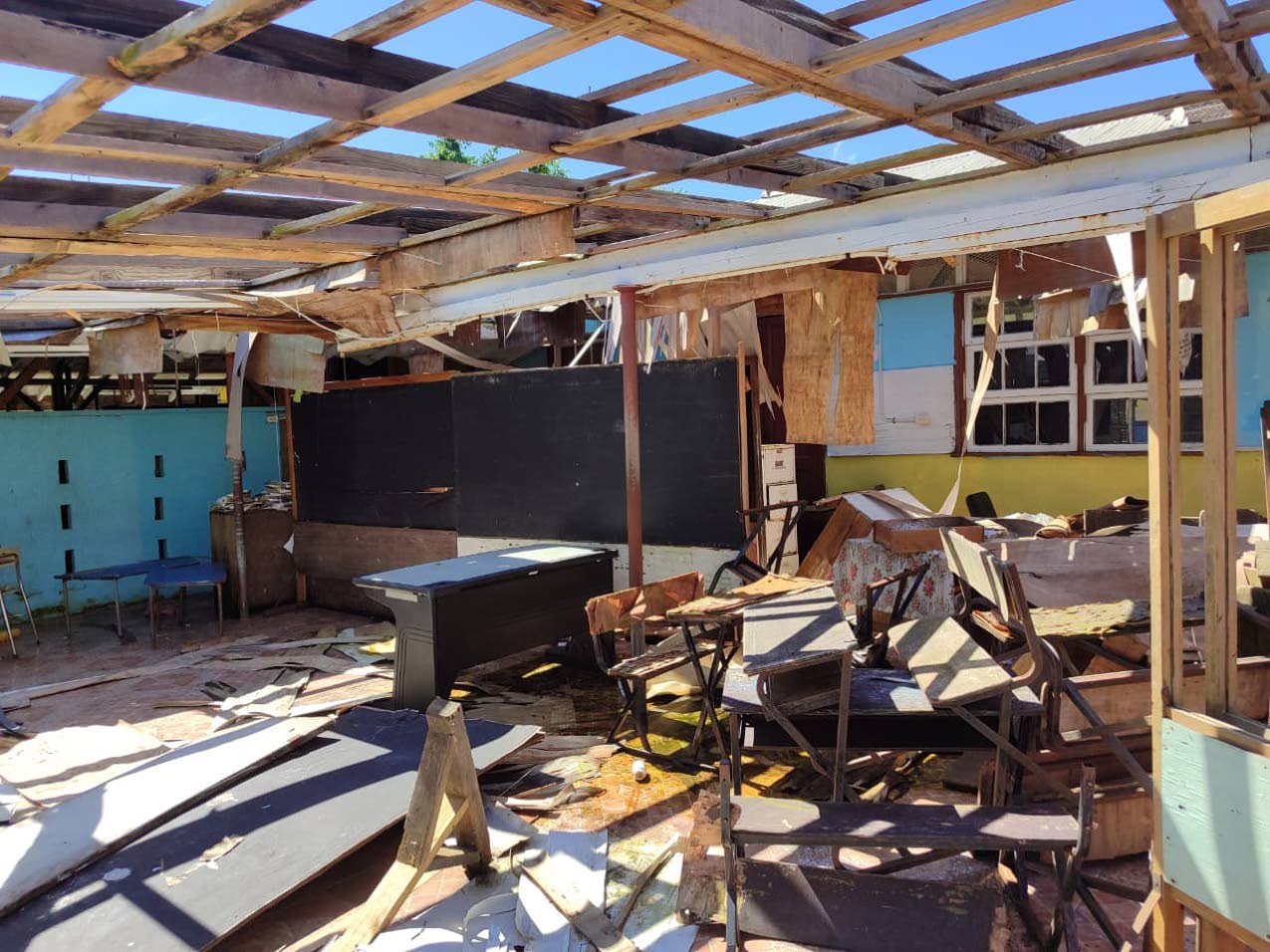
A school left in shambles by last October’s Hurricane Melissa.
“Some of this technical information that schools are asked to generate really should be done on a macro level, and logical systems put in place so that I don’t go and put the tank up on the roof only to realise that the tank is too heavy for the roof and everything collapse when the tank is now full of water. It may sound a little simplistic to some persons listening, but these are simple things that we’re talking about,” added the JAPSS president.
Jones also called for a holistic look at how disasters impact all stakeholders involved in students’ lives — educators and school staff, parents, their wider communities — outlining how failure to address challenges within these groups trickles down to what happens in the classroom.
“We don’t always recognise that the adults in the environment are also oftentimes victims of the same circumstances that the parents find themselves in,” she remarked.
“How do we call back teachers to school, how do we call back cooks and cleaners and janitors and groundsmen to school when they too are worried about where they’re going to sleep? They’ve lost everything, absolutely everything, and they too are faced with all of the challenges,” Jones stressed.
She also pointed to the impact of disasters on staff whose loved ones have been affected, noting that this places an additional burden on teachers.
“I had four teachers whose families lost everything. So even though the school was intact they were mentally not okay, and many of them felt survivor’s guilt: I am okay, my house is okay, but my mother, grandmother, my family home is gone and what do I now do. Everybody’s looking to them to finance all of the adjustments as well, and we have to make sure school is that safe place to deal with all of that,” she said.
Hurricane Melissa damaged 682 schools, mainly in western Jamaica. As of September 14, according to government data, 65 of the 306 schools most severely damaged had been fully repaired. There is an October target to finish up work on 93 schools that were between 80 and 99 per cent complete at the time, and 26 schools are expected to be completed by the end of the year.
“The next hurricane should not find Jamaica negotiating school by school on how to protect learning,” Jones insisted Tuesday.


