



Jamaica wants its 8,000 artefacts back
Grange says Government making inroads with British Museum to return treasures
THE British Museum has approximately 8,000 artefacts of Jamaican origin that have been identified in its vast collection of objects, and Culture Minister Olivia “Babsy” Grange says the Government is working at having them returned to the island.
Of that number, 7,000 pieces are held in the Americas Section, including the carpenter’s Mountain collection, Grange told the Jamaica Observer on Saturday after updating Parliament last Tuesday on her trip to London earlier this month to file a petition to King Charles III on the legality of chattel enslavement of Jamaica’s African ancestors.
“The holdings encompass archaeological materials, including Taíno artefacts, animal bones and shells, as well as ethnographic and historical objects,” Grange explained.
She said the objects associated with Taíno culture include sculptures (cemis), stone and shell tools (axes, celts), shell work (jewellery), animal bones, beads, pots and cooking tools, other ceramics, two small pieces of gold, basketry, as well as prints and coins.
Asked if there was an indication when the pieces were taken from Jamaica, Grange said, “The materials were acquired largely during the colonial period, with most collected before Jamaica’s Independence in 1962.”
She pointed to a Cedar Valley carving that was donated to the British Museum in 1757 by James Theobald; the Carpenter’s Mountain collection of Taíno wooden sculptures, which is believed to have been taken in 1792, exhibited at the Society of Antiquaries of London on April 11, 1799 and acquired by the British Museum between 1799 and 1803; as well as a collection acquired by the British Museum in 1969 following archaeological investigations at Jamaican caves, middens, and rock art sites, including White Marl, Breadnut Gully, Jacks Hill, and Rio Nuevo. That collection includes ceramics, animal bones, stone tools, and other archaeological materials.
“These collections reflect different periods and circumstances of collecting and acquisition,” Grange told the Sunday Observer.
She added that the Jamaican artefacts — notably botanical specimens and natural history items — are also part of the Sir Hans Sloane collection, which are the founding core of the British Museum, the Natural History Museum, and the British Library.
“Sloane arrived in Port Royal, Jamaica, on December 19, 1687. Over 50 years his collection grew enormously and first spawned what we loosely reference as the Sloane’s Museum in his home — a major attraction of its time which [pulled] a stream of distinguished visitors from Britain and other countries,” Grange said, pointing out that the collection includes 2,000 coins and medals; 50,000 books, prints, and manuscripts; a herbarium of 334 volumes of dried plants from around the world; and many more antiquities.
Biographical information on Sir Hans states that by his death in 1753 he had collected more than 71,000 items.
“Ultimately, he offered the collection to Britain for the sum of £20,000, which was purchased by the Government with money raised by a lotter creating the British Museum at Bloomsbury and later its offspring, the Natural History Museum at South Kensington established in 1881,” Grange added.
Britain’s Department for Culture, Media, and Sport (DCMS) has reported that 6.5 million people visited the British Museum for the 2025/26 and 2024/25 financial years.
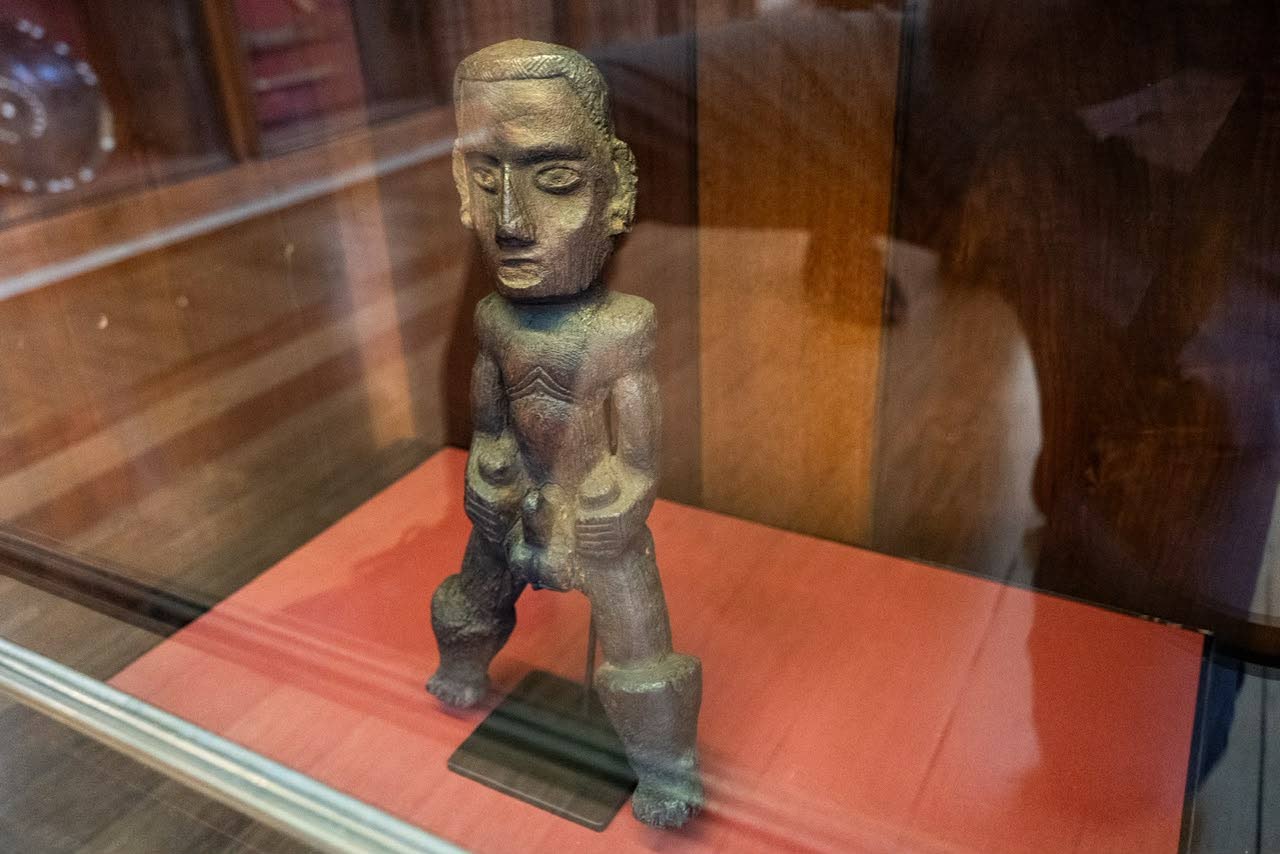
This Taíno cemi/anthropomorph is on display in the Enlightenment Gallery of the British Museum. The object is believed to originally have come from Cedar Valley, St Catherine.
In April 2026 the DCMS reported that its 15 sponsored museums and galleries had together surpassed a £1-billion milestone in collective self-generated income in 2024/25, a first since it started keeping records.
The £1.3-billion total, it said, was an increase of almost 2.5 times that of the previous year, when adjusted for inflation. The department attributed much of the increase to the British Museum, which alone accounted for 81 per cent of the figure.
The museum, which is supported by government grants and self-generated commercial and fund-raising activities, documents the story of human culture from its beginnings to the present. Its permanent collection of eight million artefacts is said to be the largest in the world.
Last Tuesday, in her report to Parliament, Grange said the Jamaica delegation also used the trip to London to strengthen engagement with the British Museum, which has allowed local teams to inspect its inventory.
“The relationship has improved and we are making inroads. There is greater willingness to discuss plans for collaboration, which we believe will assist to get these priceless artefacts back home where they belong, to the Jamaica people,” Grange told the House.
Asked to expand on the effort to have the artefacts returned, Grange told the Sunday Observer that “the museum has cited the British Museum Act 1963 as a constraint to repatriation, as it prevents the museum from giving away, selling, or returning objects from its collection, except under the specific conditions set out in sections 3 and 5 of the Act.”
However, she disclosed that consideration is also being given to developing a memorandum of understanding between the United Kingdom and Jamaica to address access, visibility, and other areas to be agreed.
“The British Museum has also demonstrated openness to professional engagement and has extended invitations to participate in collaborative research,” she said.
Grange also said that following a visit to the UK in May this year of two Jamaican experts, which was funded by the British High Commission here, “the British Museum offered to facilitate a virtual viewing of selected Jamaican objects in its collection, including the Carpenter’s Mountain collection, several other Taíno objects, including celts, pestles, bowls, and two small pieces of gold”.
She said that a viewing held on September 16, 2026 brought together 47 participants from the Institute of Jamaica, Jamaica National Heritage Trust, The University of the West Indies, and the Ministry of Culture, Gender, Entertainment and Sport, providing an opportunity for Jamaican experts to examine objects they had never previously seen.
“To date, including select officials from the delegation I led, only under 10 Jamaicans have had the opportunity to view these objects in person, all during 2026,” the minister told the Sunday Observer.
Asked where the Jamaican artefacts would be housed if the repatriation efforts prove successful, Grange said: “The space to house them would be the National Gallery of Jamaica, where another Taíno collection from Aboukir, St Ann, also resides and is on display.”


