



RADA to provide 7 million gallons of water
Building 30 ponds for farm use
CORAL SPRING, Trelawny — The Rural Agricultural Development Authority (RADA) is building ponds, some of which will come on stream before next March, which will provide millions of gallons of water to the farming sector.
“Currently, over 30 ponds, [with] total water holding value over 7 million gallons, are at varying stages of construction; some of them to be finished before this financial year,” said RADA’s Principal Director, Technical Services, Marina Young.
She was speaking, Tuesday, during the opening plenary for the ongoing Caribbean Week of Agriculture at the Ocean Coral Spring Resort in Trelawny.
“We are basically constructing farm water ponds, and there are two categories: Individual farms and… farmer group communal ponds, which are usually over 1 million gallon capacity,” she said.
The development comes as Government intensifies its drought mitigation programme, with water storage identified as an important component in building greater resilience in the agricultural sector. In September, Agriculture Minister Floyd Green announced an additional $60 million for RADA to develop water catchment points in 25 areas identified for intervention. The catchments are intended to store rainwater for use by farmers in areas with high levels of agricultural production.
“This is a very important component where, over the years, including 2026-27 financial year, we have very serious commitments in terms of providing support to the farmers with the water storage capacity,” Young said.
She explained that three communal ponds are currently under construction, while the remainder will be constructed for individual farmers who do not have water sources or access to water.
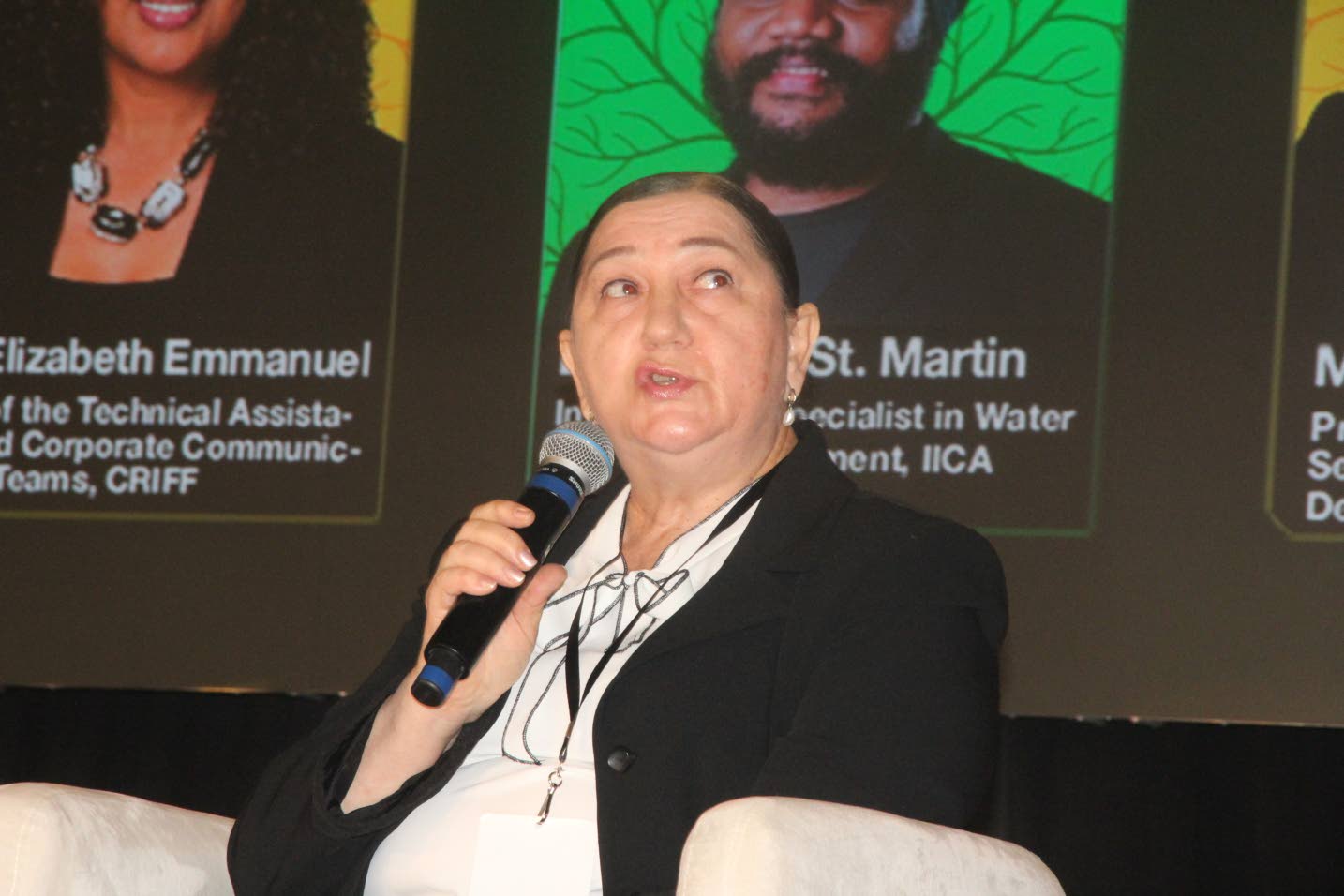
Principal director at the Rural Agricultural Development Authority Marina Young speaking, Tuesday, during a panel discussion as part of Caribbean Week of Agriculture.
As part of that effort, some farmers will carry out the excavation themselves, while the ministry will provide guidance and other forms of support.
“When we come to individual farmers, we’re offering to them to construct their ponds in collaboration with… the extension services — through their drought-mitigation programme — by providing pond liner,” said Young.
The liners are intended to reduce water loss and allow farmers to retain rainfall for use during periods when the commodity is scarce.
“It’s a very high-quality PVC material, which [is suitable for] long-term use. We’re asking farmers to excavate the earth, and we’re working together in terms of the design and completing of construction,” said the RADA director.
The model gives farmers a direct role in developing infrastructure on their properties while reducing one of the major costs associated with constructing a lined farm pond. However, the RADA official stressed that more immediate measures are also being taken to address the water shortage.
“As a short term, there’s a large capacity black tank. We call it irrigation kit, but it’s actually a quarter acre of drip system with the fittings which we — as extension services — help farmers to design based on the farm layout. [We] instal and train the farmers how to use and maintain it,” outlined Young.
She said this forms part of RADA’s disaster response and management framework under its drought-mitigation programme, which also sees support being provided by the National Irrigation Commission.


