Kremi draws on well as production expands
AS drought places pressure on water supplies across Jamaica, Caribbean Cream Limited is drawing on its own well to keep ice cream production going while adding more hours at its factory to improve the availability of its Kremi products.
The company says the well, commissioned during its last financial year, saves approximately $4 million a month under normal operating conditions for its production, cooling, and cleaning processes. It also provided a reliable supply during the drought, helping the manufacturer avoid buying expensive trucked water for its plant.
At the same time, Kremi has expanded its scheduled production time by a third, adding a fourth shift in June to build inventory and get more products into its distribution network.
Chief Executive Officer Christopher Clarke told shareholders at the company’s annual general meeting on Monday that the additional shift works alongside a cold room commissioned in 2023, allowing the manufacturer to hold stock that can be used when production is interrupted.
“The purpose of the cold room is to build an inventory that if anything happens in production, it doesn’t affect sales,” Clarke said. “The plan was to have the inventory go up and down and sales remain the same.”
Previously, a machinery breakdown could mean fewer products available for sale, he said. The extra shift gives the company more time to build that stock.
The changes come as Caribbean Cream returns to profit following a difficult financial year in which Hurricane Melissa disrupted sales and added unexpected expenses.
Revenue for the six months ended August 31 rose nine per cent to $1.77 billion, while net profit reached $113.8 million, reversing a $9.4-million loss in the corresponding period last year. Management attributed the growth in sales mainly to improved product availability across its distribution network.
The company spent slightly less on direct expenses despite the increase in sales. Those costs fell to $1.13 billion from $1.14 billion a year earlier, helping gross profit climb 32 per cent to $648.4 million. Its gross profit margin widened to 36.5 per cent from 30.2 per cent.
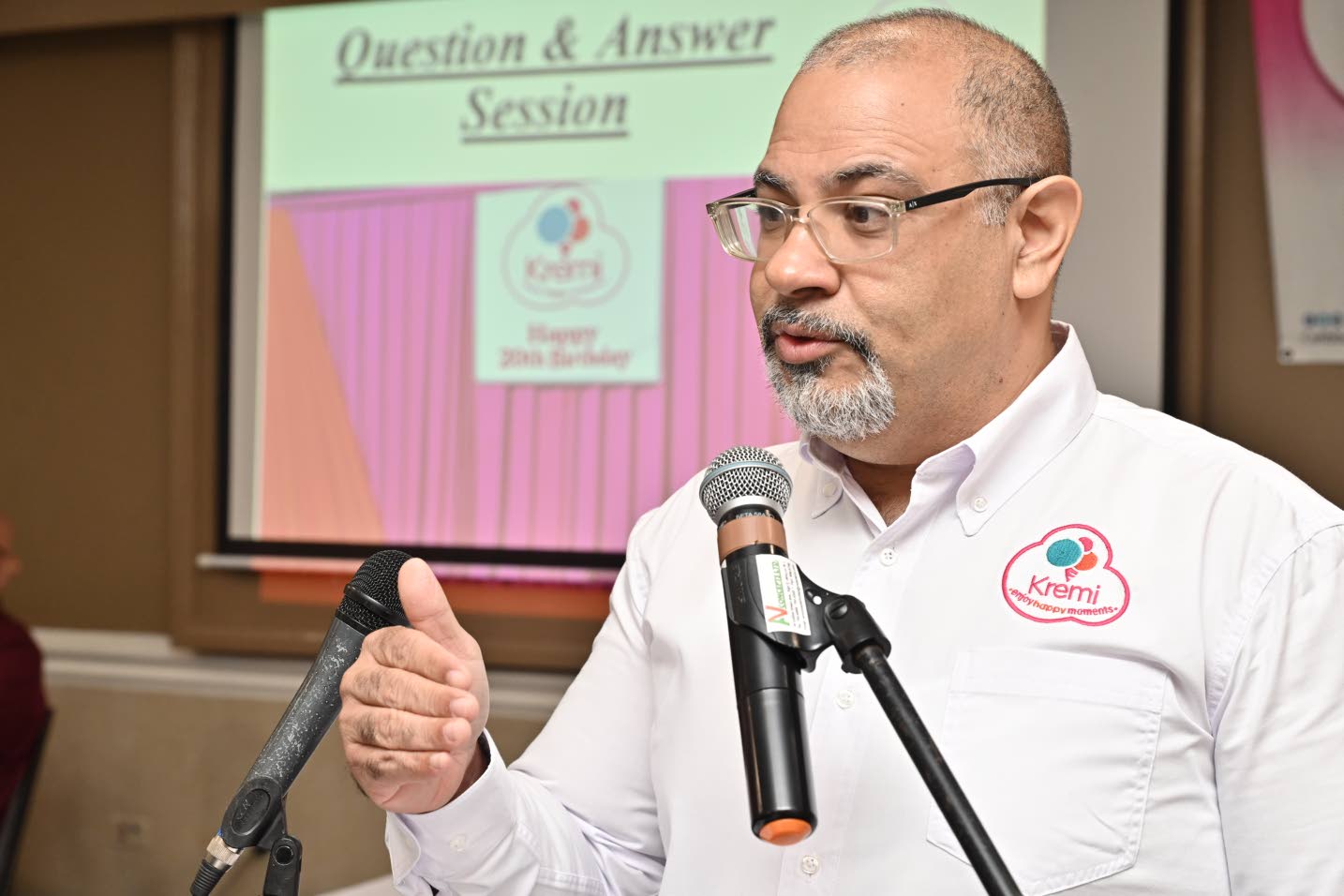
Caribbean Cream Limited Chief Executive Officer Christopher Clarke addresses shareholders at the company’s annual general meeting on Monday, October 26, 2026.
In responding to queries aout what drove improvements in the company’s margins, Clarke said Kremi had also taken a more aggressive approach to pricing. While the additional shift reduced labour hours per gallon produced, he attributed most of the margin improvement to the pricing strategy. Earlier this year, the company announced an increase in ice cream prices due to rising milk powder and shipping costs linked to Middle East tensions. The manufacturer is still keeping watch on the cost of milk powder, one of its main inputs.
The stronger performance continued into the second quarter, with revenue rising eight per cent to $890.6 million. Net profit for the three months ended August 31 climbed to $69.1 million from $4.2 million a year earlier.
Kremi also had more cash on hand at the end of August, with cash and cash equivalents increasing to $85.1 million from $28.8 million at the February year end. Net finance costs for the six months fell to $52.4 million from $60.6 million a year earlier.
The recovery follows a $95.8-million net loss for the financial year ended February 2026, when revenue slipped to $2.97 billion from $2.99 billion a year earlier.
Clarke said sales in western Jamaica were most affected during the three months after Hurricane Melissa, but began improving towards the end of the financial year and have continued to recover. Hotel sales had fallen close to zero for a period after the hurricane, he said.
Kremi’s recent investments have been aimed at addressing constraints that could limit production or interrupt supply. The company previously told the Jamaica Observer it was investing roughly $50 million in the well at its Kingston factory, while the cold room and blast freezer were installed to increase storage and production capacity.
Meanwhile, another project intended to lower energy costs is still outstanding. Clarke told shareholders that the company’s combined heat and power plant had been delayed by equipment supply and engineering issues, as well as a change of contractor.
He said the company expects the project to go live by the end of the year, but was cautious about giving another firm timeline after earlier delays. Management was also unable to provide an updated estimate of the savings, given changes in energy prices since the project was planned.