



Leo Cousins at 100: A pioneer’s unfiltered reflection on Jamaica
FOR decades, Lydford Mining Company co-founder Leo Cousins poured his life into building businesses and imagining a brighter future for Jamaica. Now, at 100 years old, the retired engineer believes the country has still not lived up to its potential.
Cousins welcomed this Jamaica Observer reporter into his home — nestled in the lush hills of St Andrew, overlooking the city of Kingston — for a cup of coffee and a walk down memory lane.
Born on October 8, 1926, Cousins still stands tall, is quick-witted, and has little patience for anything other than speaking his unadulterated truth.
His earliest memories took him back to Agualta Vale, St Mary, where he spent his formative years on a sprawling 1,500-acre estate. There, his father worked as manager of the premises, and his mother as a dressmaker.
The family occupied an 18-room great house, complete with servants, horses, and stables. It was a childhood that gave birth to his fascination with machinery and engineering, with Cousins having already driven tractors, repaired engines, and tended to livestock of his own by age 13.
“I went to [secondary] school in Kingston; I went to Government Technical school [Government Commercial, Technical and Continuation School which is now Kingston Technical High School]. And that was funny because I knew more about engines and things than what some of the teachers knew,” said Cousins with a laugh.
His early aptitude for engineering eventually caught the attention of a Ministry of Agriculture official, who encouraged him to pursue further studies at McGill University in Canada.
“In those days, if you graduated from the university and you recommended a new student, they would give them preference because at least the university knew you. So, to my amazement, they accepted me. And I panicked. I never intended to have to find money now, but my parents gave me the plane fare and money in my pocket and so forth. So, I went off,” he recalled.
Canada was pivotal for the centenarian; he pursued higher education, began his engineering career, and met his wife, Irena. They have two children and have been married for 72 years.
He delivered a comedic retelling of their love story, marked by a beautiful Polish woman who wore scuffed shoes.
“There was a function in the university…my wife was there singing her Polish songs. When she was finished, she had to pass by me. I said to her: ‘What is a pretty girl like you doing with dirty shoes?’ To which she told me, ‘If you don’t like them, clean them.’ So, I took out my nice, clean handkerchief and I brushed her shoes. And she just walked away. Two years later, I am married to her,” he said with a hearty laugh.
He told the Sunday Observer that she remains his pillar of support, and that their marriage has been the best decision he’s ever made.
As they continued to live in Canada, Cousins worked as a design engineer at Allis-Chalmers Corporation in Montreal before returning to Jamaica in 1956 to join Alcan mining company as a senior engineer. He later moved on to work in the Government’s Public Works Department.
“I took over their workshops there, and I was amazed [at] how primitive [there operation was] in comparison to what I had seen in Canada and the US…So, it’s quite funny…I began to change everything,” he recounted.
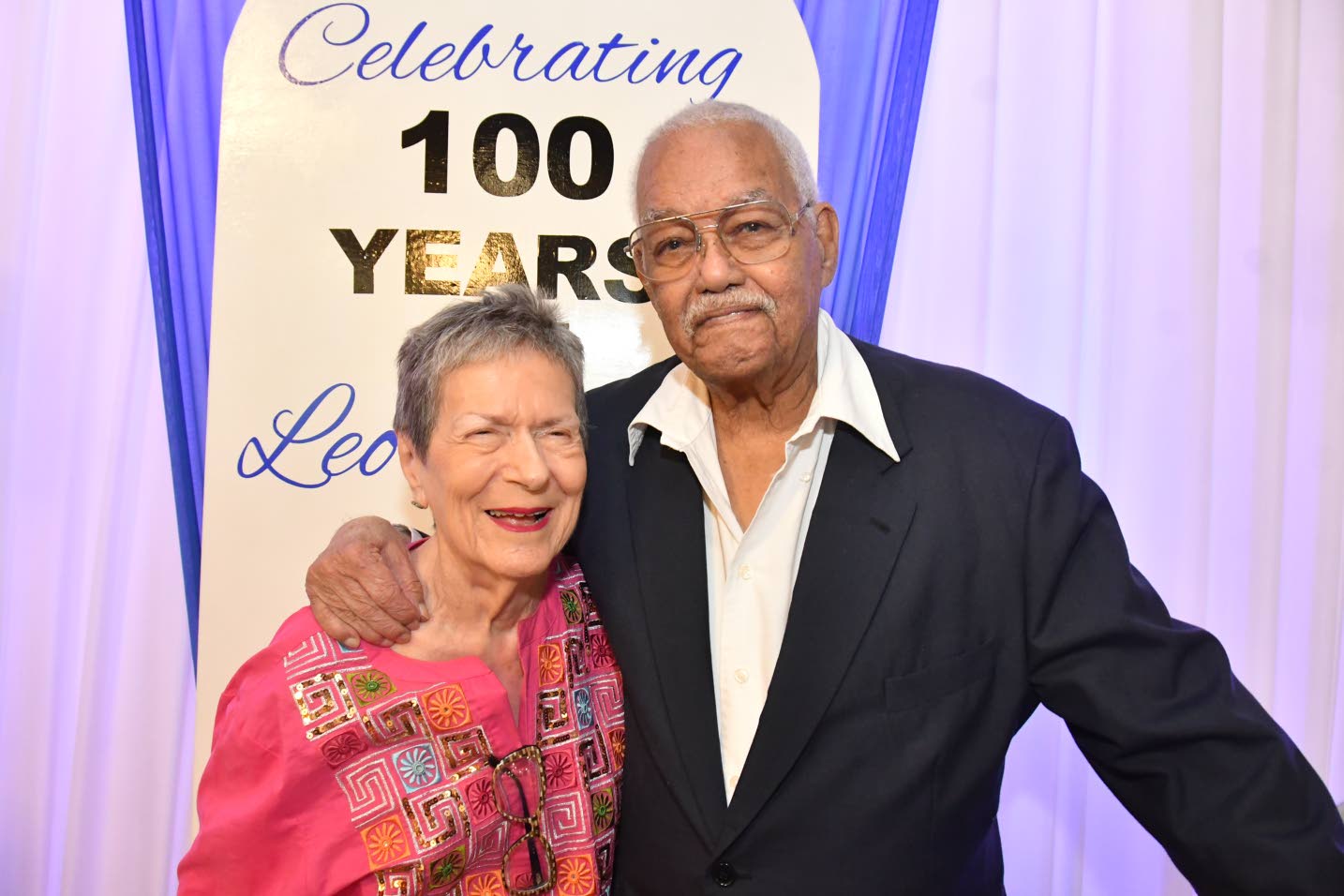
Retired engineer and Lydford Mining Company co-founder Leo Cousins and his wife, Irena, at a lunch at New Imperial restaurant in Liguanea, St Andrew, three Sundays ago to celebrate his birthday. Leo marked his 100th birthday in October 8. (Photos: Garfield Robinson)
During this time, Jamaica was also on its trajectory of becoming an independent nation. When the black, green, and gold flag replaced Britain’s Union Jack on August 6, 1962, Cousins had anticipated rapid transformation in all industries. He was especially fond of the possibilities that mining could bring.
“I saw Canada and I saw the US in my head, because these are the countries that had money and they had industry and so forth. So, I thought that Jamaica would copy these things,” he laughed, leaning back in his chair and shaking his head.
Sixty-four years later, Cousins told the Sunday Observer that the glamour of gaining independence has long since faded.
“All that has no meaning, no meaning whatsoever. Because if you are not going to show results for all that you have done, then it is nonsensical.
“If you can say we became independent and everybody has a banana every day, then that is fine; you have achieved something — everybody has a banana. It’s not much, but tell me what the people have right now in Jamaica — the poor people or the middle class — slavery disguised as freedom,” he said bluntly.
Growing up in the 1930s, Cousins maintained that Jamaica was once a country of agricultural abundance, where families were more inclined to raise and grow what they ate.
But, he argued that an increasingly high cost of living and inadequate national planning have worked to the detriment of Jamaica’s long-term development.
“What does it matter if you’re a republic or a monarchical or a communist country? What you want is a banana. At the end of the whole thing, you want a banana,” he said, his chuckle breaking his spiel on the importance of a country being able to feed its people.
These issues, he noted, also hampered his professional progress as he ventured into the quarrying sector. He established a crushing plant at Rockfort in Kingston, which later morphed into Island Aggregates, where he remained until he retired in 1980.
Cousins returned to the world of mining in 1992, this time, in a venture with his lifelong friend Dr Vincent Hill, to establish Lydford Mining Company. He argued that bureaucratic processes stunted the company’s trajectory.
“Somewhere in our 20th year — we should have been there from year three or four — we exported US$10 million worth of stuff. I was told this because I have since retired. We could have done that 15 years ago,” he said.
“I learned that the Government is operating politically, which all governments should, but when they are making judgements on business, they should use the historical performance of other countries,” he reasoned.
Now that the centenarian is enjoying the benefits of his professional life during retirement, he maintained that his biggest hope is still for Jamaica to find its path to sustainable development.
“What I would like to see after my hundredth birthday is a complete change of how we go about things…I would like the Government to set up a management team, not a political team, not a business team, but a management team. They need to find out: Why are we short of doctors or nurses? Why are we short of teachers? We have to do fundamentals first,” charged Cousins.


