



Breaking the taboo around mental health
Senator calls for rethink of how people facing this challenge are treated
THERE were calls in the Senate last Friday for the Government to fund research into dementia — a growing mental health concern in Jamaica — revise the Mental Health Act to bring it in line with today’s realities, and for Jamaicans to do more to lessen the stigma associated with mental health.
The calls were made during an unusually long debate on a motion for adjournment that was moved by Government Senator Kavan Gayle, acknowledging Mental Health Awareness Month, which ended October 31.
Gayle, a trade unionist, proposed the establishment of a national alliance for mental health awareness, protection and prevention. He argued that while employers and trade unions have a critical role to play, mental health is too important to be left to any single institution or sector.
There were robust contributions during the ensuing debate from senators on both sides of the political divide as they addressed the often sensitive issue.
During his contribution to the debate, Opposition Senator Professor Floyd Morris highlighted that there were more than 200 mental health conditions with the most commonly known ones in Jamaica being depression, bipolar disorder, schizophrenia, and dementia.
“The issue of mental illness is one which our society must come to terms with and have meaningful conversations around,” said Morris. He suggested that a collective approach was urgent given the high levels of stress within the society which he said leads to, and contributes to, depression.
Morris also repeated comments he made in the Parliament recently about the increasing number of Jamaicans being diagnosed with dementia.
“Which, as I said, is another type of mental illness. That in and of itself brings about a lot of pressure on family members and it is an area that I have called for additional resources to be earmarked for research because with an increasingly ageing population, we’re going to see an increase in mental illnesses like dementia,” Morris stated.
The Opposition lawmaker also called for a comprehensive review of how mental health is treated in Jamaica.
Pointing out that it is largely treated as a purely medical issue, Morris said, “In the context of disability we’ve moved from that era where these mental illness conditions are treated in that context, to where the rights of these individuals have to be recognised”.
The senator, who is blind, described the current Act as being outdated. He pointed out that, “It was crafted using what we regard as the medical model of disability. It is an antiquated piece of legislation that needs to be modernised and brought up to speed in terms of the new paradigm of how persons with mental illnesses are treated”. Morris argued as he called for a rights-based approach to disabling conditions.
In her contribution to the debate, Opposition Senator Dr Maziki Thame lashed the Government for not doing enough to stem the rise in mental health issues, in particular among young people.
“We want to see good mental health care readily available, accessible and affordable. We want to see a Jamaica where life can be taken in stride without having to depend on substances to numb pain and social and economic realities don’t lead to despair,” she remarked. “I believe we want to see a kind and caring society rather than one of high social violence and government madness,” she added.
Thame pointed to data which showed an almost 16 per cent increase in suicide cases over the last year which she said tells a tale of increasing despair. She referenced statements made during an interview, in June, by the chief executive officer of the Bellevue Hospital Camille Buchanan, that the hospital’s wards were increasingly being filled with young people and working professionals.
Thame also pointed to the global school-based Student Health Survey of 2026 which was conducted and published by the Ministry of Health and Wellness and the National Council on Drug Abuse with international partners, which showed that mental health has been worsening for young people.
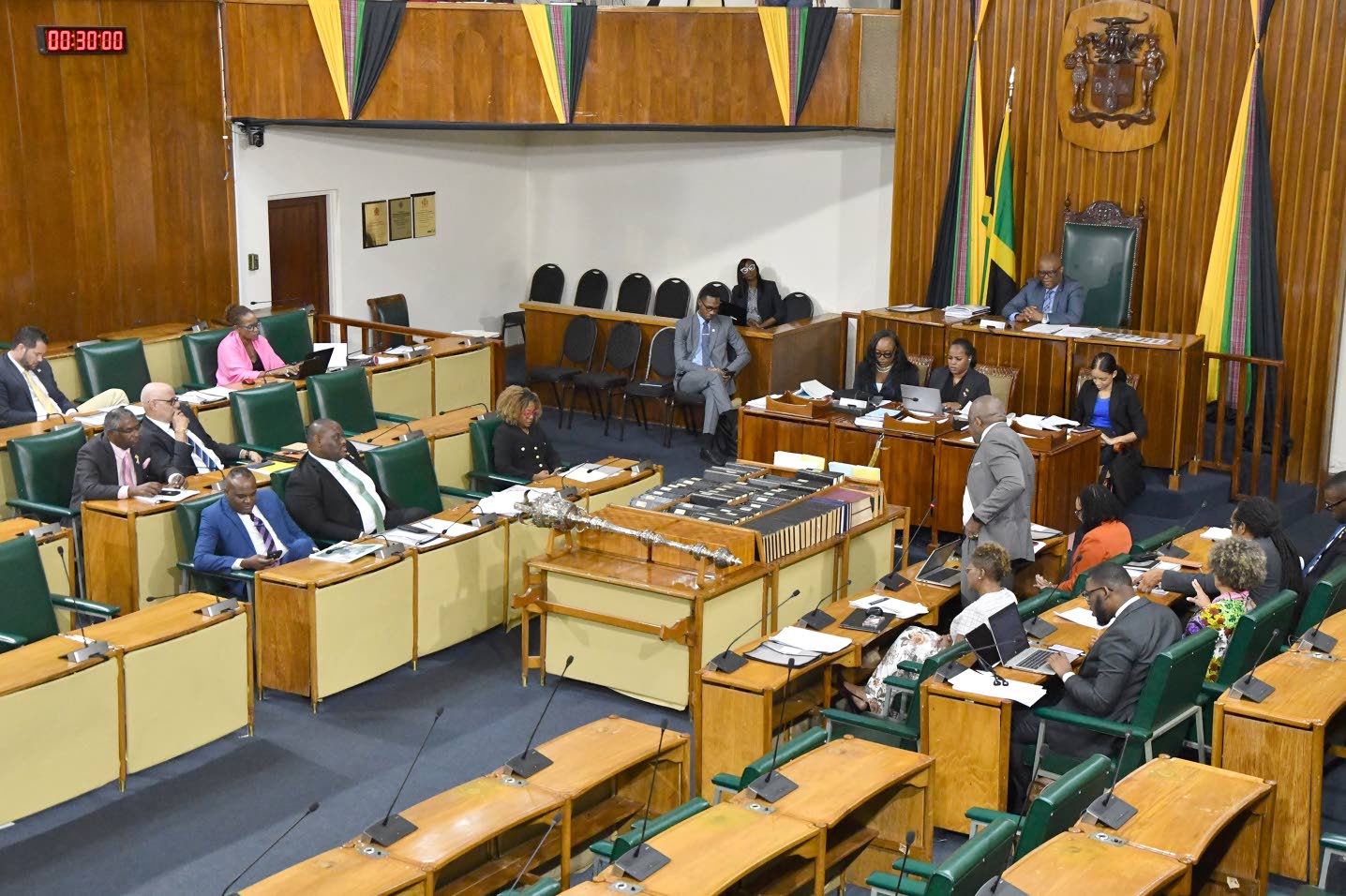
Opposition Senator Floyd Morris on his feet during last Friday’s sitting of the Senate. (Photo: Naphtali Junior)
“The report highlighted rising adolescent emotional distress, feelings of hopelessness and self-harm risks, more students suffering with suicidal thoughts, suicide planning, suicide attempts and anxiety and depression,” she noted.
She pointed out that after showing a decline from 22 per cent in 2010, to 18 per cent in 2017, adolescent attempted suicide increased to almost 24 per cent in 2026, almost one in four.
Thame questioned why the long promised 122-bed neuropsychiatric ward for the Bellevue Hospital has not been built. Pointing to years of delays and cost overruns on the Cornwall Regional Hospital redevelopment project, Thame said, “This sort of failure costs more than the overspend, it costs lives. We need a government that knows how to save them”.
She told the Upper House that one year after Hurricane Melissa hit, “the long-suffering people have neither been adequately supported by the State, nor have they been independently able to recover from their losses.
According to Thame, Jamaicans facing stress are often told to find ways to relax and unwind by going to the beach for example. “Yet, Jamaicans are prevented from accessing them,” she declared, adding that, “We live on an island, yet the people cannot escape to the beach”.
The assertion of a lack of beach access by Jamaicans was quickly shot down by Government senator Abka Fitz-Henley during his contribution to the debate.
Fitz-Henley argued that some people were abusing the social media space in a way that is adverse to the mental well-being of Jamaicans.
“Because often times there are campaigns which are permeated by lies, which speak untruths about Jamaica and what is happening in our country. That can affect the mental well-being of Jamaicans, how they feel about themselves and perception of the country,” said Fitz-Henley.
He insisted that talk that Jamaicans are being barred from public beaches is a “bold face lie,” and charged that false narrative of that type is inimical to the mental well-being of Jamaicans.
On the matter of stigma surrounding mental health, Fitz-Henley said, “For too many years, perhaps decades, the issue of discussing the mental well-being of individuals has been taboo in some cohorts of Jamaican society”.
He noted that among some demographics, it is fashionable to speak about people having discussions with their therapist, about the challenges which face them and which they seek to navigate. “But in other demographics in Jamaican society, discussing your mental well-being or challenges you face is regarded as taboo,” he lamented.
Fitz-Henley told the Senate that some young men view even a discussion on mental health as being weak, something to be ashamed of.
“It would be good to disabuse your minds of the perception that discussing mental well-being is something to be perceived as weak or not to be done,” said Fitz-Henley as he stressed that the mental well-being of every Jamaican matters.
Fitz-Henley pointed to a range of Government programmes and initiatives led by the Ministry of Health and Wellness, including the suicide prevention helpline which he noted provides an opportunity for direct consultation with psychologists and referral services. “The data indicates that an increasing number of Jamaicans are accessing this very important avenue,” he said.


