



Building Jamaica’s energy future after Hurricane Melissa
Opening remarks delivered by JPS President & CEO Hugh Grant at Jamaica Energy Summit 2026 on October 27.
One year after the passage of Hurricane Melissa, a hurricane of unprecedented scale, we have the opportunity to sit together and shape Jamaica’s energy future. We gather with gratitude. We reached this moment through an extraordinary collective effort.
A year ago, our decisions were immediate: Which hospital could we reconnect? Which water pump could we restart? Which cell site, police station, airport or economic centre could we restore? Every connection meant essential services returning, a business reopening or a family beginning to recover. Today, we must look further ahead: to the energy future Jamaica needs, the investment it requires and the partnerships that will make it possible.
This discussion comes at an important moment for the sector. We recognise the questions surrounding the future of JPS’s electricity licence. The responsibility we share here extends beyond any licence term. The energy decisions Jamaica makes today will shape our resilience, our competitiveness and the opportunities available to our people for decades.
Think of Jamaica’s energy system as the road on which our economy travels. Every household, every business and every ambition for growth depends on where that road can take us. Melissa exposed its vulnerabilities. Our recovery showed what we can accomplish when we work together to rebuild. Now we must decide how to strengthen it, expand its capacity and prepare it for the traffic of the future.
That spirit of partnership has shaped our collaboration with the Private Sector Organisation of Jamaica to convene this summit. Let us use this occasion to have meaningful discussions on Jamaica’s energy ambitions, with the urgency our economy demands and the cooperation our recovery has shown is possible.
Melissa: The Scale and Speed of the National Response
Melissa required a national response at exceptional scale and speed. Across parts of western Jamaica, entire sections of the electricity network had to be rebuilt.
Our team prevented a complete shutdown of the network, maintaining electricity supply to 23 per cent of our customers following the storm. Within one month, we had restored service to 80 per cent of customers, reaching 90 per cent within two months and 99 per cent in four months. These milestones were achieved despite the extensive rebuilding required across the network.
The road to recovery was not a straight path. We worked closely with Government and other key stakeholders to make difficult decisions about where restoration would have the greatest national impact. For example, accelerating recovery in the tourism belt was critical to protecting jobs, restoring livelihoods, and getting the economy moving.
The scale of the work was not always evident in the number of connections restored. At Roaring River in Westmoreland, restoring electricity to a single National Water Commission pumping station required approximately 20 kilometres of rebuilding and some 340 poles across difficult terrain. That one connection helped restore potable water to approximately 50,000 residents.
In places such as Treasure Beach in St Elizabeth, Bethel Town and Darliston in Westmoreland, we partnered with the regulators and the communities with the first of its kind, Emergency Mobile Power Generation which supported essential facilities while permanent infrastructure was rebuilt. I would like to acknowledge Mr Ansord Hewitt, director general of the Office of Utilities Regulation, and thank him for joining us today.
When the lights came back to Black River before Christmas, as promised, it was also the return of some confidence and normality to a community that had endured so much.
We revisit these milestones not out of sentimentality, but because the speed of restoring electricity has a direct bearing on Jamaica’s economic recovery. In February, the Bank of Jamaica shortened its projected recovery period following Melissa from three to four years to two to three years. Dr Brian Langrin, governor of the Bank of Jamaica, is with us today. Governor, a special welcome. We are pleased to have you join us.
Faster-than-anticipated restoration of electricity and telecommunications was among the factors supporting that improved outlook. I would like to commend our telecommunications partners Stephen Price, Flow; and Stephen Murad, Digicel.
That should change the national investment conversation. We should ask both what it costs to make the grid stronger and what every avoidable day of disruption costs Jamaica.
Building Resilience on Blue Sky Days
Hurricane Melissa amplified the lesson that resilience is built on blue sky days. Strong infrastructure, maintenance, network visibility, equipment reserves and trained teams determine how well we withstand storms and restore service.
Physical investment and financial preparation must work together. Financial resilience requires the same long-term discipline.
We therefore need to agree, in advance, which risks we must reduce, which we should insure and how much customers can reasonably be asked to bear. Those are difficult decisions, best made on a blue sky day. Once a storm strikes, the country needs the arrangements in place and the resources ready.
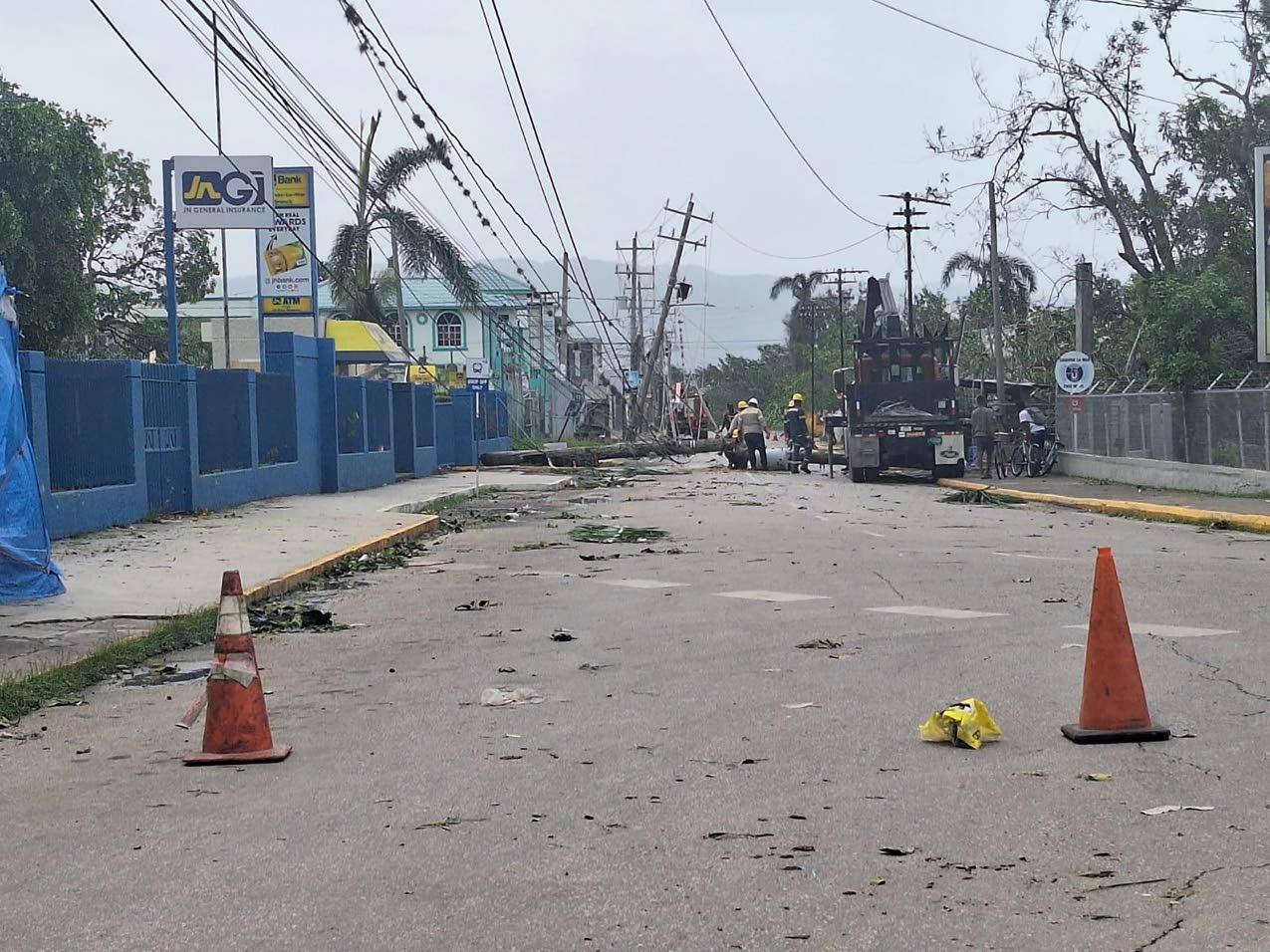
JPS crew examine a downed electricity post in Savanna-la-Mar, Westmoreland before getting to work on repairs following Hurricane Melissa in October 2025.
Make Collaboration Permanent
The difference between a slow recovery and a faster one is often the quality of partnerships. Think of it as a 4x100m relay which is won through the handovers as much as the individual performances. Government, regulators, investors and operators each carry responsibility. Progress depends on how well the decisions of one enable the next to act.
For the first time we had retainer agreements in place with overseas line crews ahead of the hurricane season, enabling faster mobilisation when Melissa struck.
The Government’s US$150 million loan facility helped secure critical resources. More than 300 line workers and 300 pieces of equipment arrived from North America, reinforcing the efforts of over 200 line workers mobilised through CARILEC and utilities across the region.
In addition, JPS and CARILEC opened a Centre of Excellence in December 2024 to strengthen technical capacity in grid operations, contingency planning and emergency response. That investment reflects where we should be heading as a region.
We must continue to develop the engineering talent, share specialist expertise and establish systems for joint planning, mutual aid, and access to critical equipment. The objective is straightforward: when the next crisis comes, cooperation should already be built into the way we operate.
What Does Jamaica Expect From Its Energy System?
Jamaica expects affordable, safe, reliable, resilient and sustainable energy to attract investment and grow the economy. A decision about tariffs affects investment. A decision about customer self-generation affects the shared cost of maintaining the grid. Delaying a resilience project may slow economic recovery after the next major event. These choices require us to be candid about trade-offs and clear about national priorities.
As we make these choices and compare Jamaica’s energy system with others, we must ensure that we are comparing apples and apples. What is the size of the market? What is the average per capita income? How much of the cost is covered by subsidies? Is it an island system, or can it draw power from neighbouring countries? Does it serve a dense population or dispersed communities requiring more infrastructure per customer? These factors directly affect the cost of delivering electricity.
At the same time, we need a more rigorous understanding of what affordable electricity really means. The lowest initial capital cost does not always produce the lowest long-term cost.
The question should be: what is the lowest sustainable cost of reliable electricity for Jamaica? That requires us to evaluate the entire system over time, including taxes, fuel, maintenance, and the investments that help protect the economy.
Design a System that works at every hour
At JPS, we support the renewable energy transition and are focused on delivering real value. Solar, wind, and energy storage have an increasingly important place in our supply mix. Integrating them well is essential to safe, reliable, resilient, affordable and sustainable energy.
A manufacturer needs electricity when a production line is running, not only when renewable conditions are favourable. Hospitals, telecommunications networks, hotels and critical public services have the same requirement. Batteries help manage intermittency and improve flexibility, but long-duration storage for large industrial loads remains an expensive challenge. We therefore need renewable generation alongside flexible supply, with technologies such as natural gas contributing during the transition where appropriate.
The objective is to diversify our energy mix and build the right combination for Jamaica, rather than declare one technology the winner.
Grid Defection
Another major change is taking place in the relationship between customers and the grid. More homes and businesses can produce electricity through rooftop solar and other distributed technologies. I see that as part of the future energy system, not something a utility should attempt to resist as innovation gives customers choice.
However, the social premise of the shared network still matters. Even customers who generate much of their own electricity may rely on the grid for backup, stability or supply when their generation is unavailable. The cost of keeping that network ready does not disappear when electricity consumption falls.
That raises a serious question of fairness. If those with the greatest ability to produce their own electricity contribute less to maintaining the shared network, is the remaining cost transferred to households and smaller businesses with fewer options?
We must avoid placing an unfair burden on customers least able to carry it. Future tariffs need to distinguish more clearly between the energy consumed and the value of access to a reliable network. This is an issue of equity and public confidence.
Investment and Regulation: Certainty with Room to Adapt
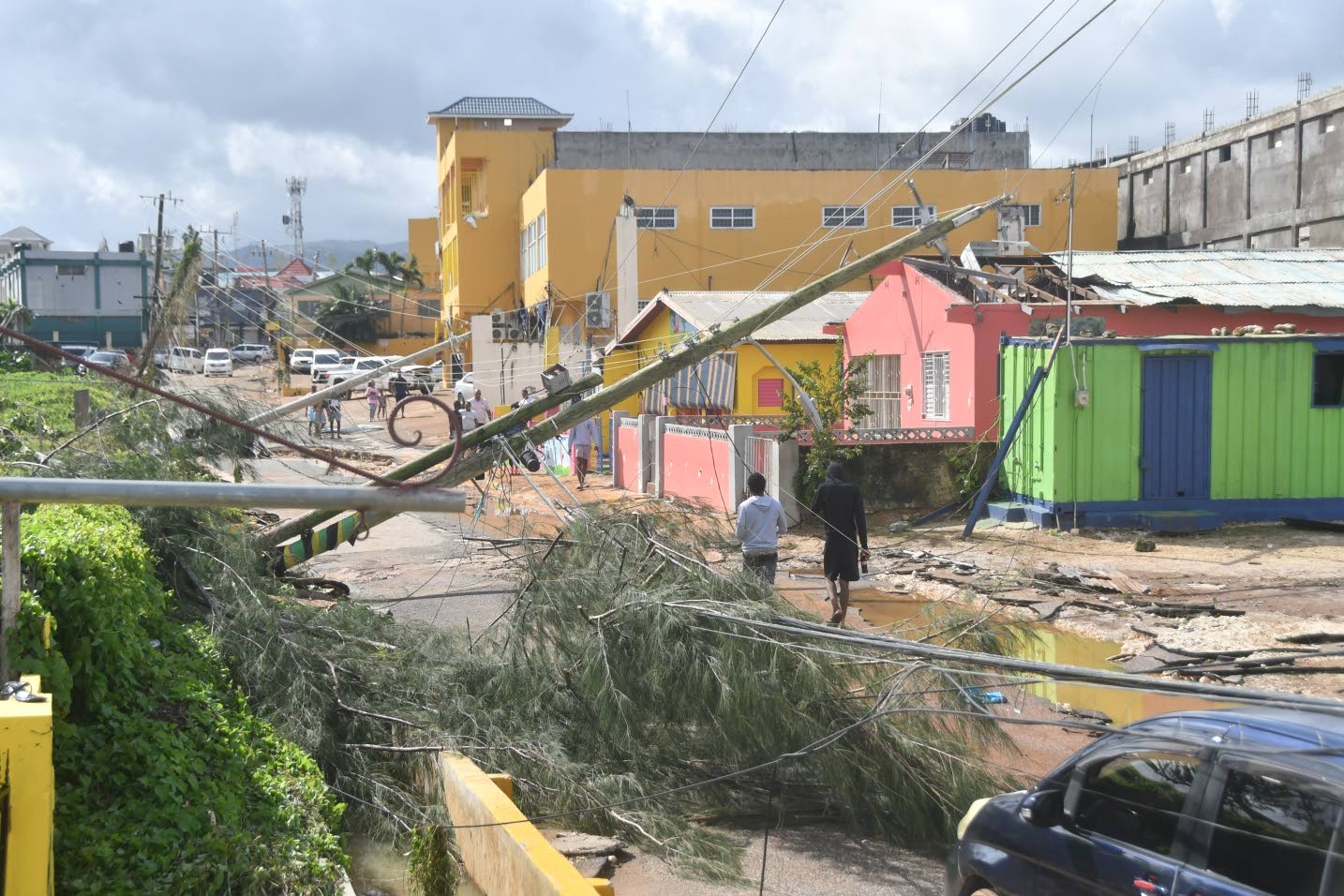
Downed utility poles on a street in the town of Santa Cruz, St Elizabeth after Category 5 Hurricane Melissa passed over Jamaica in October 2025.Photo: Garfield Robinson
The transformation Jamaica wants will require substantial, patient capital. We compete with larger economies for investors who must commit funds for decades. Those investors need confidence in strong governance, predictable rules and proven execution. Regulatory uncertainty carries a risk premium that can ultimately raise the cost of electricity.
There is a corresponding obligation on the utility. If we ask for investment certainty, we must demonstrate operational credibility, transparency, disciplined capital deployment and measurable improvements in service.
Predictable regulation and strong customer protection should reinforce one another rather than be presented as competing interests.
However, predictability does not mean rigidity. Assumptions may change materially before the end of a regulatory cycle. A mature framework should provide a credible way to revisit those assumptions, with appropriate scrutiny and accountability to customers.
Understanding that balance between investment confidence and customer accountability is part of this summit’s objective.
Build for Growth
A primary limiting factor Jamaica and this region faces is lack of scale. Economic growth must be at the centre of energy planning as electricity is productive infrastructure.
We should ask whether our energy plans are designed only around current consumption, or whether they anticipate the productive economy we want five, 10 and 20 years from now.
A modern grid needs to support changing patterns of demand, new sources of generation and opportunities that may not yet appear in today’s load forecasts. An integrated resource plan should connect generation, network investment, climate risk and national economic priorities.
There is also an economic relationship that deserves more attention: growth can help finance modernisation. Take for instance, under the assumptions used in our capital planning, an increase of just half of one per cent in electricity sales could create the room to support approximately 10 per cent more capital investment, roughly US$7 million to US$8 million, without an associated increase in tariffs. It shows why we should not separate discussions about the cost of the grid from discussions about growth in the economy.
Growth can also help lower energy costs by making better use of the grid’s available capacity. Data centres and electrification of transportation are opportunities to examine, alongside arrangements that encourage productive industries. When we look at comparison electricity consumption, the average monthly consumption in Jamaica is approximately 165 kWh, compared with 250 kWh in Barbados and more than 1,200 kWh in Florida.
We currently have the capacity for more productive use of the grid. In fact, the ability to attract growth without significant investment in capital is a recipe for lower prices.
We should therefore aim for energy infrastructure that attracts growth which in turn will make energy infrastructure more affordable.
The Purpose of This Summit
This brings me back to why this summit has been convened. International experience and local expertise must inform this discussion. We have representatives of Government, regulation, customers, business, multilaterals, the energy industry and regional institutions together in one room.
Melissa revealed the extraordinary commitment of our people and the strength of national and regional cooperation. It also showed us which approaches work and which must change.
Today, we will examine global trends, energy as a catalyst for growth and the practical choices involved in building resilience. We will explore the characteristics that successful systems share, such as strong partnerships, long-term planning, credible regulation, operational discipline, diversified fuel supply and the ability to adapt as technology changes.
This first summit is the start of what will be a series of engagements on Jamaica’s energy future. The goal is to establish a common direction, stronger working relationships and practical next steps.
The Decisions before Us
The storm we must guard against is the one we create by failing to have a realistic plan for that future. Jamaica cannot afford to make the grid an experiment. Our choices must be grounded in evidence, sound engineering and a clear understanding of their long-term cost. Let the decisions we advance and the partnerships we form lay a stronger foundation on which we can build.


