



Haitian trafficking network
Police suspect organised smuggling behind illegal arrivals here
HEAD of the Portland police Superintendent Ainsley McCarthy has charged that the frequent arrival of Haitians on the shores of the parish is part of a broader trafficking network across Jamaica.
“We have a Haitian population here in Jamaica. For example, in Montpelier, St James, we have Haitians there. So these Haitians who come in from time to time, some of them are trafficked. They pay to get here, and then there are persons who pick them up to take them to other locations, most times outside of the parish,” McCarthy said during the latest episode of the Jamaica Constabulary’s
Force4good podcast.
McCarthy was supported by head of Police Area Two Assistant Commissioner McArthur Sutherland, who told the podcast that many of the Haitians are being employed by Jamaicans to conduct farming in the hills of Portland.
He said police have done numerous operations targeting that practice and, “We believe some level of coordination is outside of the Portland parish.”
According to Sutherland, last year the police had to intervene after a dispute between two of the immigrants during a party held on one of the farms left one of them dead.
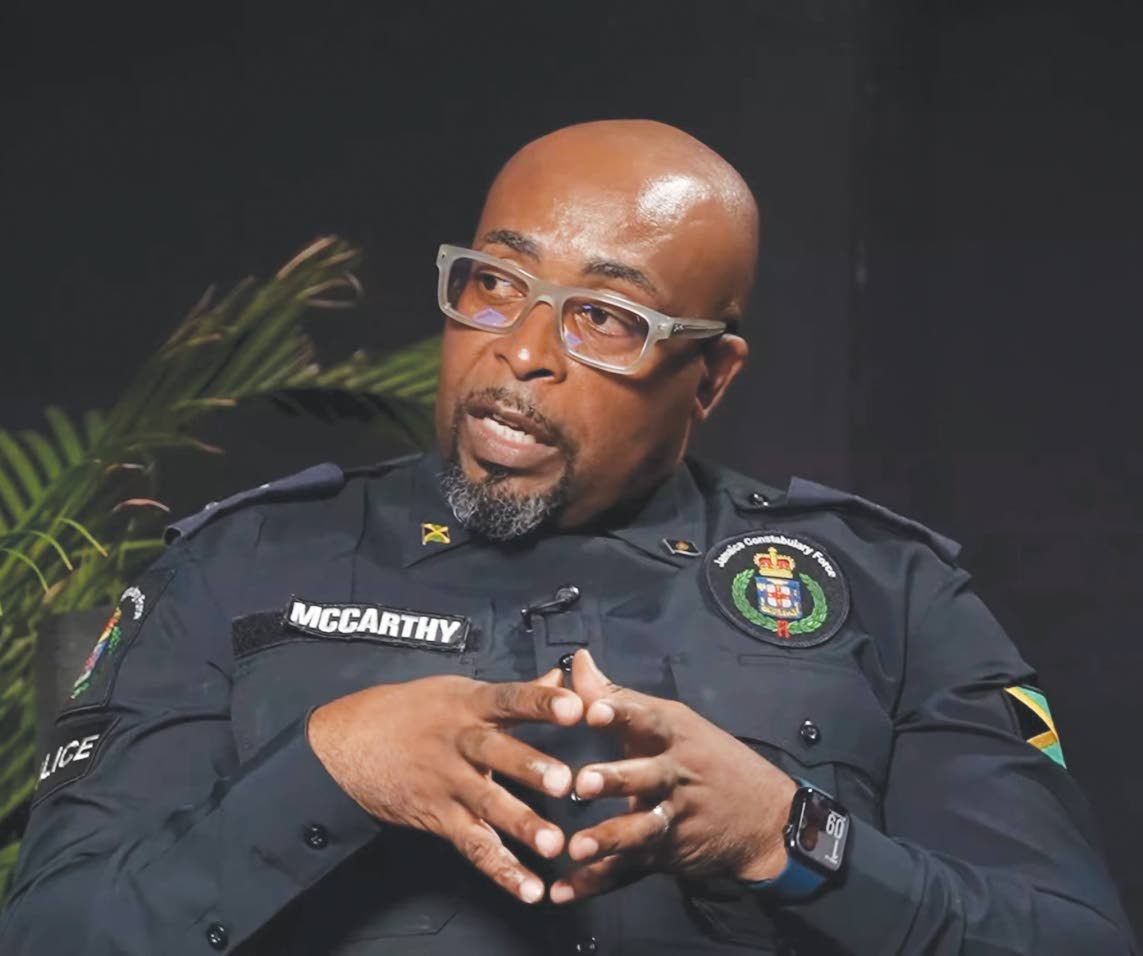
Superintendent Ainsley McCarthy, commanding officer for the Portland Division of the Jamaica Constabulary Force (JCF), speaking on an episode of the JCF’s Force4good podcast.
“The matter is still before the court and that [Haitian] is still in custody. From an organised approach, we have sufficient reason to suspect — or I would say believe — that it is organised, to an extent. One of the evidence of that organisation is the fact that we see returnees — persons who were removed [and] returned. The last trip we had one such case, and we are dealing with it,” Sutherland added.
Last month, police apprehended 22 Haitians across Area 2 — which covers Portland, St Mary, and St Ann — within a one-week period, raising concerns about a possible human-smuggling operation along Jamaica’s north-eastern coastline.
In June, 17 Haitians arrived in the Passley Gardens area of Port Antonio. Days later an additional 11 landed on Jamaica’s shores. They were taken to Port Antonio Police Station for health and immigration processing.
According to Sutherland, Jamaica requires “infrastructural support” to successfully tackle the issue as there are multiple uncontrolled ports across the island.
“The maritime coastal domain awareness is critical, [and] Portland is no exception. We have been looking at this from several years back — from the days when we were looking at it as gun-for-drugs [trade]… where they bring down the weapon and in exchange they get the marijuana. We have not seen much of that activity. But the emergence now of, what I’d say, either people smuggling or people seeking refuge, whichever category you look at it from, we definitely need the right infrastructural support as a country to really handle that,” added Sutherland as he argued that an ongoing cross-border collaboration is needed.
That collaboration, he explained, would be “a very solid intelligence network that can identify the triggers and alert us so we can mobilise and respond to these situations as quickly as possible”.

Area Two Commander for the Jamaica Constabulary Force (JCF) Assistant Commissioner of Police McArthur Sutherland, speaking during the JCF’s Force4good Podcast.
“We know that at times they will get off the boat, out in the water, and swim towards shore in order to avoid detection. So it’s not necessarily that [the] boat [is] coming up on the shore. They have different approaches to getting here,” explained Sutherland.
He underscored that the Haitians do not arrive through a controlled port, making it difficult for law enforcers to conduct risk assessment and, in instances, health risks came to the surface and had to be treated with appropriately.
Meanwhile, McCarthy reported that through the support of the Portland Disaster Risk Management Committee and other agencies, law enforcers are better able to deal with the arrival of immigrants.
“Although it’s considered disaster risk management
— dealing with hurricane, earthquake
— we also come together to deal with the influx of illegal Haitians coming into the island. And we have the Red Cross that provides food, clothing, and meals also on a daily basis to these people while they’re here.
“We have the health department, who I just [need to] pick up my phone and I call Dr [Sharon] Lewis [medical officer of health for the Portland Health Department] and I say, ‘Doc, we have some visitors to the island and she should make special arrangement to get them medically examined.’ Then I will call PICA (Passport, Immigration and Citizenship Agency) and PICA comes in, does the interviews, and we get them out of the island as quickly as possible, in most cases. And where people apply for asylum, the matter goes through the court,” said McCarthy.


