



Will AI grow Jamaica’s economy and shrink your pay cheque? Part 2
THE most dangerous job cut in Jamaica will not make the evening news.
No one will hold a press conference for the entry-level vacancy that never gets advertised, the summer trainee a firm quietly stops taking on, or the departed clerk whose desk is left empty while existing staff absorb the extra work with a software login.
Jamaica could produce more with artificial intelligence while offering fewer openings to the people trying to enter our workforce. For a recent The University of the West Indies, University of Technology, Jamaica or HEART graduate, losing the chance to get a first job is just as damaging as being laid off. For a household, national gross domestic product (GDP) growth means very little if the main breadwinner loses bargaining power over pay, or if a school-leaver cannot get a start.
Before automating a role, every employer should ask themselves: What are our customers actually paying us for? If you automate the wrong thing, you do not save a business; you just strip out the human trust that made customers buy from you in the first place.
Who gets a slice of the cake?
The Caribbean AI Association’s (CAIA) future of work group performed an economic forecast using thousands of 5-year simulations on Jamaican employment data in its study, Jamaica: Jobs, AI and export demand, to see how AI adoption, wage shifts, and worker mobility play out across the island.
Jobs were not treated as single blocks; real Jamaican professions were broken down into the tasks and actions that make them, across dozens of occupations. Entering a routine invoice into a spreadsheet is a world away from calming down an angry client whose shipment is stuck on the Kingston wharf, even when the same clerk handles both before lunch.
AI can draft the invoice in seconds, provided the business has clean records, steady power, and reliable internet. It cannot own the relationship when things go wrong. And while software lets a business produce more with the same headcount, that company will only hire again if customers buy more of what it sells.
In the broad AI adoption scenario across all industries by 2030, the study projects a sharp divide:
National output is 3.61 per cent higher than on a path without AI.
About 5,300 more Jamaicans are unemployed than on the non-AI path.
Pay for desk and office jobs (like accounting, administration, and customer support) drops by 1.97 per cent, which is roughly $2 less for every $100 earned, while pay for hands-on and physical trades rises by 2.86 per cent.
A bigger national cake does not guarantee a bigger slice in your pay cheque.
A study on job displacements by the Caribbean AI Risk Management Council estimates a gross position displacement for Jamaica at 5.3 per cent of current employment, near the top of the 3.1 to 6.0 per cent band across 12 Caribbean economies. That means roughly five out of every 100 existing positions could be removed before counting new work.
New demand could generate work equal to about 2.5 per cent of current employment, leaving a painful gap unless our workers are supported to cross over into new roles. As a 2025 International Labour Organization study shows, most jobs will not disappear overnight; instead, the tasks inside them will be rewritten.
The AI Hiring Trap
A company does not have to fire anyone for the job market to dry up. It only has to freeze junior hiring. That leaves young Jamaicans in a trap: every job ad asks for two years of experience, while the entry-level desks where they used to earn that experience are vanishing.
Routine customer support, bookkeeping, data entry, and basic administration are first in line. Our outsourced services sector faces double pressure, as overseas clients use AI to pull routine work back in-house.
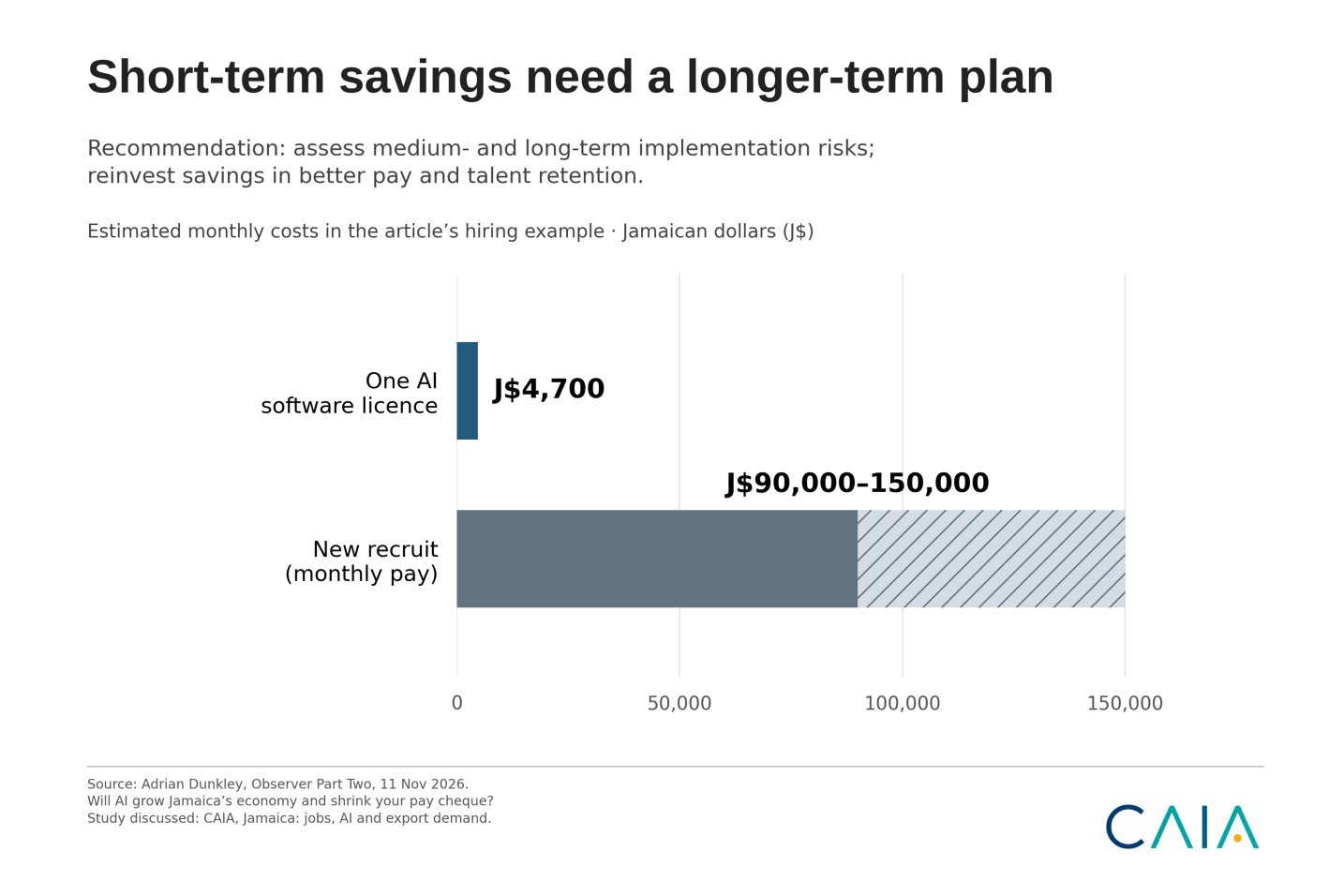
Look at the math facing a Jamaican business owner. You can buy an AI software licence for $4,700 a month and hand it to an existing employee, or you can hire a new recruit at $90,000 to $150,000 a month.
Many bosses will take the $4,700 shortcut, raise their senior worker’s workload, and cancel the vacancy. Hiring a new recruit costs 19 to 32 times more upfront than an AI licence, so the cash saving is instant. The hidden tax, including indirect and medium- to long-term costs, comes later.
Software works around the clock and never needs coaching, which makes a boss impatient with a trainee’s learning curve. Yet a J$4,700 licence does not give your senior clerk a 30-hour day. That employee still has to check every AI output and carry the blame when the machine invents a number. Overworking your best people while locking out fresh recruits hollows out your company’s future, and leaves every worker with less say over wages.
Make the work make sense
Training someone to do an obsolete process faster will not save their job. Whether you run a business or work in one, here is how to make AI work without breaking your team:
Kill the zombie paperwork first: Before automating a report, ask who reads it and what decision it changes. Free up your staff to solve tough customer problems or win back lost accounts instead of generating faster clutter.
Pilot one workflow with the frontline: Pick a single process and include the people who actually do the work. Measure time, cost, and errors first. Decide which decisions must stay with a human, run the trial, and count the time spent checking the AI’s mistakes before assuming you need fewer staff.
Audit your own week (for workers): Write down everything you do from Monday to Friday and highlight the tasks that rely on judgment, relationships, or local business knowledge. Ask to join an AI trial at work to help shape your role around better outcomes, and insist on paid learning time. Workers should not fund a company’s transition through unpaid overtime.
Small but tallawah
We already see what our young people can do when given the tools. Teenagers in Jamaica are using AI right now to build software and reproduce in a single week the technical work that used to take large companies months.
What those teenagers lack is not talent; it is work opportunities and guidance. Building a tool on a laptop is one thing; serving clients, managing expectations, and taking responsibility when a system fails takes real-world mentorship.
When we pair that raw youth energy with seasoned guidance, the opening for Jamaica is huge. Today, a local entrepreneur, or an “intrapreneur” building a new line inside an established firm, can use a small team and AI software to compete directly with legacy giants. Many overseas buyers will gladly trade a bit of polish for a service that is faster and cheaper. A sharp five-person firm in Kingston or Mandeville can now win export work that once required 50 staff and deep capital, provided our people have the internet access, equipment, and practical training to compete.
Teach the next person the ropes
If a business cuts out junior staff today to save on payroll, who will have the experience to supervise its systems, spot a quiet calculation error, or handle a crisis five years from now?
Protecting the route from newcomer to expert must be part of the plan:
Pair juniors with veterans: Have newer staff check AI outputs and explain why a decision makes sense, while senior staff teach the unwritten rules and exceptions that no manual covers.
Give older workers time to adapt: Back experienced staff with practical coaching so their hard-won knowledge stays in the business.
Run the “blackout test”: Regularly check whether your team can still diagnose a failure and serve customers when the AI tool is wrong or offline.
Jamaica’s real prize is building businesses that keep more income and ownership right here. We should judge our success with AI by both the output our companies produce and the doors they open: First jobs, paid learning, and a clear path from school-leaver to seasoned professional.
Adrian Dunkley is president of the Caribbean AI Association and founder of StarApple AI. He designed and teaches the AI Officer Programme, which covers AI fluency, business strategy, project design and risk.


