



Sagicor: Turning jobs into careers
This is the first of 10 nominees for the Gordon “Butch” Stewart Business Leader Award to be featured by the Jamaica Observer. The other nine stories will follow over the coming days. The Business Leader Award presentation will take place on Sunday, December 13 at AC Kingston Hotel on Lady Musgrave Road, beginning at 4:30 pm. Ten companies are vying for the award which is being held under the theme, ‘Business Leader: Employer of Choice’.
IF you turn the spotlight on Sagicor Jamaica’s industrial relations practices, you will find an organisation brimming with confidence, its executives leaving no room for self-doubt when marking their own employer of choice scorecard.
“Sagicor Group Jamaica is a place where people build careers, not just jobs,” they aver without the faintest hint of hesitancy.
The written responses of the executives to questions seeking to pull back the curtain on the company’s work environment are suffuse with self-assured nods to their own sense of industrial relations elitism.
Yet, in all fairness, this institutional bravado is not entirely unexpected from a company that has, over many decades, built the reputation of being a magnet to some of the brightest minds within the financial sector.
Christopher Zacca, a Massachusetts Institute of Technology maths graduate, is the poster child for the high-level talent that the insurance-led group regularly attracts and retains. For the past nine years he has been the chief executive officer.
“One of my priorities has been building a culture in which our team members feel valued, supported, and able to grow,” Zacca says in explaining why, in his judgment, employees find Sagicor a “place where people build careers” — as expressed so unabashedly by his organisation.
“We have invested significantly in leadership and professional development,” he continues, “strengthened succession planning at all levels and created more opportunities for team members to gain experience across different areas of the business.”
If Sagicor is indeed a place of endless possibilities, where careers can take root and blossom at scale, this is, in part, an artifact of the sheer breadth and depth of its organisational architecture.
Zacca is aware of this.
“First, there is the breadth of opportunity,” he points out. “Sagicor is a diversified financial services group, so our team members can build careers across insurance, banking, investments, asset management, technology, finance, risk, and many other areas. We have many examples of people who joined Sagicor in one capacity and, through development and exposure to different areas of the business, have gone on to build long and successful careers with us.”
To belabour the obvious, Zacca’s assertion ultimately faces the verdict of the jury that matters most: the over 3,000 folks who show up to their workplace each day, and who in effect get to stress test management’s perception of the quality working conditions they provide to the employees.
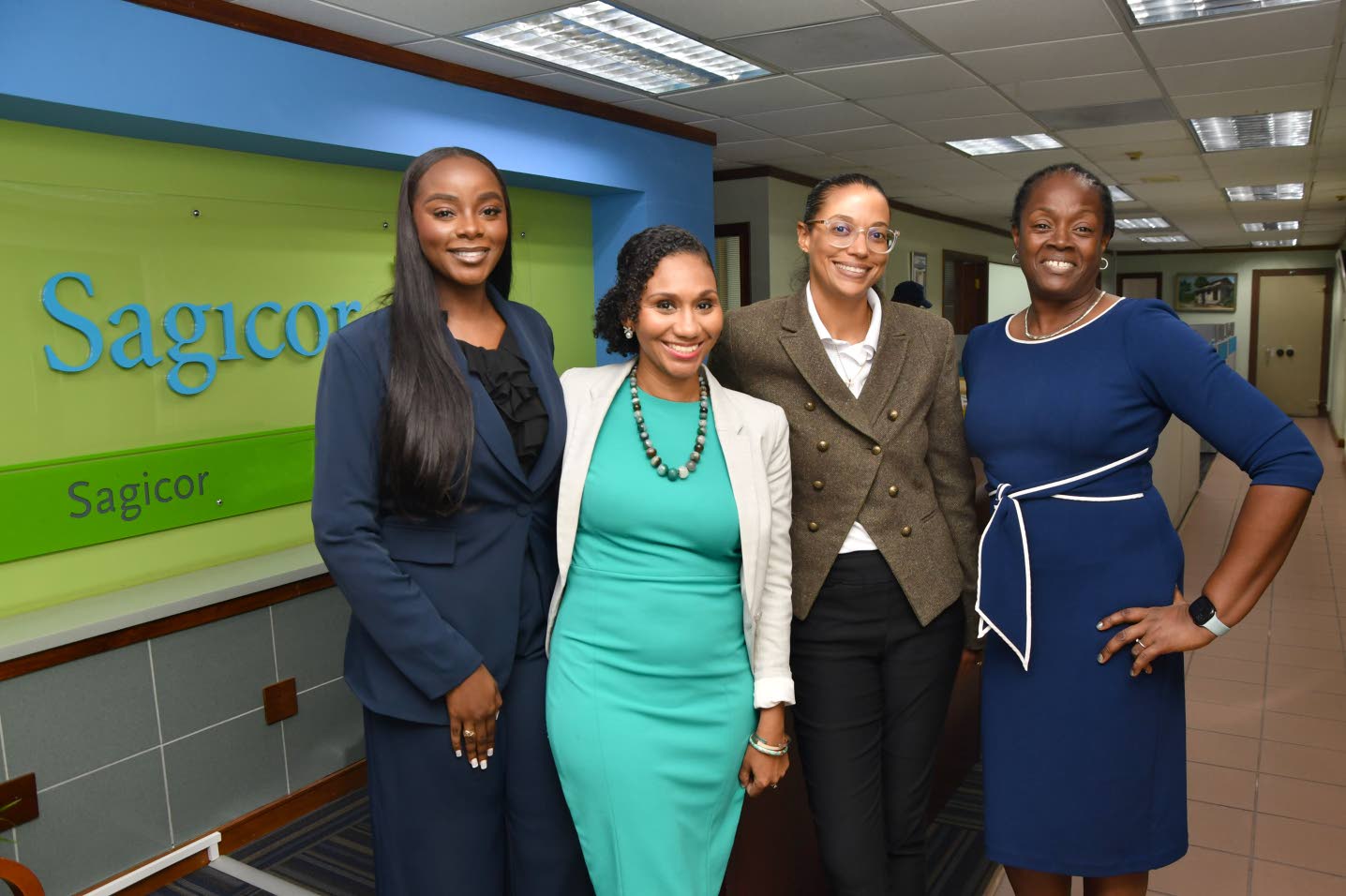
Joanna Banks (second right), who was recruited directly into her current position of executive vice-president, strategy and business development and chief technology officer, says that once she landed the job at Sagicor, her growth and exposure accelerated. With her are (from left) Abigail Davis, manager, corporate strategy and financial analysis, Sagicor Group Jamaica; Jodi-Kaye Ennis, vice-president, transformation, Sagicor Group Jamaica; and Chorvelle Johnson Cunningham, CEO, Sagicor Bank Jamaica. (Photo: Naphtali Junior)
The company has at hand a whole raft of data that serve as proxy measurement for the health of the working environment — from the average tenure of its managers and line staff, the rate of promotions, compensation levels, to the internal infrastructure that is in place to promote staff engagement, welfare, meritocracy in hiring and promotion, dispute resolution and so on.
But first, some mundane data points.
There are 851 clerical/administrative workers at Sagicor. There are 1,309 in the broad category of supervisors, professional technical and all the way up to assistant manager, while 275 individuals occupy the higher-level category called managers; they sit just beneath the level of the vice-presidency that has 30 occupants. The numbers shrink dramatically as the workforce ascends the organisation’s pyramid-shape chart. So, 27 vice-presidents, 12 senior vice-presidents, an executive vice-president and the group president and chief executive officer constitute the upper echelons of the company.
As the CEO, Zacca is the sole full-time employee to occupy a seat on the firm’s 15-member main board. His tenure succeeded that of Richard Byles who, as Sagicor’s boss in 2017, was named Jamaica Observer Business Leader of the Year (now Gordon “Butch” Stewart Business Leader) for his outstanding performance as a corporate fiduciary. Byles retired shortly thereafter and was appointed governor of the Bank of Jamaica from where he also retired earlier this year.
Sagicor Group’s nomination for the Gordon “Butch” Stewart Business Leader Award differs from that of Byles’; he was nominated in his personal capacity, not as a corporate body as is the case now with Sagicor. This year, Sagicor is among 10 institutions that are competing for the award, under the theme, ‘Business Leader: Employer of Choice’.
In making the case for his company’s candidacy, Zacca leans heavily into the work he and his senior management team have undertaken to create frictionless upward pathways for employees, especially at the middle to upper levels of the organisation.
“We place significant emphasis on learning and development,” he stresses. “We invest in technical training, professional development, and leadership programmes such as Sagicor LEAD, which is helping us to develop the next generation of leaders from within the organisation. We encourage innovation as well, giving team members opportunities to challenge how we do things, develop new ideas, and contribute beyond the boundaries of their individual roles.”
Lorna Bond is one employee who swears by Sagicor’s worker-friendly ethos. She enjoys the unique vantage point of deep institutional memory; by any reasonable measure, hers is the voice of authority on the issues at hand.
“Sagicor Group Jamaica maintains a strong commitment to meritocracy and fairness,” declares Bond, whose 44-year tenure places her at the extreme end of the normal curve for years of service at this organisation. It also means that this is the place where she has spent her entire working life.
An important context to Bond’s longevity is that she joined Life of Jamaica (LoJ), Sagicor’s predecessor, in 1982, only 12 years after the company was founded by Denis Lalor, R Danny Williams — both of whom have died — and Adrian Foreman. She was a fresh University of Technology, Jamaica graduate and was engaged as an entry-level employee in accounts. In her almost half-a-century run at Sagicor, Bond has outlasted not only the three founders, but all the CEOs — except for Zacca — who have served the organisation.
Now, the assistant vice-president attributes her achievements at the company to her personal adherence to strong ethical guidelines, and the system and culture of meritocracy in place at Sagicor.

Christopher Zacca (right), president and CEO of Sagicor Group Jamaica, meeting with some of his senior executives (from left, clockwise) Chorvelle Johnson Cunningham, CEO, Sagicor Bank Jamaica; Willard Brown, CEO, Sagicor Life Jamaica; Jodi-Kaye Ennis, vice-president, transformation, Sagicor Group Jamaica; Abigail Davis, manager, corporate strategy and financial analysis, Sagicor Group Jamaica; Tracy-Ann Spence, executive vice-president and chief investment officer, Sagicor Group Jamaica; and Joanna Banks, executive vice-president, strategy and business development and chief technology officer, Sagicor Group Jamaica, on Thursday, November 19, 2026. (Photo: Naphtali Junior)
“Promotion and advancement are tied to performance and impact, and leadership communicates its decisions and promotes a strong culture of high performance,” Bond stresses.
“Sagicor has given me and my colleagues the opportunity to grow, to build meaningful careers and to be part of something larger than ourselves,” she adds. “I have always felt that the company values its people and invests in them, and that is a big reason I have stayed and continue to be proud of the work we do.”
If Zacca’s assertion of creating or at least striving to create a work environment in which employees can thrive is to stand on the testimony of a single employee, there can be no more credible advocate than a 44-year veteran of the organisation.
“I would strongly recommend Sagicor as an employer of choice for anyone looking to grow their career through their own hard work,” she declares, borrowing from the very phrase that encapsulates the theme of the Business Leader Award programme. “Only retirement,” she adds, “would take me away from Sagicor.”
On average, senior staffers spend 13 years at Sagicor, a tenure that the company describes as above what generally obtains across the industry, and a stat the executives believe reflects the success of the programmes they have in place at Sagicor to promote from within.
“Promoting from within is central to how we build leadership. For three years running our team members have filled more than four in 10 of our managerial vacancies.”
Here is how the company explains the process: “We use our eight-tier structure, mentorship, and investment in training to give team members a clear path from their first role into management. It is also one reason our managers stay with us for an average of 13 years… the consistency with which the company can achieve these high rates of internal job promotion reflects a deliberate focus on growing our own leaders.”
There are many other managers whose stories validate, if not replicate, the experience that Bond has had with Sagicor.
One good example is Willard Brown, the CEO of Sagicor Life Jamaica and head of insurance. While he can’t match Bond’s tenure at the company, his experience with moving up the corporate ladder is not dissimilar.
Brown joined Sagicor as a computer programmer while completing his actuarial studies. A transfer to the actuarial department where he was later promoted to manager was followed by “a series of other promotions” that ultimately landed him the senior executive role as CEO of Sagicor Life.
“I believe that Sagicor does a good job of recognition and promotion of internal staff in a fairly balanced and transparent manner,” says Brown. “We tend to try to fill roles via internal promotion to encourage the staff to pursue self-development.”
An example of an executive who charted a completely different path that landed her close to the very pinnacle of the company is Joanna Banks. Three years ago, Banks was recruited directly into her current position of executive vice-president for strategy and business development.
Banks says that once she landed the job at Sagicor, her growth and exposure accelerated.
“I have the opportunity to work across multiple businesses and functions and on some of the most important strategic and transformational initiatives underway across Sagicor,” she says. “That breadth of experience has been extremely valuable. It has given me a unique and holistic view of the business, allowed me to develop relationships across the organisation and the wider region, and stretched me professionally in ways that I do not think a more narrowly defined role would have. I view my own experience at Sagicor as one of considerable professional growth, even though that growth has not been through formal promotion.”
Banks, Brown, and Bond are by no means the only managers who are very bullish on Sagicor’s claim as an employer of choice. Tracy Ann Spencer, the head of investments and capital market for the Caribbean; Abigail Davis, manager for corporate strategy and financial analyst; and Jodi-Kaye Ennis, the vice-president of corporate strategy, all shared their experiences with the Business Leader Award project and spoke with one voice.
“The breadth and scope of my responsibilities have expanded significantly … most recently being given a Caribbean-wide mandate,” notes Spencer. “There is genuine opportunity for people who perform, demonstrate leadership, and are prepared to take on greater responsibility. Employees can build meaningful careers here, whether through promotion, expanded mandates, new assignments, or exposure to different areas of the organisation.”
Davis joined Sagicor in 2019 as a group treasury operations associate on a one-year contract. She signed on to a full-time contract in 2021 and has not looked back since.
She was promoted three times to reach her current position.
“What makes this progression meaningful to me is that it has never been only about title,” she explains. “It has been about scope, exposure, and trust… Today my work includes major strategic transactions, capital markets work, multi-jurisdictional regulatory engagement, and analyses that have regional implications. My advancement has come from problem-solving, bringing solutions to business, and market challenges, continuing my studies, staying agile, and taking chances on myself.”
Ennis, too, didn’t begin her journey with Sagicor in her current post as a vice-president; she began as a manager and gradually worked her way two rungs up the ladder.
“I was fortunate to have supervisors who believed in me, advocated for me, and were prepared to have the right conversations on my behalf, sometimes even when I did not fully see my own potential,” says Ennis, in sharing slices of her experiences.
“I have seen colleagues compete for roles through processes that I considered transparent and fair,” she continues. “Individuals may not always agree with the process or outcome, but that does not necessarily mean the process was unfair. My own experience was somewhat different, as I did not apply for my promotions; they came as my scope, responsibilities, and contribution grew over time.”
— Moses Jackson is chairman of the Gordon “Butch” Stewart Business Leader Award Selection Committee


