



JPS: Obsessed with safety, training
This is the fifth of 11 nominees for the Gordon “Butch” Stewart Business Leader Award to be featured by the Jamaica Observer. The other six stories will follow over the coming days. The Business Leader Award presentation will take place on Sunday, December 13 at AC Hotel Kingston on Lady Musgrave Road, beginning at 4:30 pm. Eleven companies are vying for the award, which is being held under the theme ‘Business Leader: Employer of Choice’.
Jamaica Public Service Company (JPS) is the dominant player in one of the most thankless industries within any modern society.
The electricity it manufactures and distributes is entirely invisible and remains well outside the daily consciousness of even those who heavily rely on it for their livelihood.
This unusual feature regularly puts the light and power provider on a paradoxical collision course with its customer base. This is because the service becomes visible to customers only when it is temporarily absent from their homes, workplaces, and lives. When this happens, the public’s ire is directed at JPS, not as a good faith but imperfect provider of electricity, but as a malicious and unreliable actor.
The uncomfortable fact is that JPS’s 600,000-plus customers
— households and corporate
— are rarely exercised by the unfathomable technical and operational complexity involved in maintaining reliable electricity supply to their homes and business places or by the nature of the workforce and scale of capital commitment that is required to get the job done.
To guarantee stable and reliable energy supply to Jamaicans, JPS attracts and maintains one of the highest concentrations of engineers that can be found in any company across the island. This group
— nearly 300
— is supported by dozens of highly trained technicians that make up the core of the company’s 1,300-strong workforce.
By its own account, JPS works assiduously to retain the cadre of talent that can help it meet the high demand of keeping the country’s industrial wheels turning.

JPS President and CEO Hugh Grant (left) in discussion with Chief Financial Officer Vernon Dougas (centre) and Senior Vice-President, Shared Services Rick Case. (Photo: Joseph Wellington)
The company’s internal data suggest that the strategies and programmes that are in place to achieve this mission are working; it is holding on to its pool of talent at rates that would be the envy of its peers across the region and beyond.
So the 200 managers and senior managers who form the spine of the organisation’s middle leadership, on average, spend 17 years on the job, well above the international industry mean of six years.
“This reflects a culture where people choose to build their careers with us,” JPS declares in written response to questions posed by the Business Leader Award project seeking to deepen our understanding of the firm’s industrial relations practices. “Tenure across our leadership ranges from new appointments in the past year to colleagues with over 43 years’ service,” the company continues, “a balance that combines deep institutional knowledge with fresh perspectives. We support this through leadership development programmes and succession planning.”
In August 2024, JPS appointed a new president and chief executive officer. Hugh Grant is a Jamaican who returned home to take up the top job after more than two decades of engineering and executive roles at Consolidated Edison Company in New York. He brought with him an unshakable mindset that prioritises workplace safety.
Grant immediately set about turbocharging the culture of workplace safety that already existed at the organisation and identified a core leadership team that could help translate his vision into policies, programmes, and action.
“A key area of focus for me has, therefore, been the building and reinforcement of a stronger safety culture,” he says. “I have collaborated with the unions to make safety our North Star.”
To help him execute his safety-first philosophy, the CEO made a series of internal promotions
— empowering experienced and competent individuals to drive his vision.
“I have also been very intentional in engaging our internal stakeholders, including the unions,” he adds. “A starting point for me was creating alignment around the safety and the well-being of employees. We deal with an unforgiving commodity. Contact with electricity can be life-changing, so one of the biggest gifts we can give to our employees is to have them go home safely at the end of each work shift.”
Among the specific measures that the CEO put in place were:
• the production of video safety messages for staff,
• facilitating union participation in executive safety meetings, and
• incorporating their feedback in the implementation of initiatives to improve safety awareness and compliance across the organisation.
About 70 per cent of JPS’s employees are represented by four unions, making the union voice an indispensable component of the industrial relations climate at the organisation.
Grant says he values the partnership with the unions and incorporates their ideas into decision-making.
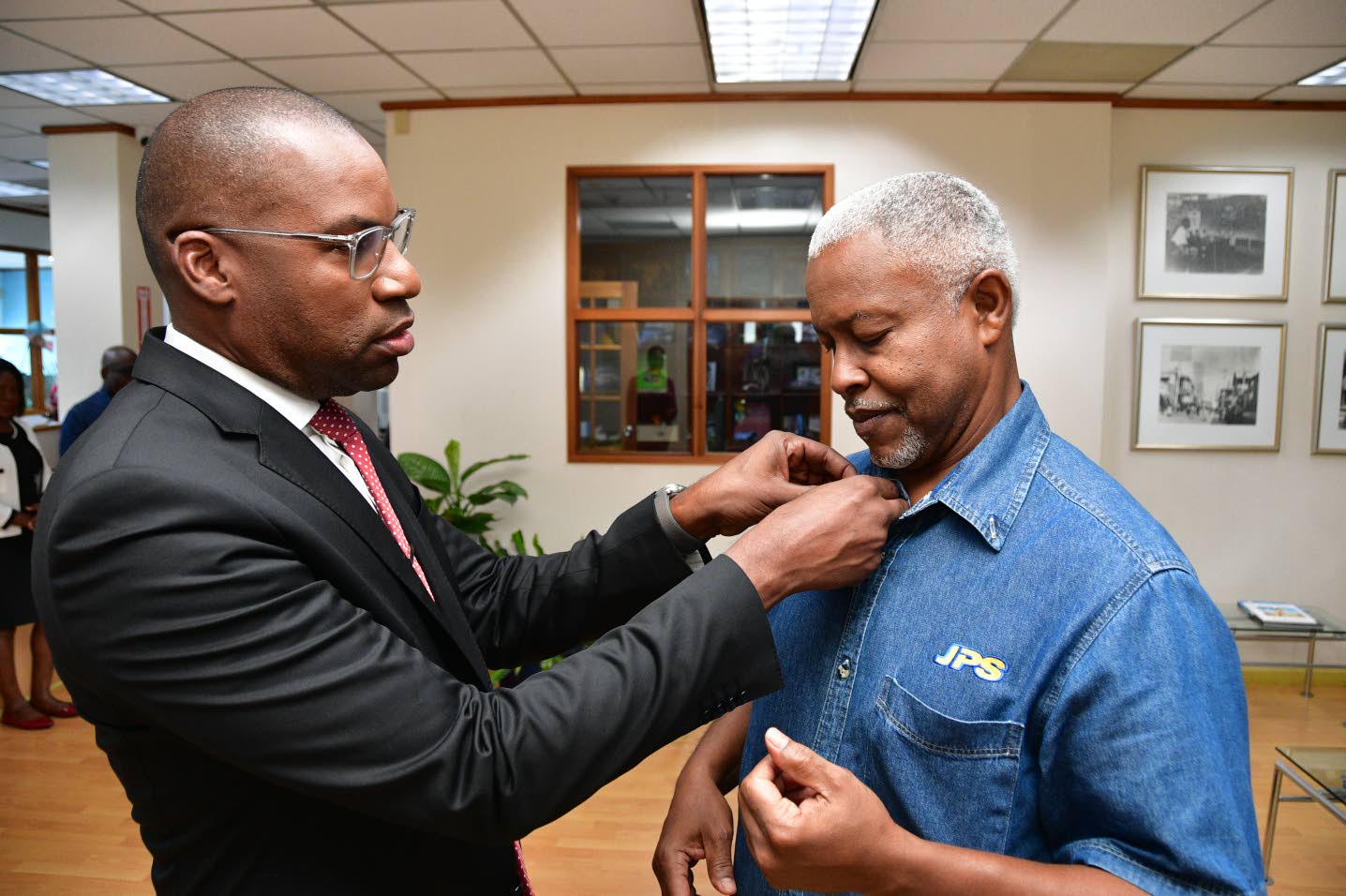
JPS President and CEO Hugh Grant (left) with Acting Senior Vice-President, Stakeholder Relations Samuel Davis.
“Most significantly, as a leadership team, we have taken on board the unions’ suggestion for a peer safety observer programme,” he says.
This includes colleagues observing one another at work and providing feedback for improvement.
As someone who has had significant experience not only in the executive office, but in the field, Grant has not been afraid to lead from the front.
“I have also maintained a strong presence in the field, which provides me with the opportunity to interact with team members outside a formal meeting setting,” he explains. “Employees really appreciate this and use these occasions to share feedback on the operations and offer suggestions for improvement.”
Hand in hand with the obsessive attention to safety is the company’s programme of continuous education and training, the end result of which is an organisation that the CEO now believes is “probably the most diverse and dynamic training environment in Jamaica”.
Between 2022 and 2026, JPS spent $116.3 million on skills training and to support the education pursuit of members of staff.
“We take pride in developing our team members,” says Grant. “Over the last five years we invested over $110 million in staff training and development. We also partner with one of our shareholders, Korea East West Power (EWP), on an exchange programme that allows our employees to go to Korea to be exposed to best-in-class technology in a range of areas, including clean energy, power generation, and system protection. They spend one to three months in Korea and return with experience and expertise that are passed on to other team members and integrated in the operations as we work towards operational excellence.”

JPS President and CEO Hugh Grant (third left) engaged in a power discussion with (from left) Melisha Higgins, customer relations; Shenell Lowe, customer relations; Deon Aarons, finance; Carolyn Parchment, people pperations ; and Ramon Lewis, marketing.
Korea East West Power of South Korea and Marubeni Corporation of Japan each own 40 per cent of JPS. The Government of Jamaica has a 19.9 per cent stake in the company.
The CEO makes the case that JPS is regarded as a regional leader in energy by its peers across the Caribbean, a reputation that no doubt would have been enhanced by the launch of the JPS Centre of Excellence in 2024. This centre offers training to other utilities across the region.
“So far, we have had persons from about 12 Caribbean countries coming here to Jamaica for training at the JPS Centre of Excellence,” he lets on. “Through the centre, we also expose lecturers and students of The University of West Indies and the University of Technology, [Jamaica] to trends in energy and give them hands-on training in emerging technologies and core utility operational areas.”
The resource that the light and power company is committing to building competence and expertise within its workforce has not been without industrial relations reward. Some of the employees have become the loudest and most diligent advocates for this company as a caring employer.
You can count among them Ruthlyn Johnson, a customer service area manager for the eastern section of the island.
Johnson’s first job at JPS was a communications officer. She then meandered her way across the organisation and eventually up the ladder
— moving from communications manager to quality control manager, before assuming her current position as customer service area manager.
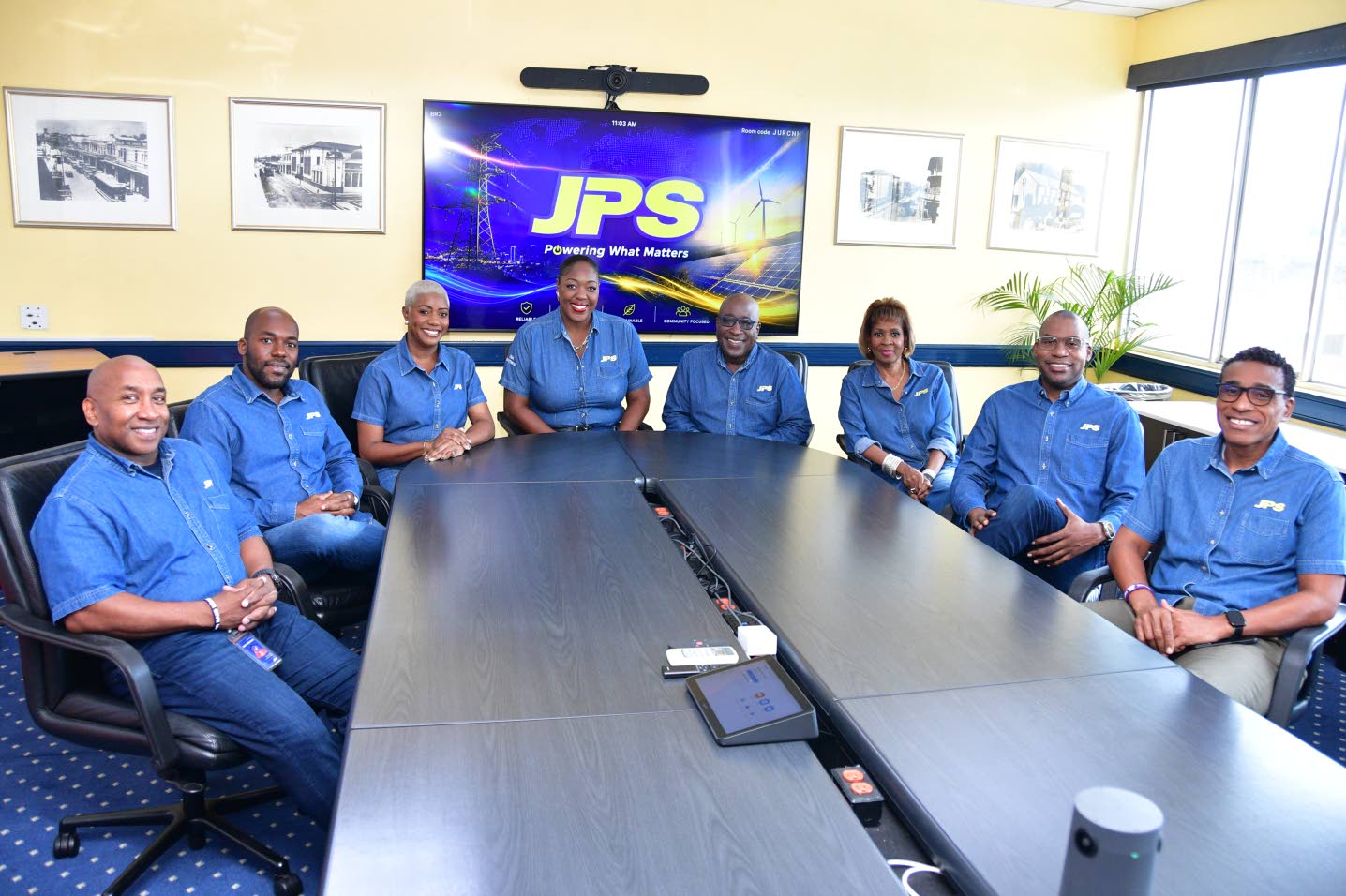
JPS executives clad in blue denim with the company logo and name (from left) Chief Operating Officer Lance Becca; Vice-President Power Generation Sameer Simms; Senior Vice-President Customer Experience & Commercial Pia Baker; Senior Vice-President, Legal Counsel and Company Secretary Melanie Gilchrist; Senior Vice-President, Energy Delivery Blaine Jarrett; Senior Vice-President, People Operations Charmaine Heslop-Decosta; President and CEO Hugh Grant; and Senior Vice-President, Shared Services Rick Case. Missing from this photo are Acting Vice-President Stakeholder Relations Samuel Davis; and Chief Operating Officer Vernon Douglas. (Photo: Joseph Wellington)
“This journey reflects the organisation’s confidence in my abilities and recognition of the value that effective communication brings to business success,” she says. “My move into customer service was based on the vision that I could use those skills to positively influence customer interactions and outcomes.”
As an organisation with a high technical-based workforce, it is not surprising that meritocracy in both hiring and internal promotion would be a strong feature of JPS’s corporate culture.
And it is.
“Meritocracy is a strong feature of the company,” declares Johnson. “However, as with any organisation of this size, it is more evident in some areas than in others,” she adds. “I have seen numerous employees join the organisation in entry-level roles and progress to senior leadership positions. The company offers many opportunities for growth and development, creating an environment where individuals can build meaningful and rewarding careers based on their performance, skills, and commitment.”
On average, the JPS non-executive staff earn $7.9 million per year. Part of this emolument is generated from a performance incentive scheme that the company established for three subsets of employees covering 24 per cent of its workforce. The incentives are linked to the firm’s overall performance, individual objectives, and to a range of safety and reliability measures.
“We are committed to extending productivity incentives to all employees, and work is in progress to make this happen” the company says.
Johnson claims that within the wider marketplace, JPS enjoys the auspicious reputation of being among the best-paying employers in Jamaica.

The lady with a smile that could power JPS, Marcia Brown-Elliott, executive assistant.
“Interestingly, even among those who may criticise the company or express concerns about its services, there remains a strong desire to work here,” she asserts. “Many continue to apply for positions because they recognise the opportunities for professional growth, competitive remuneration, and long-term career development that the organisation offers.”
Sharmica Holness, key account executive, and Annmarie Myrie-Chambers, manager of customer service performance and analytics, share a similar career growth trajectory at JPS, both having joined the organisation at entry level positions.
Holness’s first job in October 2013 was as a sales representative for the then energy solutions division, called the eStore. She says that her steadfast dedication, “high performance, and a commitment to delivering exceptional results” landed her a promotion to a customer service post in October 2014. After two years in that role, she was promoted to her current job.
“My career progression within the company demonstrates that upward mobility can be achieved through performance, initiative, and willingness to embrace new challenges,” says Holness. “The transition from sales rep to customer service agent to now being a key account executive has led to the expansion of my leadership capabilities, thorough understanding of sales execution, customer relationship management, and stakeholder engagement coupled with sound knowledge of JPS’s core business. The people operations and HR [human resource] teams at JPS must be commended for recognising talent, investing in their people, and creating opportunities for growth and success.”
Myrie-Chambers, on the other hand, started her journey at the light and power firm in 2001 as a customer relations representative.
“When I look back, a lot of my growth started with a simple interest in learning how to do something beyond the job I was hired to do,” she says, adding that JPS’s employees are rewarded for hard work.
Like Johnson, Holness describes her pay package as reasonable, but cautions that she lacks the necessary information to determine if the company was, in fact, doing the best it could in its reward to employees.

The vivacious Maxine Faulkner, executive assistant to JPS President and CEO Hugh Grant.
“I believe my remuneration is reasonable, but I’m not in a position to say it’s the best JPS can afford or to speak for every employee,” she says. “JPS is strongly unionised, and collective bargaining gives employees a voice in decisions about their pay.”
Holness points to the current labour agreement which, she says, ends on November 30, adding that negotiations are already underway.
She issued a veiled word of caution to JPS, putting the company on notice about some of the key considerations that could shape the wage package negotiations.
“The rising cost of living is a real concern for employees,” she warns, “and the company also has to consider what it can sustain. I’m confident that JPS and the union can once again reach a fair agreement that takes both into account.”
Veshawn Burnett has been on a fast track up the ladder at JPS. He rose through the ranks to become a specialist engineer, but for the past two months has been acting as the director of generation operations planning and performance.
By all accounts, Burnett is a standout employee. He was named employee of the year (top performer) in his department in 2017, 2018, and 2022-2024. He was also named overall employee of the year in power generation in 2019 and 2022, and has been selected on numerous occasions to represent JPS locally and internationally.
These company-wide accolades and recognitions are among the four-recognition programmes in JPS’s toolkit for building staff morale and rewarding high performance.

Gina Williams, director organisational development and change, and Milton Oliver, technical training officer, power generation in a planning session.
“I’m grateful for the trust and opportunities I’ve received, and proud to work at JPS and contribute to Jamaica,” says Burnett.
The experience of Marsha-Gay Wallace, people operations advisor, provides another window into the breadth and depth of the industrial relations climate at this organisation. Wallace has been with the company for seven years without formally moving up the corporate ladder.
But she herself is quick to point out that the absence of vertical movement does not necessarily mean the lack of progress or absence of career development.
“While I have remained at the same level, my responsibilities have grown considerably over the years,” she argues. “My role has expanded to include responsibility for the company’s engineering and information technology internship programme, and my title was changed to people operations advisor to reflect the wider scope of my responsibilities.”
Wallace also stressed that she has experienced significant job satisfaction with aspects of her role.
“One of the most rewarding aspects of my role is also being able to contribute to the development of others,” she notes. “Through the internship programme, approximately 85 per cent of participants have been successfully placed in roles at JPS. For me, growth is not just about how far I can go personally, but also about helping others get their start.”
Moses Jackson is chairman of the Gordon “Butch” Stewart Business Leader Award Selection Committee.


