


IWD 2026: Lexan Blair on line work and restoration at JPS
WHEN Lexan Blair reported for duty at JPS in 2024, her first shift was defined by urgency. She joined just after Hurricane Beryl, as part of the St James operation, as a Lineman 3, and was determined to hit the ground running’.
“That was my first day on the job, right after the hurricane,” she recalls. Today, as a linesperson, she works in a field many still label male-dominated, yet at JPS, she describes a different reality — one where she feels empowered because roles are assigned by competence, not gender. Women are held to the same standards, trusted to deliver, and expected to meet targets with the same accountability.
Blair describes her role simply: “It’s the outside part of the job — climbing poles, splicing conductors, digging pole holes, patrolling when there’s a hazard, and managing outages.” Her department, she adds, is maintenance — the team responsible for keeping the grid reliable through scheduled work while staying alert for whatever arises in between.
A normal day begins with a safety meeting, followed by task assignments. But line work does not always adhere to schedules.
“That task can change the moment an emergency comes in, like if a car damages a pole,” she explains. They gather materials, head out, confirm their work location, and complete the job.
She also stated that there is no guarantee of an early finish. Some days are routine; others run late into the night. And the part the public rarely sees, she says, is the time – “The early mornings and the late nights. Sometimes you have to work through your lunch break just to get something done. Sometimes you have a working lunch. The time sacrificed and the hours nobody sees — that’s what I’d want people to understand.”
Blair chose this path deliberately. While studying electrical installation at HEART, her teacher shared a flyer about the JPS Lineman Apprenticeship Programme with her cohort, and she was immediately intrigued. “I said, all right, I’ll apply,” she remembers. She was already applying elsewhere, but JPS called her in. “I did the interview, went through the training, and then got started on the job.”
When asked about stepping into a male-dominated field, Blair does not frame her experience as a battle. She frames it as discipline and performance. “I’m kind of an overachiever and a perfectionist. I like things done a particular way. I like things neat,” she says.
She credits her St James crew for backing her from the start, and says that support has remained consistent. “Sometimes I tell them, don’t bother with the ‘girly treatment’,” she adds with a laugh. Support is always welcome. Being treated as fragile is not.
Her drive is both personal and professional. As the eldest of three, with two younger brothers watching, she recognises she has a responsibility to set a higher standard so they can follow her lead. On hard days, she reminds herself: “I have to be a good example, and that motivates me to stay on the right track.”
During her almost two years with JPS, Blair has covered St Elizabeth (where she grew up), Westmoreland, St Ann, and Hanover. Terrain and weather are not minor; they determine pace and risk — heat that wears you down, bush and rocks that slow movement, gullies, and flooded areas where, she says, “your shoes go under water”. One skill she is especially grateful to have mastered is “observation” — the ability to spot faults and notice the details that keep the work safe and effective.
During Hurricane Melissa, those skills were put to the test.
Blair was on standby at work as the hurricane approached. The team waited for the all-clear, as safety is the first rule. When the storm passed, workers checked their homes where possible. Blair’s damage was not structural, though water had entered. Others were not as fortunate. “Some of my co-workers lost their roofs,” she says.
For her, the emotional weight came when she stepped outside and saw what Melissa had done. “All the poles were on the ground. Everything was just down,” she recalls. “Nobody expected this level of damage. It was overwhelming.”
Restoration began with patrols — assessing damage, identifying what each section needed, and ordering the materials required to get the job done. Priorities were clear: “Critical infrastructure first – hospitals, NWC pumps, and other crucial sites.” “You can’t have a hospital without power. People need water,” she says. The hardest part was the sustained grind: “Starting at six in the morning and leaving at midnight, one, two o’clock the next morning.” Flooding complicated everything. “Trying to set a pole in and encountering water was not a funny thing. It made everything more tedious.”
Still, there were moments that cut through exhaustion and kept her going. Blair remembers how she and her team pushed to restore major corridors in St James while communities watched and waited. People kept asking the crew for updates, wondering whether that night would be the one they got light, and she would reassure them: “We’re working on it.” When power returned, the response was immediate and encouraging — “the uproar, the clapping, and the thank you.”
Amid that pressure, safety is non-negotiable. When asked what she will never compromise, she answers without hesitation: “Your PPE. We don’t play with that.” Gloves, boots, helmet, uniform, glasses — tinted for day, clear for night. “You do not remove PPE at any point, under any circumstances.”
She also describes the systems that protect them – pole chokers, bucket-truck lanyards, and the crew ethic: “You have to be your brother’s keeper”.
Being a woman in this role attracts mostly positive attention. “People usually stop to watch. There are people who will stand there just to see me climb a pole,” Blair says. When asked what the job has done for her confidence, she responds with motivation: “It feels great that I can do what they do. I’m happy that I’m doing something I really love. It has given me stability.”
Her message to young women is equally inspirational. “Go after it. Don’t let anybody hold you back. If this is something that you want to do, anything you want to do in life, you can do it, so try it.”
Ten years ago, she says, she would not have imagined herself here. “I wouldn’t have thought that 10 years ago I would be in this job right now, but I’m here, and I’m grateful.”
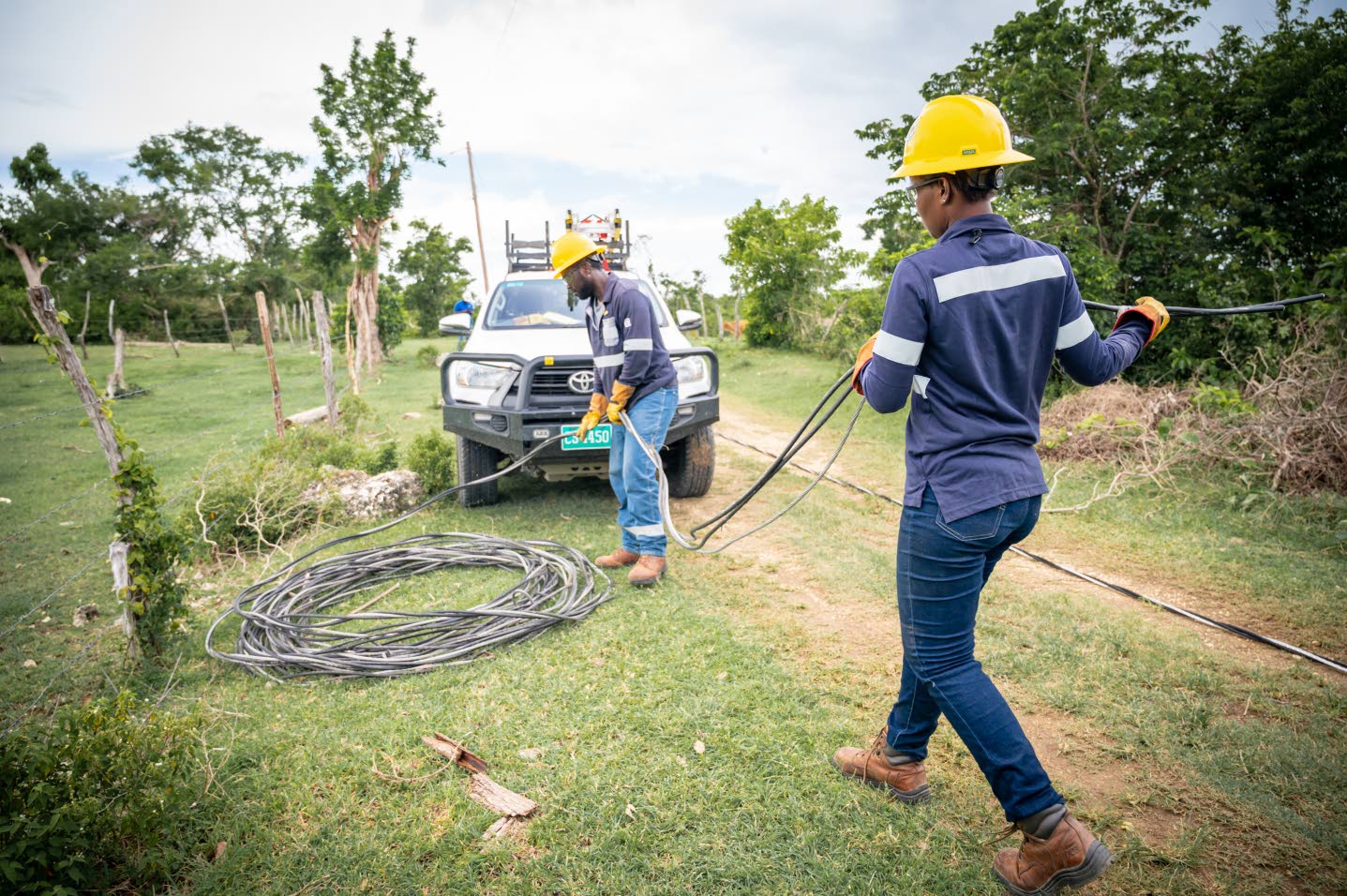
Lexan Blair, Lineman 3 at JPS, caught in action..

