Damage report
Parliamentary committee wants hurricane destruction details from key agencies
The Infrastructure and Physical Development Committee of Parliament has agreed to summon a wide range of agencies as early as next week to gather information on the extent of the damage caused by Hurricane Melissa.
Meeting at Gordon House on Wednesday, members of the committee began what they described as a crucial phase in charting Jamaica’s recovery. The discussions centred on accountability, coordination, and the urgent need to strengthen oversight of reconstruction efforts.
Chairman Heroy Clarke outlined that the committee would invite several key entities — including the National Works Agency (NWA), National Water Commission (NWC), Jamaica Public Service Company (JPS), Flow, Digicel, the Port Authority, and local municipal corporations — to give updates on their respective areas of responsibility.
“We are within right to bring these agencies to bear and to get an understanding of what we really want,” Clarke told members, citing Standing Order 73c, which empowers the committee to examine Government policies, receive submissions from citizens, and facilitate dialogue with ministries and public bodies.
He added that the meetings would include the Rural Agricultural Development Authority, while representatives of municipal corporations would be asked to speak to road and bridges under their portfolio, while NWA and NWC have the responsibility for the major roads that were impacted.
Member of Parliament (MP) for Clarendon Central Delroy Williams urged the committee to widen its lens beyond headline figures and take particular note of damage to parish and rural roads — infrastructure that, he warned, underpins everyday life for many communities.
“You really want to get a big picture of what has happened… with respect to your road network and your road infrastructure and they [the local municipal corporations] currently have responsibility for a significant percentage of our road network which are primarily parochial community roadways which would impact community lives in a major way. So I think it would be fruitful to have them here,” Williams told colleagues as he argued that impaired local roads would have a knock-on effect on markets, schools, and emergency access.
Meanwhile, St Thomas Western MP James Robertson told the committee that the Government must approach the rebuilding process with discipline and transparency.
“Good policy and implementation of policy is what is going to drive Jamaica’s recovery. Our ministers, our bureaucrats in all our agencies, are going to have to understand that once we agree on a way forward, the policy is signed off on. Statements by ministers, agencies, is the remit of this body to examine. We will have to take it seriously and we may also have to understand that we have to look at our recent history at implementation of policy; where it is failing, where it is challenged, we have to look at that. You can’t just go forward because we have a crisis at this time and ignore the past,” he emphasised.
Robertson called for committee members to familiarise themselves with key policy documents, including the Government of Jamaica’s procurement laws and emergency contracting procedures. He also called for attention be given to the long-delayed United Kingdom-funded bridge programme, which was designed to replace or rehabilitate 55 bridges across the island.
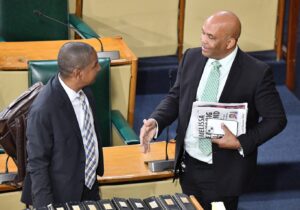
Member of Parliament (MP) for Clarendon Central Delroy Williams (left) speaks with St Thomas Western MP James Robertson after the sitting of the Infrastructure and Physical Development Committee at Gordon House on Wednesday.
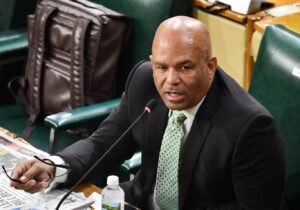
Member of Parliament for St Thomas Western James Robertson speaking during the sitting of the Infrastructure and Physical Development Committee on Wednesday at Gordon House.
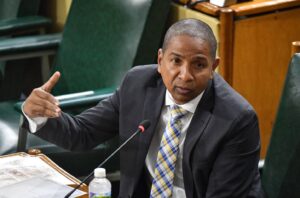
Member of Parliament for Clarendon Central Delroy Williams speaks during the sitting of the Infrastructure and Physical Development Committee on Wednesday.
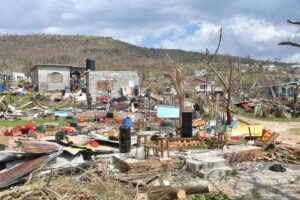
A section of Westmoreland after Hurricane Melissa’s rampage last week. (Photo: Garfield Robinson)