



Retail demand led Easter bun and cheese sales this year, producers say
Key Points:
Everyday consumers drove Easter bun and cheese sales, with retail purchases accounting for the majority of demand despite economic pressure.
Consumers maintained traditional buying habits, showing little evidence of trading down, even as they became more deliberate in spending.
Strong seasonal demand persisted after Hurricane Melissa, but underlying caution remains, especially in cheese purchases where value and flexibility are influencing choices.
Everyday shoppers, rather than bulk corporate buyers, were the main force behind Easter bun and cheese sales this year, according to leading producers, suggesting Jamaican households are still making room for seasonal traditions even as spending remains under pressure in the months following Hurricane Melissa.
Responses from manufacturers point to a market where consumers remained engaged in the Easter ritual of bun and cheese, while showing signs of more deliberate spending in some categories. Retail channels accounted for the majority of sales, with companies reporting steady demand, improved volumes and continued preference for familiar pack sizes and established brands.
Tarik Parkins, managing director of Maxfield Bakery, told Jamaica Observer that the company recorded a 14 per cent increase in sales volume for Easter 2026 compared with the prior year, with exports delivering one of the strongest gains.
“Sales were led mostly by the export segment which saw a 50 per cent increase over 2025. The bulk of sales came from everyday consumer purchases. Supermarket sales as well as the shops and bread box sales, we are talking…66 per cent of sales were from retail customers,” Parkins said.
Corporate and institutional orders have long been a feature of the Easter trade, with businesses often purchasing bun and cheese for staff appreciation initiatives, customer gifts and office gatherings. Churches, schools and community groups also typically place orders for fellowship events, outreach activities and seasonal fund-raisers, making the segment an important secondary channel even when it does not dominate overall sales.
At Continental Baking Company Limited, which trades as National Bakery and produces National and HTB buns, Sales Manager Omega Harris said volumes improved year over year despite a more crowded marketplace.
“Bun sales delivered improved year-over-year volume despite increased competition and new market entrants. Both National and HTB brands held their sales with no decline, supported by strong retail execution and availability across key outlets,” Harris said.
Asked whether bulk or corporate purchases drove performance, Harris said everyday consumers through retail outlets were the dominant source of demand.
“The majority of HTB’s sales were driven by everyday consumers through our retail spaces rather than bulk or corporate orders. Strong in-store presence, merchandising, and accessibility were key contributors to this performance,” Harris said.
“Consumers continued spending and upheld Easter traditions despite external challenges, including outlets impacted by Hurricane Melissa. This was especially evident on Holy Thursday, which recorded the strongest sales activity across the National wholesalers and retail outlets we service,” she added.
That finding is notable given the broader economic backdrop. Since Hurricane Melissa struck last October, damaging businesses, homes and productive sectors, companies across industries have spoken of softer spending patterns, supply disruptions and pressure on household budgets. Yet Easter appears to have remained one of the occasions consumers were reluctant to abandon.
There was also little sign, according to bun makers, of a major move by shoppers to cheaper alternatives. Harris said sales data showed consumers largely continued to purchase the traditional 35-ounce size.
“There was no significant evidence of customers trading down. Sales data showed that consumers primarily purchased the 35oz size, indicating they maintained their typical buying patterns and remained committed to traditional Easter purchasing,” he said.
Maxfield Bakery reported a similar experience.
“We are not seeing where customers are trading down or switching to cheaper bun options, we have actually gained market share,” Parkins said.
Even so, producers acknowledged that success this year required sharper execution. Parkins said Maxfield Bakery introduced new promotions, though not simply to clear inventory.
“We actually did do some new promotions to move stock but it wasn’t necessarily just to sell stock, it was more about changing customer receivable patterns to improve cash flow,” he said.
Other bun producers, including Mothers Enterprises Limited and Consolidated Bakeries (Jamaica) Limited which trades as Purity, were also contacted for comment but had not responded up to press time.
On the cheese side of the tradition, GraceKennedy Limited, which produces Tastee Cheese through its subsidiary Dairy Industries Limited, said cheese also recorded increased demand during the Easter period compared with last year, with retail consumers again representing the majority of sales. Corporate customers remained active, particularly in smaller pack sizes used for staff and client gifts.
The company said larger sizes, especially the 2.2-kilogramme format, continued to perform well across retail and wholesale channels because they allow consumers to “cut and wrap” portions to suit different budgets. Smaller 250-gram and 500-gram sizes remained popular among corporate buyers, while Tastee Cheese tubs continued to gain traction.
But GraceKennedy’s response also pointed to a more cautious consumer than the bun segment suggests. The group said spending patterns reflected sensitivity to current economic conditions.
“Overall consumer spending on Tastee Cheese continues to reflect sensitivity to current economic conditions, with more deliberate purchasing and a stronger focus on value and flexibility,” the company told the BusinessWeek.
That may be the clearest indication of how consumers approached Easter spending this year. Consumers still showed up for a deeply rooted cultural tradition, but many appear to be making more calculated decisions about how much they buy and in what format.
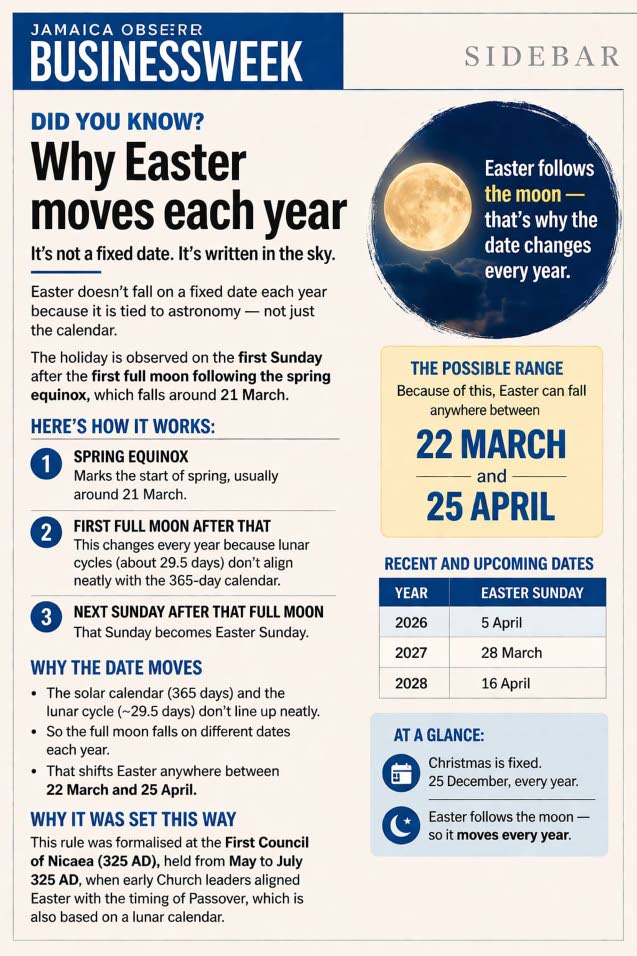
The earlier timing of Easter in 2026 also helped pull stronger activity into March, GraceKennedy said, potentially giving manufacturers and retailers a longer runway for promotions and distribution ahead of the holiday weekend. Good Friday was observed on April 3 this year, more than two weeks ahead of last year’s April 18 date.

A 15.2oz (430g) Tastee Easy Pull cheese tub on display. GraceKennedy Limited said smaller, convenient pack sizes such as the Easy Pull tubs remained popular with corporate buyers for staff and client gifts, while retail consumers continued to favour larger formats, especially the 2.2 kg size, for their flexibility and value during the Easter season.
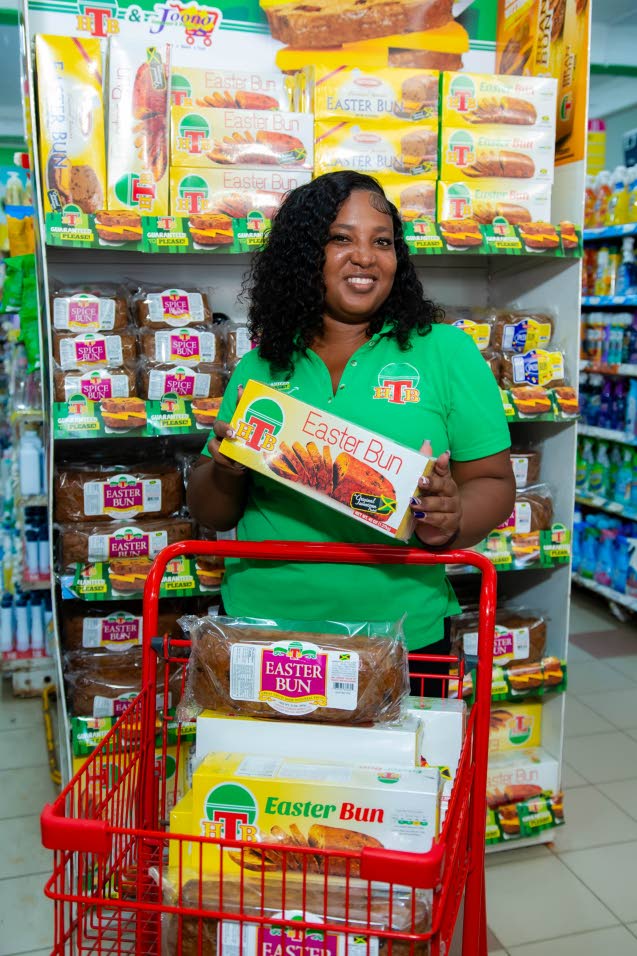
Neisha Shady promoter at Continental Baking Company Limited, producer of the HTB and National brands, displays an HTB Easter bun after stocking supermarket shelves.
.


