From survival to empowerment
Kerry-Ann Blake shares autism guide for mothers, caregivers
FOR many mothers, receiving an autism diagnosis for their child can feel isolating, overwhelming, and uncertain. Ten years ago, that was the reality for Kerry-Ann Blake who was left searching for answers and support after noticing developmental changes in her son that others around her struggled to see.
Now, the mother, advocate, and founder of Friends of Autism Jamaica (FAJ) is turning her personal journey into a gift for other mothers this Mother’s Day, sharing a practical guide for caregivers of children with autism designed to help them move from survival mode to empowerment.
As she reflected on her journey, Blake said it was an overwhelming feeling when her son got diagnosed.
“I would have gone through months of just not knowing what is going on and I felt like no one else understood, because prior to getting my son tested, when I took him to the paediatrician or to other doctors, because he’s still young, persons were telling me that they’re not seeing what I’m seeing and so forth or I’m worrying too much, or every child develops at a different pace and stuff, but I was literally seeing regression in my son. I saw where things that he would have already started doing, he totally stopped, so I knew that I was seeing the changes, but from a medical standpoint, I had to wait until he reached this growth spurt, so I felt alone,” she told the Jamaica Observer.
“When he got the diagnosis, there weren’t a lot of places out there where I could just readily go, and then when I did find somewhere, it was on the more expensive side. At the time, we weren’t able to afford it, but when I look at it, I’m like, ‘What about those mothers who would not have been able to afford that cost?’ ” said Blake.
Determined to ensure other parents did not have to face the journey alone, Blake founded Friends of Autism Jamaica in 2016. What started as her search for guidance has since evolved into a support network connecting families, providing screenings and training, and advocating for greater understanding of autism in Jamaica.
“The more I speak about autism, the more people I’m meeting who do have a child who is on the spectrum. Some parents notice that their child is having challenges, but they have not gotten the child tested as yet, so while we might have a figure that…this is the amount of persons on the spectrum in Jamaica, we still have a group of children who have not been tested because it’s a process to get that test. You don’t get up today and have the test done. It takes resources, financial resources, and so forth.”
This Mother’s Day, Blake said she wanted to do something practical for the mothers and caregivers who are often overwhelmed by the demands of raising children with special needs. The result was a brief written guide she shared with the Sunday Observer featuring lessons from her own journey and the shared experiences of other women raising children with autism.
One of the first messages in the guide encourages mothers to “give yourself grace to grieve”. Blake said many parents struggle with feelings of guilt when processing a diagnosis, but she wants them to understand that acknowledging those emotions is healthy.
“It’s natural to mourn the life you expected. Processing these emotions is not betraying your child; it’s a vital step in becoming the strong advocate they need,” she said.
She also stressed the importance of early screening and intervention, something she believes can make a significant difference in a child’s development. She noted that through Friends of Autism Jamaica, free screenings are offered to families as a starting point.
“Early screening is a gift. Lean into therapies, whether speech or behavioural, because they unlock your child’s potential,” she encouraged.
Blake also highlighted the importance of trained shadows in schools, noting that FAJ provides training for individuals interested in supporting children with autism in educational settings.
Beyond therapies and diagnosis, she said parents must build what she describes as a “village” around their children.
“No journey is undertaken alone. A supportive family, whether biological or adoptive, becomes the foundation upon which your child stands,” she told the Sunday Observer, noting that she had her mother Pamela Blake and neighbour Miss Olive, who were an instrumental part of her journey.
She also encouraged mothers to register their children with the Jamaica Council for Persons with Disabilities (JCPD) to access grants, tax exemptions, and legal protections, noting that “navigating these processes may be daunting, but they provide essential support for your child’s well-being”.
As an insurance advisor, Blake also encouraged families to think long-term and financially prepare for their children’s future. She stressed that financial planning is crucial and “planning for the future is an investment in your child’s continued growth and security”.
But amid the responsibilities, paperwork, and therapies, Blake said she wanted mothers to remember to celebrate the small wins.
“Each new word or held gaze is a monumental achievement. These ‘inchstones’ contribute to a beautiful life,” she said.
The guide also offers suggestions for making the home environment calmer and more supportive, including using visual schedules, creating quiet spaces, and educating relatives and friends about autism to reduce stigma.
“Explain your child’s needs to family, showing that ‘different’ isn’t ‘bad’,” Blake urged. “Education fosters empathy, creating a more inclusive community.”
At the heart of the guide, however, is a reminder that caregivers must also care for themselves.
“I know that, especially moms with a child who has a special need, it can become overwhelming, and sometimes we can lose ourselves while going through the process of being a caregiver. It can be hard to follow a structure. Sometimes we don’t even have a structure in place because we’re just going in with the mindset that whatever comes up, we have to tackle it, but we have to take care of ourselves,” she encouraged.
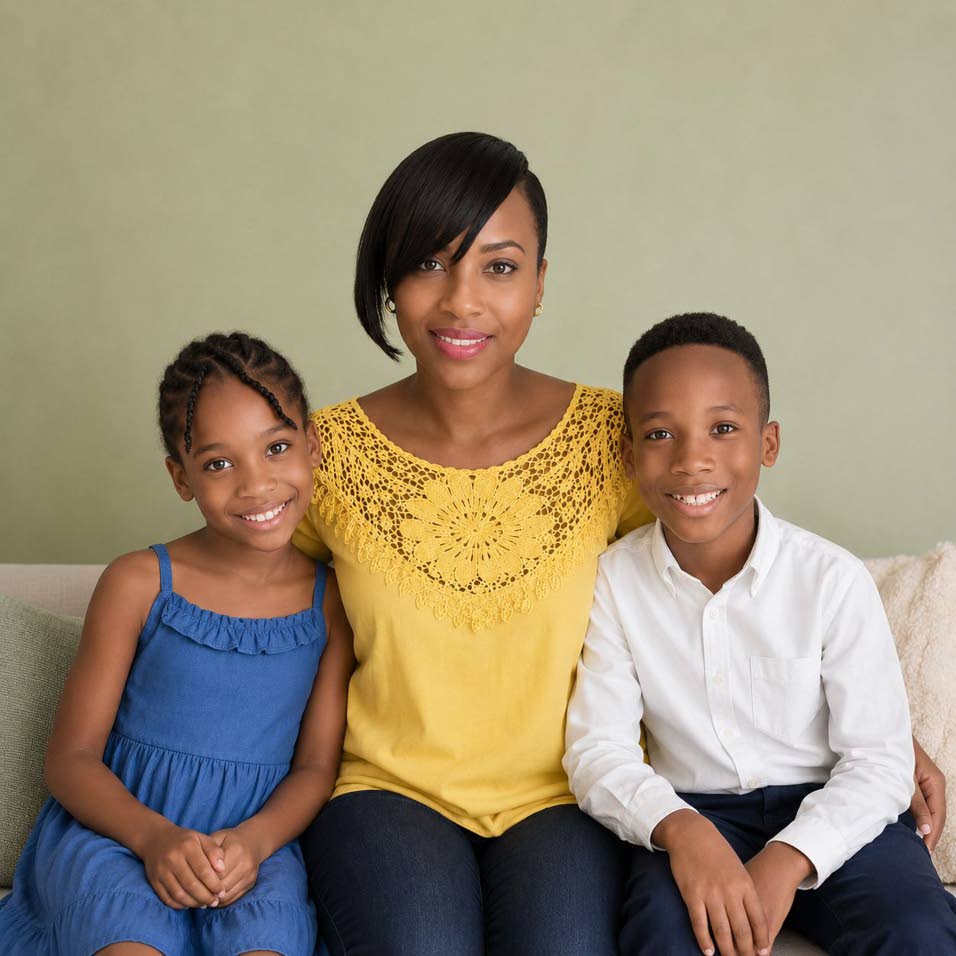
President of Friends of Autism Kerry-Ann Blake, her daughter Oriana (left) and son Odeon Campbell.