



First Rock returns to profit but cash strain persists
FIRST Rock Real Estate Investments returned to profit in 2025 after rental income surged and property values climbed. But the real estate company is still burning cash, restructuring debt and depending heavily on luxury home sales to support
liquidity.
The company reported net profit attributable to shareholders of US$3,327 for the year, reversing a US$8.89-million loss a year earlier as rental income jumped 663 per cent to US$1.23 million and investment property revaluations added another US$4.44 million to earnings.
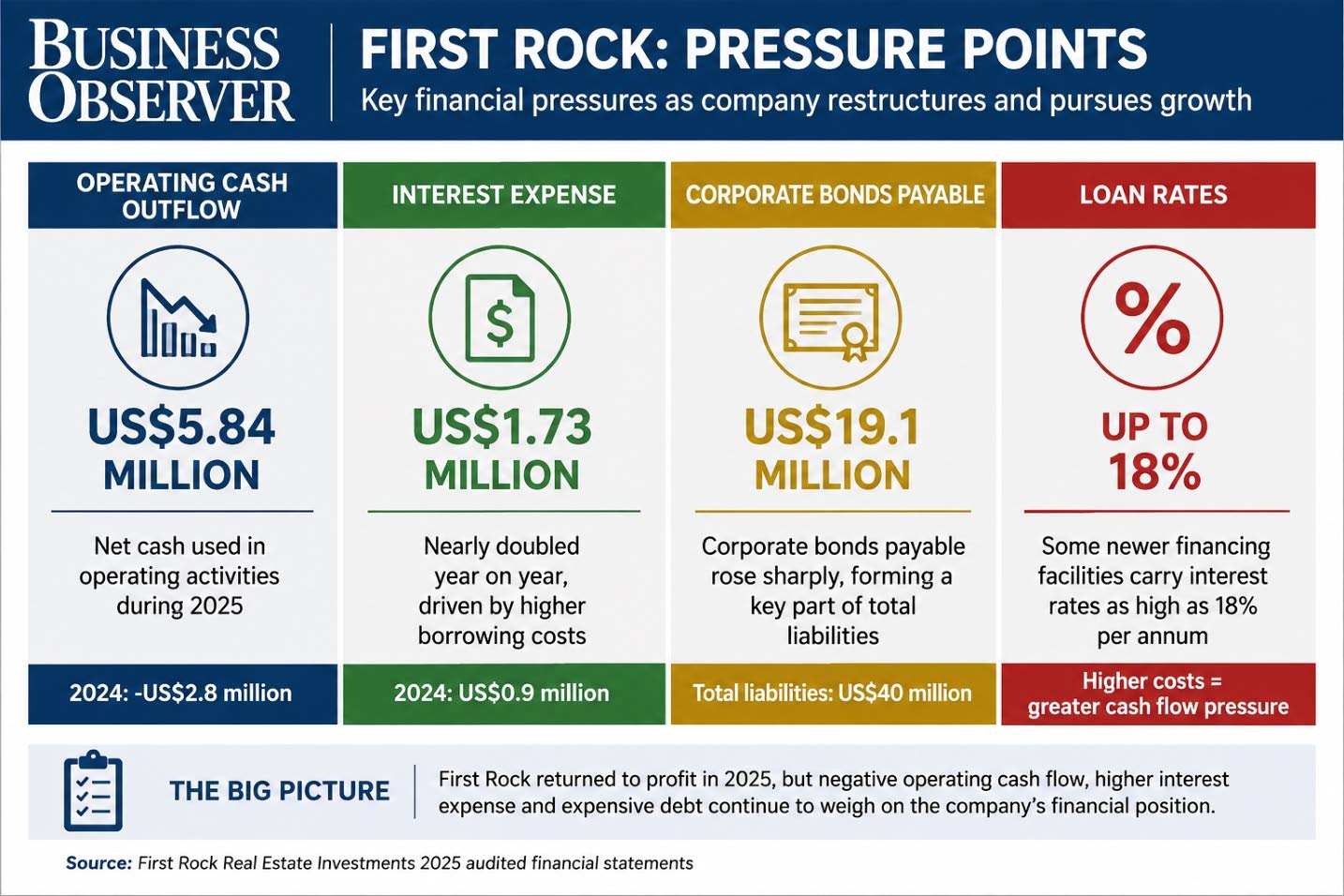
The sharp increase in rental income reflects First Rock’s strategic shift towards stabilised commercial and income-producing real estate assets as the company attempts to reduce reliance on one-off development sales. Beneath the profit recovery, however, the financial statements reveal continuing strain on cash flow. Operating activities consumed US$5.84 million during the year while interest expense nearly doubled to US$1.73 million. The company also remains in discussions with creditors to refinance short-term debt and secure additional funding as elevated interest rates continue driving up financing costs across the real estate sector. Without the property revaluation gains First Rock would have remained under significant earnings pressure.
The near-completed Hambani luxury development in Kingston 6 has become a critical part of the company’s near-term cash-generation strategy. In an April 30 disclosure, Mayberry Investments said seven homes at the development had received practical completion certificates and were all under contract for sale. Prices for completed units ranged from US$1.8 million to as high as US$2.3 million, with Mayberry stating that proceeds generated so far were sufficient to cover expected development costs and create surplus cash flows.
Chief Executive Officer Ryan Reid said the company’s financing structure was intentionally designed around development completions and unit sales.
“Unit sales are indeed a key part of our repayment strategy, and that’s really by design, which reflects the direct alignment between our development pipeline and our capital structure,” Reid told the Jamaica Observer in written responses.
The group’s balance sheet expanded during the year, with total assets rising 15 per cent to US$65.8 million while liabilities climbed to US$40 million from US$31.5 million a year earlier. Corporate bonds payable rose sharply to US$19.1 million while long-term loans remained elevated at roughly US$16 million combined current and non-current.
Some of the company’s newer financing arrangements carried interest rates as high as 18 per cent, according to the audited notes, highlighting the increasingly expensive cost of capital facing highly leveraged property developers in Jamaica’s elevated interest rate environment.
Reid said management expects rental income to play a larger role in strengthening operating cash flow.
“The revaluation gains reflect genuine value creation in our portfolio,but we absolutely understand that cash generation is important, hence the massive movement in our rental income year on year,” Reid told Business Observer. “We expect operating cash flow to further improve meaningfully.”
Even while continuing refinancing discussions, First Rock is also pursuing regional acquisitions in Costa Rica and Martinique valued at a combined US$28 million. Reid argued that the planned deals are aimed at accelerating recurring cash flow rather than expanding aggressively into speculative developments.
“The acquisitions we’re pursuing are not about expansion for its own sake, they are highly selective opportunities that we believe will generate returns faster than greenfield developments would. These are fully tenanted rental income opportunities,” Reid said.
“In each case, the entry price, existing entitlements, and near-term development potential mean these assets contribute to cash generation rather than stretching it further.”
The company’s auditors, Ernst & Young, identified the valuation of investment properties as a key audit matter, noting that investment properties and investment properties held for sale accounted for roughly 50 per cent of total assets at year end.
After years of debt-funded expansion First Rock is now under pressure to prove its evolving rental income strategy can generate sustainable cash flow rather than relying heavily on property revaluations and development sales.
.

REID…unit sales are indeed a key part of our repayment strategy, and that’s really by design, which reflects the direct alignment between our development pipeline and our capital structure.


