



Double challenge
PIOJ flags rising oil prices, lingering effects of Melissa for impacting growth outlook
JAMAICA’S economic recovery is facing a double challenge as the lingering effects of Hurricane Melissa combined with rising global oil prices puts further pressure on an already weak growth outlook, the Planning Institute of Jamaica (PIOJ) has warned.
The economy contracted by 5.9 per cent during the January-March quarter, largely due to Hurricane Melissa, which struck the island as a powerful Category 5 storm last October. Now, the ongoing conflict in the Middle East is adding to the strain, with rising energy costs threatening to slow the pace of recovery.
Highlighting Jamaica’s vulnerability to global shocks, PIOJ Director General Dr Wayne Henry, speaking at the institute’s quarterly briefing on Wednesday, said that rising oil and commodity prices are already affecting trade and output performance locally.
“If global oil prices remain elevated for an extended period, Jamaica could face significant economic challenges. Higher energy costs will spur inflation, widen the trade deficit, slow real gross domestic product (GDP) growth and strain fiscal performance,” he said.
Pointing to the tourism sector, a major source of foreign exchange, as one industry likely to be hard hit, the director general said it is expected that rising airfares, cruise costs and local operating expenses could continue to reduce visitor arrivals.
The Accommodation & Food Service Activities industry, which contracted by 20.4 per cent during the first quarter of this year, was largely driven by a 17 per cent decrease in visitor arrival, a 27.5 decline in stop-over arrival, and 1.1 per cent fall in cruise visitor arrivals. Preliminary data for the current April quarter already shows a near 23 per cent dip in airport arrivals when compared to the same period of last year.
Similarly, energy-intensive sectors, including mining and manufacturing, are also facing higher input costs, as supply-chain challenges limit access to key inputs.
“Generally, most industries will be adversely affected by rising costs of energy and other critical imported inputs such as fertiliser due to supply-chain constraints as a result of the conflict,” Henry added.
Since the start of the United States-Iran war in late February, disruptions in the Gulf and the closure of the Strait of Hormuz have caused oil prices to surpass US$100 per barrel. For Jamaica, this is affecting energy-dependent sectors, with price volatility impacting inflation, the trade balance, and real GDP.
“With respect to the trade balance, higher global prices for energy products, grains, fertilisers, and shipping will inflate import costs. Rising input costs will also result in higher prices for domestically produced goods, reducing competitiveness on the global market,” Henry said, while noting that Jamaica’s trade deficit is likely to widen as imports outpace exports.
He added that heightened investor uncertainty may also constrain the demand for Jamaican exports, which could further depress output and GDP growth.
The PIOJ head, in calling for proactive and integrated policy measures, said these will be needed for Jamaica to accelerate its renewable energy transition, strengthen agricultural and tourism linkages, diversify visitor markets and maintain vigilant monetary and fiscal management.
“By embedding energy resilience into tourism and production strategies, Jamaica can mitigate the anticipated effects of oil price volatility, protect livelihoods, and secure a more sustainable path toward inclusive growth,” Henry said.
As the country’s short-term prospects remain generally negative, the PIOJ in its forecast said the expectation is for a further contraction within the range of 3-4 per cent during the current April-June quarter, largely driven by the combined effects of the hurricane in addition to elevated oil and fertiliser prices.
Despite these headwinds Henry, however, said that the economy is projected to witness growth of about 1-3 per cent in financial year 2026/27, largely supported by a stronger performance in the latter half of the fiscal year (October 2026 to March 2027), when recovery from the weather-related shock of 2025 is likely to become more pronounced.
“However, if current conditions persist during the upcoming quarters, then there will likely be a downward revision,” he said.
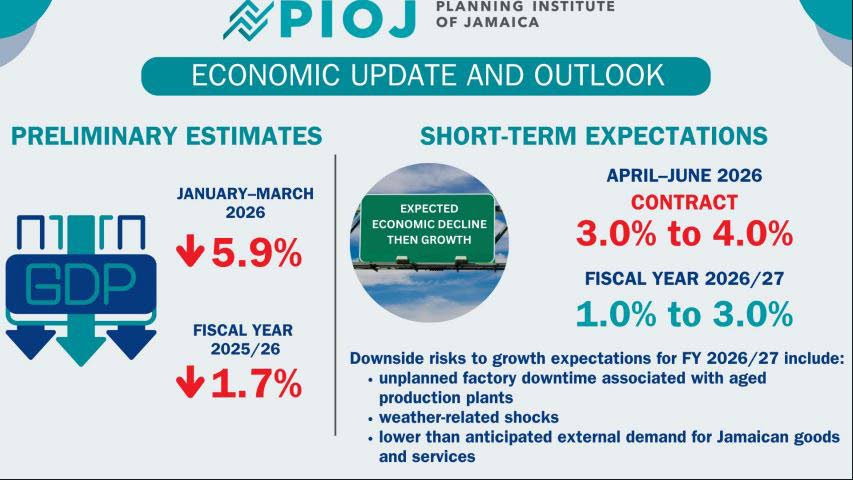
PIOJ’s preliminary estimates and short-term expectations for January-March and April-June.


