



‘I prayed to hear my son’s voice’
Mom shares how she took her child from being non-verbal to verbal with prayer, dedication
TWO months after her son celebrated his first birthday, Peta-Gaye Forbes Robinson said her motherhood journey took an unexpected turn. Her toddler started to regress in his development and was later diagnosed as a non-verbal autistic child with no chance of ever speaking.
However, that was a diagnosis she refused to accept.
After nine years her son, Shadrach Robinson, is now verbal and can operate independently, a journey she said was long and stressful, but proof that God can do what others deem impossible.
With a desire to help other children she founded Gifted Minds — a structured, home-based intervention programme dedicated to supporting children on the autism spectrum through individualised learning — and is sharing her story to provide other parents in similar situations with hope.
Robinson shared that she was first alerted that something was wrong when her son, who initially could list all the letters of the alphabet and count to 20, could only say the letter ‘E’ in a forced tone after his first birthday. She said family members and friends soon pointed out that her son was not meeting developmental milestones, and she moved to get him examined. She was referred to a behavioural specialist and waited prayerfully for things to turn around, but they never did.
When her son was around three years old she said she took him to a neurologist for an assessment and the results left both her and her husband, Ricardo Robinson, in tears.
“What was said was that they were not even getting any sounds from him that sounded like hope. They were like, ‘He’s possibly gonna need someone to always be there for him, he’s going to need assistance 24/7.’ He wouldn’t speak, he wasn’t compliant or anything like that, so it broke us. We were worried when we got that diagnosis of autism because we didn’t know what that looks like,” she told the Jamaica Observer.
With a background in early childhood education, Robinson said she started to research autism to learn more about the condition and how to be there for her son, but her job in corporate Jamaica kept her busy and away from home. She shared that she would constantly hear the Lord telling her to resign from her job and dedicate time to her son, but she was fearful of the financial impact the decision would have on their family.
She left his progress in the hands of State institutions. However, her son still showed little to no signs of progress.
When the COVID-19 pandemic hit in 2020, she said the call to resign from her job got so strong that she could not ignore it any more. Another assessment confirmed that her son had made no progress, and she and her husband were losing hope.
“It broke us again, and I said, ‘I’m not even going to accept that report because I know what the Lord has been showing me.’ He showed me that he would speak and, in fact, we experienced him speaking so it’s a matter of understanding what was happening at that time. That was when I said, ‘Alright, this is it, I’m going to resign,’ and I resigned,” Robinson recounted.
She shared that she withdrew Shadrach from school and took up homeschooling, relying on help from Jamaica Life Learners — a comprehensive homeschooling service. She said the transition was hard for her family, and it seemed like she was not making progress with her son. On the verge of defeat, she turned to God in prayer.
“I remember I prayed and I said, ‘Lord, I don’t understand. What is this? What does that mean?’ and I almost gave up. I decided that Friday I wasn’t going to do anything at all with him that was school-related, and you know what happened? The instruction that the Lord gave me was to pull his speech and ability to spell, which is a technique in how you group the letters, starting with the vowels and the consonants, so that was what I did with him,” she recalled.
Robinson said that at first her son was non-responsive, and in frustration she told him to go and play. A few minutes later she heard him repeating the letters A, E, I, O, U. He was about five years old at the time and she realised that moment marked a turning point for him.
However, her most cherished memory was the day her son told her he loved her for the first time. She shared that she was in his room one night, crying as she questioned whether she would ever hear him utter the words, ‘I love you, Mommy.’
“I remember I turned my back on him and I started crying, and I just heard him come over to me and say, ‘I love you,’ ” she shared, noting that the words were jumbled, but she jumped with pure joy.
“I said, ‘Wait, what?’ He said, ‘I love you.’ I said, ‘Say it again, Papa,’ and he said, ‘I love you,’ and I said, ‘Yes, Papa, that’s it,’ ” she recounted, her voice filled with joy and laughter as she was brought back to the milestone moment.
Peta-Gaye Forbes Robinson (right) with her son Shadrach Robinson.
“I was there just looking in his eyes while he’s there doing it, and the more he said it, he got louder each time. I said, ‘Say it with confidence, Papa; louder,’ and he started saying it louder and I heard it start to turn into a more defined, ‘I love you’ over a period of time until every single time, and I’m not exaggerating, possibly every other second or minute, he would be saying, ‘I love you, Mommy.’ To this day, he repeatedly says, ‘I love you, Mommy.’ That’s his first sentence, and that broke me,” she told the Sunday Observer.
From there, she said the Lord kept guiding her to different resources that were beneficial for her son. She later formed Gifted Minds in 2021 and began helping other children on the spectrum, alongside her son. While the learning materials were beneficial, she said it was her moments of intercession and prayer that truly transformed her son.
“At some point in time, when I prayed, I realised that the symptoms would lessen, and then when I stopped praying, the symptoms increased. What I did was I just repeatedly kept praying, so intercession became a major part of it in that every aspect of it, surrounding every region of his brain, I interceded. The Lord brought me into that understanding of the regions of the brain, the areas that I need to touch and the data. I would pray on those, and I would see a massive turnaround with him,” she shared.
Robinson said her son, in the last five years, has made massive improvements. She shared that he was initially triggered by sounds, numbers, and refused to eat due to challenges with texture. She added that her son would also have to be restrained by five people to clean his teeth due to sensory issues, but she stuck to the mission, and he has transformed.
“Now, where we’re at, it’s like when I look back I’m like, ‘Oh, wow, that was the purpose for all that sacrifice,’ because now he is eating everything! Now I have to literally be reminding myself, don’t you ever utter out of [your] mouth, ‘You’re talking too much,’ because I remember at some point in time I prayed to hear his voice, and so I enjoy it,” said Robinson.
Now 10 years old, she shared that Shadrach is a leader who loves all things engineering, often fixing old phones and gadgets around the house. He particularly loves studying aeroplanes and, in most cases, can identify the make and model from the sky. She said earlier this year he was re-diagnosed as having an expressive receptive language gap, which is the discrepancy between a person’s ability to understand language and their ability to express it. She added that her son is also enrolled in a mainstream public school and is fully independent.
In a word of encouragement to parents facing similar developmental challenges with their children, Robinson noted that it’s okay for them to not know everything, but cautioned that they should not linger in that stage for too long.
“Don’t linger with the, ‘Why did I?’ or ‘Why me?’, but move into the stage of asking, ‘How?’, because that is how I began to step into knowledge about what to do to take me from one stage to the next. The moment I began to ask, ‘How do I do this’ or ‘How does this work?’, the Lord began to unfold a number of things before me and I began to make moves as to what to look into, what to research, and how to apply it — and that’s how I was able to step into where we are now,” said Robinson.
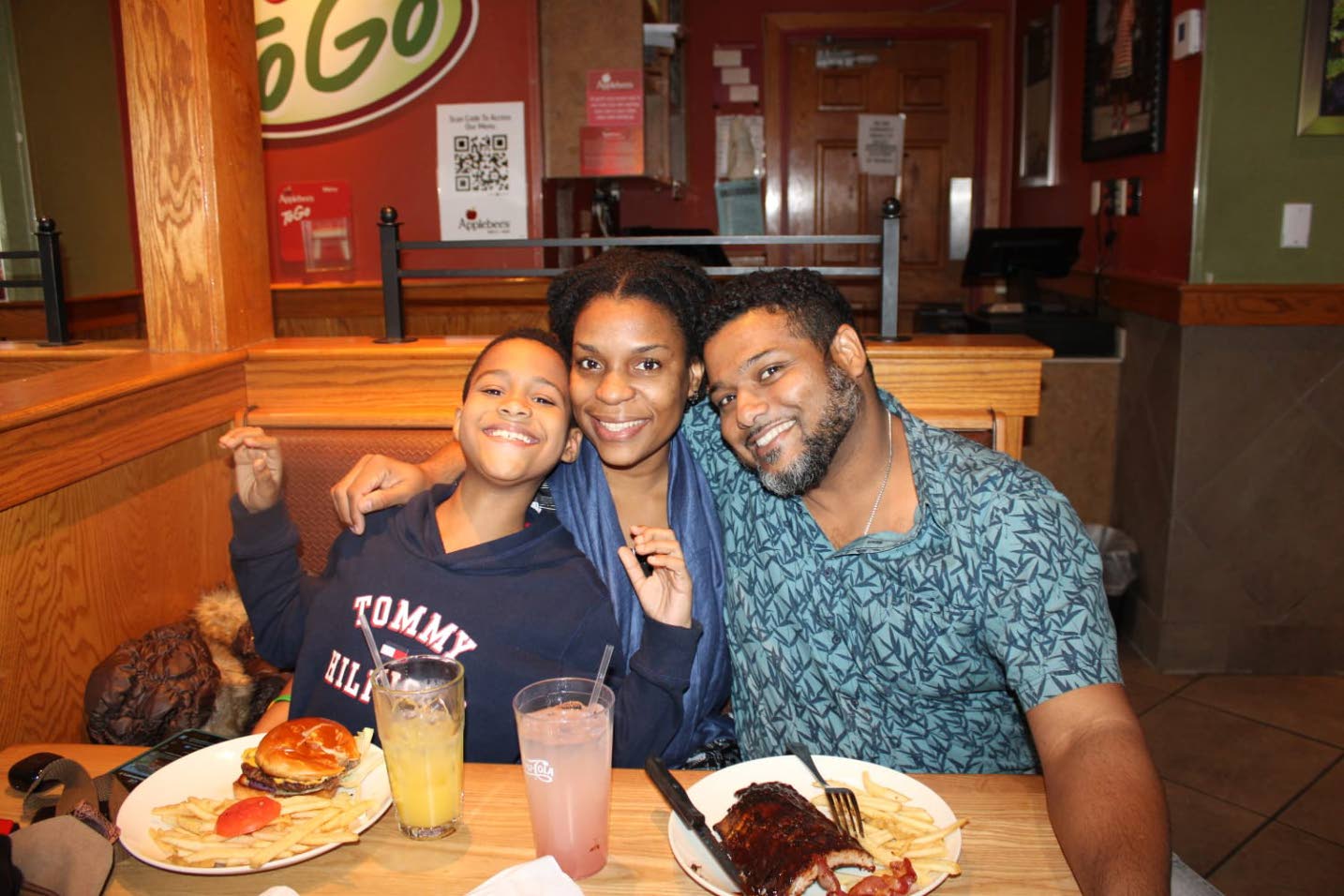
Peta-Gaye Forbes Robinson is flanked by her son Shadrach Robinson (left) and husband Ricardo Robinson.
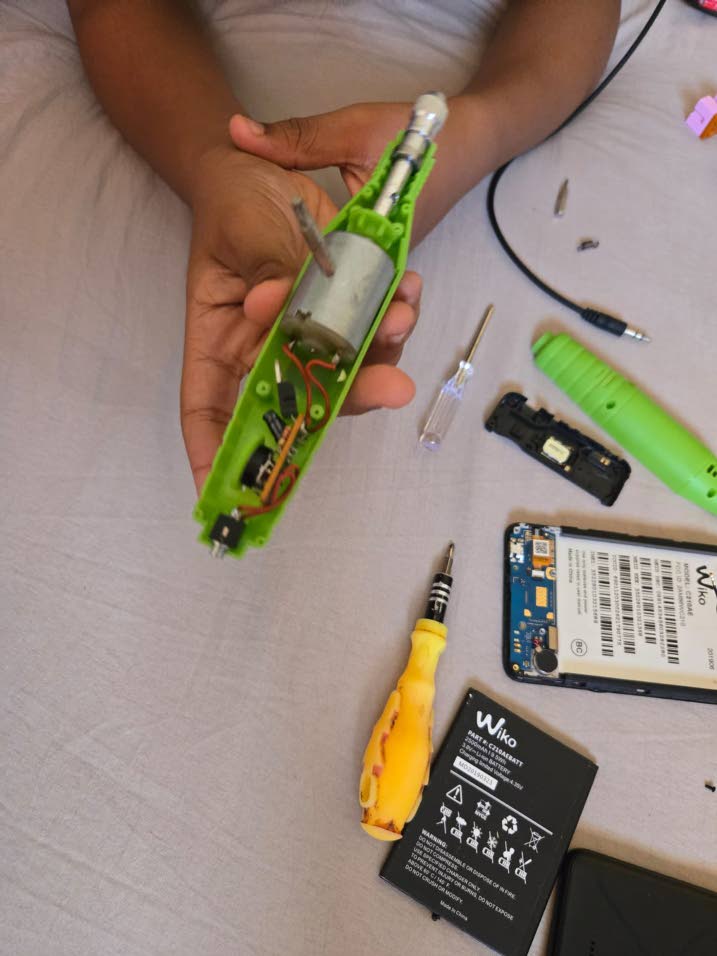
Ten-year-old Shadrach Robinson disassembles a gadget to repair an old phone.


