



Planting hope
School garden programme helps restore green spaces damaged by Hurricane Melissa
FIVE schools in St James have benefited from the Climate Resilient School Gardens Initiative, a programme piloted by the Institute of Jamaica through its Natural History Museum of Jamaica (NHMJ).
The schools — Garlands Primary, Niagara Primary, Montego Bay High, Herbert Morrison High and the Caribbean Christian School for the Deaf — were the recipients of fruit and native tree seedlings, medicinal plants, herbs and pollinator plants, to replenish green spaces that were damaged during the passage of Hurricane Melissa.
The first phase of the programme was implemented between April 17 and 30, 2026, with preparation of the garden spaces and handing over ceremonies taking place during that time. A capacity assessment to determine schools suitable to benefit was carried out with the aid of the Rural Agricultural Development Authority, and 4H Jamaica St James.
The success of the initiative was made possible through the collective support of a wide network of partners, chief of which were the American Friends of Jamaica and the Tourism Product Development Company, which provided funding for educational resources, project logistics, and permanent garden signage at each participating school.
Additional contributions were made by TransJam Highways, BirdsCaribbean, BirdLife Jamaica, the Forestry Department, Trees That Feed Foundation, and SuperValu Group of Companies. The Public Gardens and Zoo Branch of the Ministry of Agriculture, Fisheries and Mining also conducted site assessments, and offered planting guidance.
The Climate Resilient School Gardens Initiative was conceptualised as a celebration of Earth Day 2026, observed annually by the NHMJ as an opportunity to raise awareness about Jamaica’s biodiversity and the importance of protecting the environment.
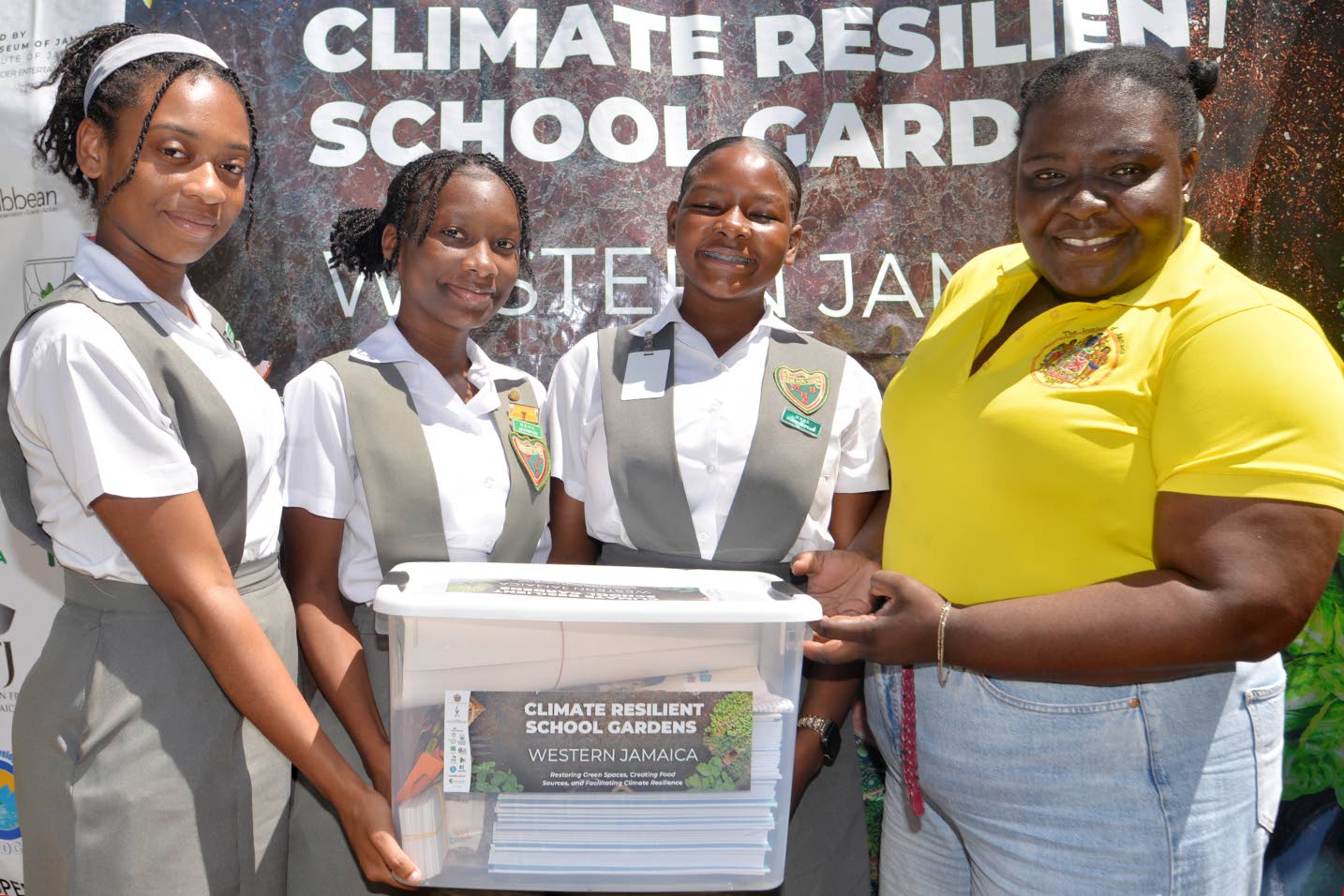
Kareen Parks-Swaby (right), assistant education outreach officer, Institute of Jamaica (IOJ), presents a resource kit to students of Montego Bay High School during a handover ceremony, as part of material provided under the IOJ’s Climate Resilient School Gardens Initiative.
“We wanted to implement something lasting for Earth Day 2026 so we designed this programme of restoration, education, and community empowerment,” said Eartha Cole, NHMJ education outreach officer.
In addition to seedlings and plants, the schools were also gifted gardening tools and fertiliser, as well as a resource kit that provides information on climate change, garden care best practices, and other educational material.
The kits also included information on pollinator creatures including bees and birds, which some of the plants, once grown, should attract. The programme is the first and largest of its kind in Jamaica, providing long-term and hands-on education for students in western Jamaica.
“There has been a lot of focus on restoring the built environment in western Jamaica, which is important, but the natural environment has also been devastated by the passage of Hurricane Melissa. This is our way of mobilising our students to help restore what has been lost,” said Cole.
In welcoming the initiative Georgette Wellington, principal of Garlands Primary School, said, “You have not only brought plants, you have planted hope. You have planted the future and renewed pride in Jamaica, land we love.”


