



Holness says land titling is critical to Jamaica’s development agenda
Prime Minister Dr Andrew Holness has pointed to a possible link between land titling and the growth of Jamaica’s gross domestic product (GDP), noting that some of the world’s most successful countries have titled between 90 and 100 per cent of their lands while Jamaica remains at about 60 per cent.
He therefore maintained that increasing the number of titled properties should be a national priority, arguing that secure land ownership can help drive economic growth by allowing citizens to build wealth, access financing and pass assets from one generation to the next.
Holness made the remarks on Thursday during a ceremony at the Meadowbrook Church of Christ in Kingston where residents of Ackee Walk and Jackson Town received land titles under the Government’s ongoing land regularisation programme.
The initiative seeks to formalise ownership for people who have occupied lands for years, and in some cases decades, without legal title.
Drawing comparisons with countries across the globe, Holness said he had recently reviewed data comparing land titling rates with GDP per capita and found a strong relationship between the two.
“I’m not saying that it is causal but there’s certainly a relationship there; what we see is that countries with a high level of titling also have a high level of GDP,” he said.
The prime minister cited countries such as Singapore, Switzerland, Norway, Denmark, Sweden, Germany, Australia, New Zealand, Canada, the United Kingdom and the United States, which he said have titling rates ranging from 90 to 100 per cent and are among the world’s most developed economies.
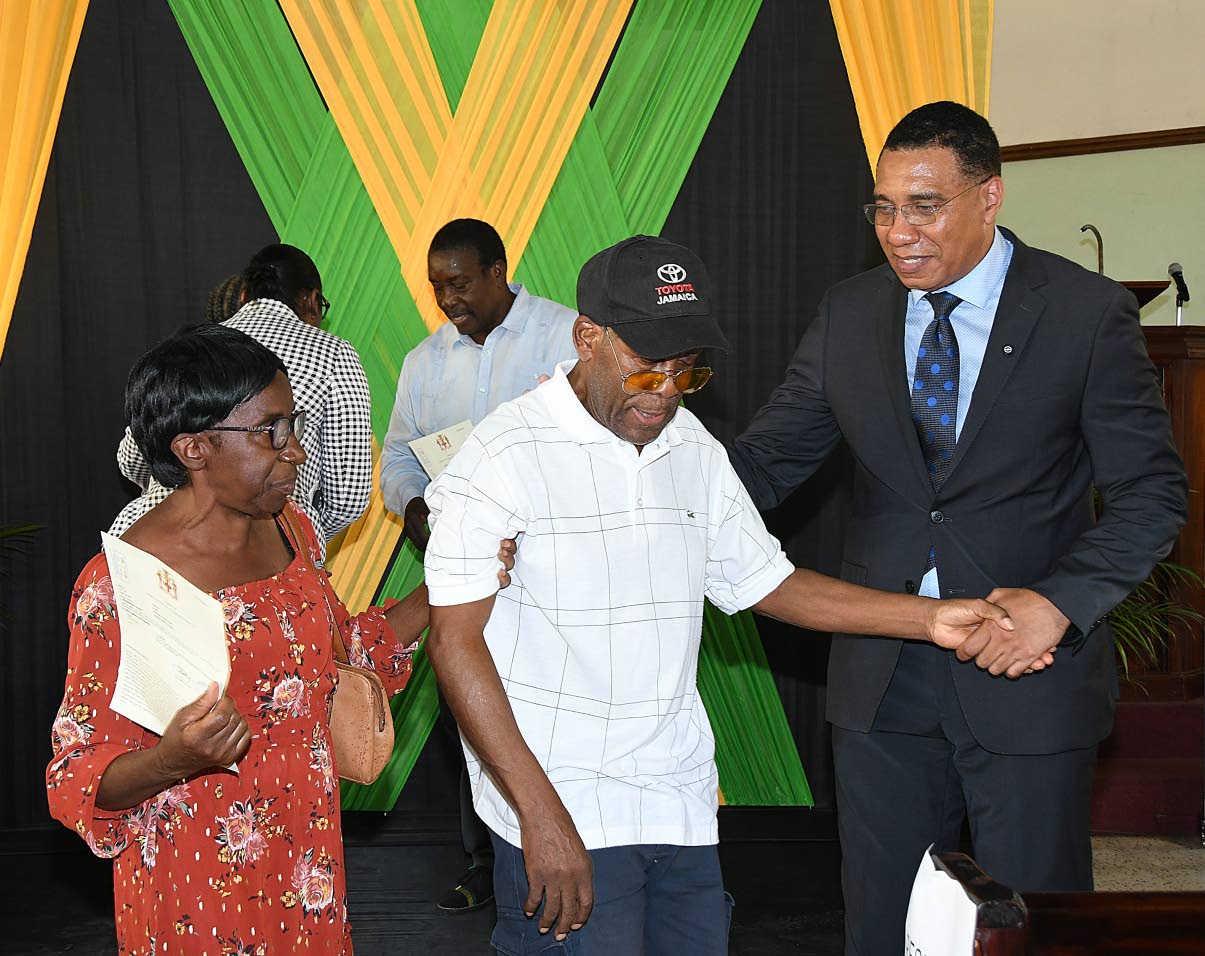
Prime Minister Dr Andrew Holness assists Sharon and Errol Smith after they received their land title on Thursday during a ceremony for residents of Ackee Walk and Jackson Town at the Meadowbrook Church of Christ in Kingston. (Photo: Karl Mclarty)
By contrast, he noted that countries including Ethiopia, Ghana, Kenya, Uganda, Tanzania, Nigeria, Pakistan and Bangladesh have substantially lower rates of registered land ownership.
While acknowledging that Jamaica’s estimated titling rate of about 60 per cent compares favourably with some developing countries, Holness argued that the country remains well below the level needed for land ownership to make a significant contribution to economic development.
“So we’re not too bad but we are not in the region where titling is going to contribute significantly to our economic development and that is why it is a strategy of the Government to rapidly expand the titling process,” he said.
According to Holness, land titling does more than provide legal certainty. It also helps transform occupants into owners who are more likely to invest in and protect their communities.
He also argued that untitled land limits opportunities for families to leverage property as collateral, transfer assets to future generations and build wealth over time.
Thursday’s ceremony marked the latest step in the Government’s effort to regularise informal settlements and increase the number of registered landowners across Jamaica. Ackee Walk and Jackson Town were among several communities that benefited from a declaration made under the Registration of Titles, Cadastral Mapping and Tenure Clarification (Special Provisions) Act, which allows the State to undertake a more systematic approach to resolving long-standing land ownership issues.


