



Democracy demands discipline, not disorder
Dear Editor,
Democracy is noisy. It thrives on disagreement, rigorous scrutiny, and passionate debate. Parliament is not expected to be a place of unanimous consent; it is designed to accommodate competing ideas and hold governments accountable. However, there is an important distinction between robust opposition and outright disorder. When Members of Parliament (MP) disregard the authority of the chair, refuse to observe parliamentary conventions, or descend into personal attacks, they weaken not only the institution but also the democratic principles they claim to defend.
It is against this backdrop that former Speaker and state minister in the Ministry of Justice Marisa Dalrymple-Philibert deserves commendation for publicly rebuking the conduct of Opposition MP Nekeisha Burchell following her exchanges with House Speaker Juliet Holness. Her intervention was not an attack on free speech or the Opposition’s constitutional role; rather, it was a necessary defence of parliamentary order and respect for the office of the Speaker.
Predictably, the People’s National Party (PNP) has framed the matter as an attempt to silence Opposition voices, arguing that disciplinary action threatens parliamentary democracy. That argument misses the point entirely. Parliamentary democracy is not threatened when rules are enforced; it is threatened when those rules are openly flouted without consequence. Freedom of expression inside Parliament has never been synonymous with freedom from accountability.
The office of the Speaker occupies a unique constitutional position. Regardless of who holds the office, the Speaker is entrusted with maintaining order, enforcing standing orders, and ensuring that every member is treated fairly. Respect for the chair is, therefore, not about personal loyalty to Holness; it is about respect for Parliament itself. Once members begin treating the Speaker with open contempt, the authority of the institution is gradually eroded.
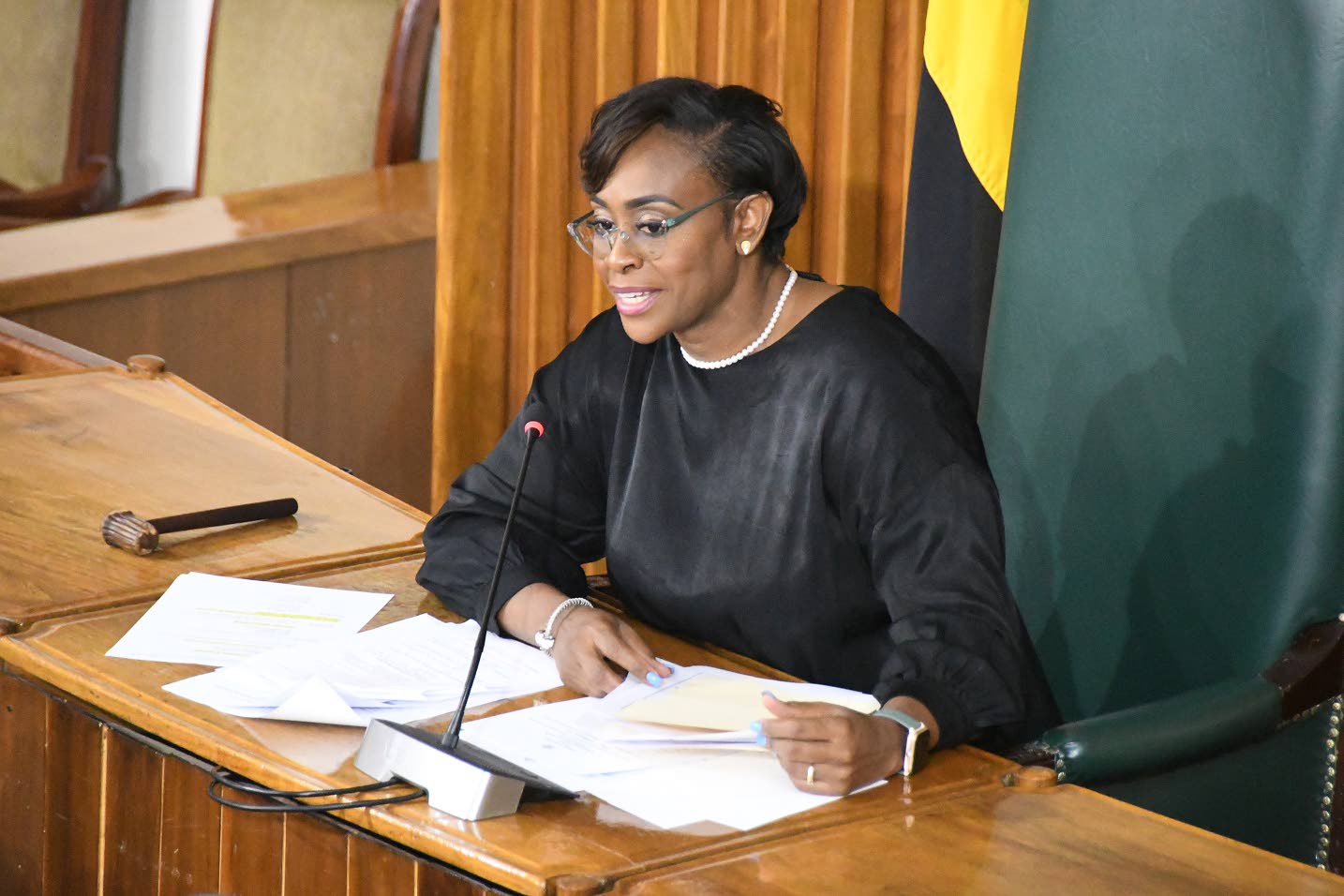
Juliet Holness
This is not the first time Gordon House has witnessed scenes of growing disorder. Over recent months, repeated confrontations, interruptions, and defiance of the chair have disrupted parliamentary proceedings and prompted repeated calls for improved decorum. Such behaviour may generate viral social media clips, but it does little to enhance public confidence in one of Jamaica’s most important democratic institutions.
Burchell’s refusal to apologise compounds the problem. An apology should never be viewed as weakness; it is an acknowledgement that institutions deserve respect even amidst political disagreement. By doubling down, instead of reflecting on her conduct, she risks normalising a culture in which defiance is celebrated and civility dismissed as political surrender.
This is precisely when senior parliamentarians have a responsibility that extends beyond partisan allegiance. Experienced legislators on both sides of the aisle should be mentoring younger members, helping them appreciate the distinction between vigorous advocacy and unnecessary confrontation. Parliamentary privilege carries with it parliamentary responsibility. Newer members should be encouraged to challenge policies, interrogate ministers, and hold governments accountable — but always within the framework of respect for the institution.
The PNP, too, should exercise caution before defending conduct simply because it originates from one of its own. Political parties strengthen democracy not by excusing poor behaviour, but by demanding higher standards from their representatives. Leadership sometimes requires correcting one’s colleagues rather than applauding them.
Likewise, the Government must continue to resist the temptation to interpret every criticism as obstruction. Democracy requires an effective Opposition. Jamaicans benefit when governments are questioned, policies are tested, and ministers are challenged. But those exchanges must occur within a framework of mutual respect and adherence to parliamentary rules.
Ultimately, this issue is larger than one MP, one Speaker, or one political party, it concerns the culture of Jamaica’s Parliament. Gordon House should be remembered as the nation’s highest forum for reasoned debate — not as a theatre of confrontation where shouting matches eclipse substance.
The Jamaican people expect their elected representatives to model the values they seek to instil throughout society — respect, discipline, civility, and accountability. If MPs cannot demonstrate these virtues within the walls of Parliament, it becomes increasingly difficult to persuade citizens to uphold them outside.
Dalrymple-Philibert’s intervention should, therefore, be seen not as an attempt to suppress dissent, but as a reminder that democracy flourishes when liberty is balanced with responsibility. Parliament belongs to the Jamaican people. Those entrusted to serve within it should conduct themselves accordingly — whatever their political affiliation.
Nekeisha Burchell
Oneil Madden
maddenoniel@yahoo.com


