



IMF: Global economy weathers Middle East shock
DESPITE months of conflict in the Middle East, the global economy has held up better than expected, prompting the International Monetary Fund (IMF) to keep its growth forecasts broadly unchanged.
In its latest World Economic Outlook (WEO) Update released Wednesday, the IMF projected growth of 3 per cent in 2026 and 3.4 per cent in 2027, while warning that downside risks remain significant.
“The global outlook is being shaped by two powerful forces pulling in opposite directions,” Petya Koeva Brooks, deputy director of the IMF’s Research Department, said during a media briefing, highlighting them as “the lingering effects of the energy shock from the war in the Middle East and a technology-driven investment boom.”
According to Brooks, while higher energy prices and geopolitical uncertainty have weighed on the global economy, the strength of the AI investment cycle has surprised the IMF since April, benefiting a number of countries integrated into the technology value chain. The IMF also said the impact of the conflict has so far been less severe than initially feared.
“Nevertheless, the world economy has weathered the shock from the war better than feared so far, with limited evidence of second-round effects,” Brooks revealed.
The IMF attributed that resilience to several factors, including inventory drawdowns, increased oil production outside the Gulf, and the growing share of renewable energy, which has reduced the world’s dependence on fossil fuels. Financial conditions, while briefly tightening earlier this year, have also remained supportive by historical standards. While growth has held up, the inflation outlook has become less encouraging. Global headline inflation has been revised up to 4.7 per cent this year, while the core inflation forecast remains broadly unchanged.
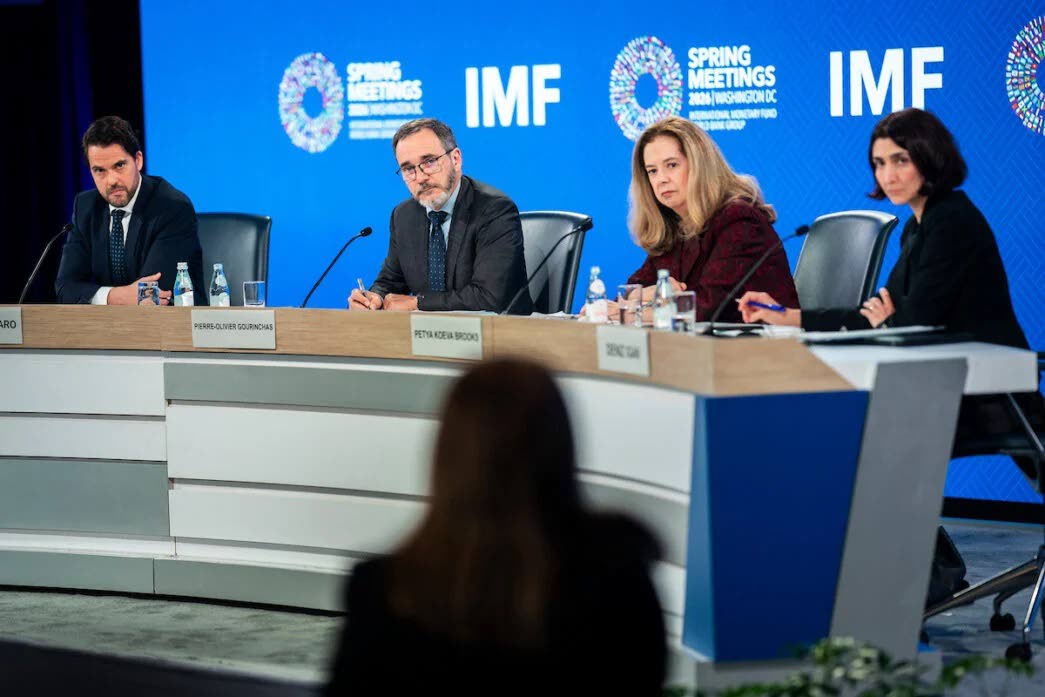
Petya Koeva Brooks (second right), deputy director of the International Monetary Fund’s (IMF) Research Department, and Deniz Igan (right), division chief in the IMF’s Research Department, participate in a media briefing on the Fund’s latest World Economic Outlook update. Also pictured are Communications Officer Jose Luis de Haro (left) and Pierre-Olivier Gourinchas (second left), IMF economic counsellor and director of the Research Department.
“Put simply, the disinflation trend that has been in place since early 2024 has stalled,” she added.
Despite maintaining its baseline forecast, IMF officials acknowledged that uncertainty surrounding the outlook remains unusually high, particularly following renewed tensions in the Gulf. Asked how the fund could maintain a baseline forecast in such an uncertain environment, Brooks said the IMF now has a clearer understanding of how the conflict is affecting the global economy than it did four months ago, allowing it to return to a traditional baseline forecast. She stressed that the current projections are based on several assumptions, including a gradual reopening of the Strait of Hormuz, beginning in mid-July and a normalisation of conditions by March 2027. The forecast also assumes geopolitical uncertainty remains elevated, commodity prices broadly follow market expectations, and the AI investment cycle moderates over time.
“If developments were to go in a different direction and if we were to see an impact through much higher oil prices, higher inflation expectations, and less benign financial conditions, then the impact of those developments…would take a toll on the global economy,” said Brooks.
She added that while the IMF could not speculate on how the conflict would evolve, it would continue monitoring developments and revise its assumptions in future forecasts if necessary. The IMF said risks remain tilted to the downside, warning that renewed conflict in the Middle East could reignite commodity price volatility, tighten financial conditions, and worsen food insecurity in low-income countries. Conversely, faster adoption of AI technologies and a quicker normalisation of trade through the Strait of Hormuz could provide an additional boost to growth.
The fund urged central banks to remain focused on price stability while governments rebuild fiscal space and continue structural reforms to strengthen resilience.


