



Is Jamaica shaking more?
Experts say Jamaica’s 15 felt earthquakes reflect more reporting
EARTHQUAKE experts say they are not overly concerned by the 15 felt earthquakes recorded in Jamaica so far this year, explaining that the apparent increase reflects greater public reporting rather than heightened seismic activity.
The latest quake was a 3.4-magnitude tremor felt at 6:20 pm last Wednesday in Kingston and St Andrew. It had a focal depth of 16 kilometres.
Karleen Black, scientific officer at the Earthquake Unit, and Dr Simon Mitchell, professor of sedimentary geology at The University of the West Indies, said Jamaica experiences more than 200 earthquakes annually. However, only earthquakes that are reported as having been felt by members of the public prompt the issuance of a public bulletin.
“What we have noticed is that since the October 30, 2023 earthquake, persons have been a little more aware of even the slightest bit of shaking that they feel, so there seems to be more reporting. But, even with that, the number that we’re seeing is not suggesting that we’re having more earthquakes,” said Black.
Only earthquakes that are reported as having been felt by people prompt the issuance of a public bulletin by the Earthquake Unit.
She shared that last year there were only eight felt earthquakes, despite the island recording more than 400 earthquakes. Similarly, in 2024 there were only 19 felt earthquakes reported out of hundreds for the year.
Black said the Earthquake Unit does not publish every earthquake recorded because the majority are minor movements that are not worth alarming the public, due to their little to no impact. She explained that the current process states that when calls are made to the unit or the Office of Disaster Preparedness and Emergency Management (ODPEM) about a possible earthquake that was felt, the unit would cross-reference the date and time of the report and the seismic activity that took place to determine if an earthquake did occur. If checks reveal there is a correlation between the time the quake was felt and the data in their system, then the report is sent out.
Black noted that up to May of this year, Jamaica recorded more than 250 earthquakes, but only about 12 were felt and reported. She said the majority of quakes are recorded on the eastern side of the island, but Jamaica is an earthquake-prone country and so earthquakes are not just limited to the east.
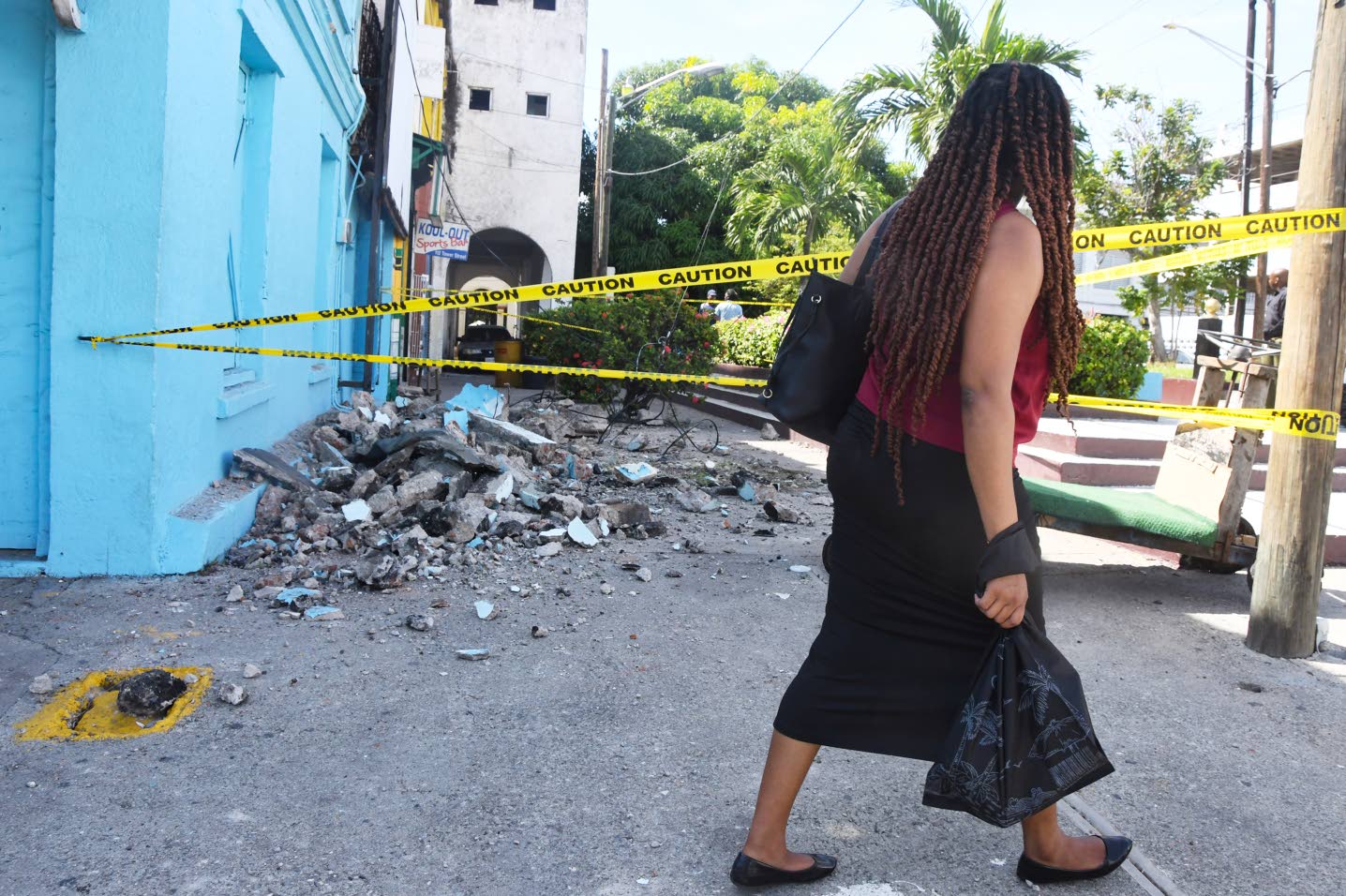
A Jamaica Observer file photo of a pedestrian passing a building that suffered damage at the intersection of Tower and Church streets in downtown Kingston after an earthquake rocked Jamaica at on October 30, 2023. (Photo: Naphtali Junior)
Referring to the recent magnitude-7.5 earthquake off Venezuela and other seismic events in Cuba and Haiti, Black said she had noticed growing concern among Jamaicans about the frequency of earthquakes occurring across the region. However, she stressed that there is no reason for the public to be unduly alarmed.
“To be honest, these earthquakes are not the ones that we need to be worried about. When you see an earthquake in Haiti or Cuba, or even the Cayman Islands — in January 2020, right before the pandemic, there was a 7.7 earthquake off the coast of Cuba, somewhere between Cuba and Cayman, we all felt it, but it was 7.7 and the place didn’t fall apart, even for such a big earthquake — [if we don’t seem alarmed] [i]t’s because the earthquakes that caused the island a lot of damage would be the earthquakes that happen on the island or very close offshore.
“If we look at the shaking we felt for the 5.6 earthquake [in 2023], it far exceeded what we felt for the 7.7 earthquake coming from so close to us, about a hundred or so kilometres away, so it’s the ones that are on the island or just off the coast, very close to us, that we should consider,” she told the Jamaica Observer.
Professor Mitchell, seeking to provide another explanation for the frequency of felt earthquakes, said Jamaica is being squashed.

Karleen Black, scientific officer at the Earthquake Unit. (Photo: JIS)
“We have a series of very accurate Global Positioning System (GPS) sites across Jamaica. So basically, they’re little points set in concrete on the ground, and every so often people from the Earthquake Unit, and sometimes other people coming in, go and measure these, and they measure them related to satellites,” said Mitchell.
“We can measure individual millimetre movements over time, so what we end up with is being able to actually work out how Jamaica is being squashed. And effectively, Jamaica is being squashed, and it’s being squashed from the north-east towards the south-west, and there’s probably about five millimetres of shortening and compression in that direction each year. Now that, over time, builds up and, of course, it builds up across all the different little faults across Jamaica, so eventually it gets too much for a particular fault, and it moves, and that’s what gives us the earthquakes that we feel,” he explained.
He said he anticipates that the rest of the year will see Jamaica having felt earthquakes.
“It’s not going to change probabilistically, so in other words, we would have the same probability of having earthquakes unless we get one big one. If we get a bigger one we’re going to see more. If we don’t get that big one it’s going to be the same thing — so we might expect, let’s say, one a month is what we typically might expect to feel,” he reasoned.
Black urged Jamaicans to ensure that they stay prepared for a possible earthquake and take the necessary steps to make their environments safer.
“Earthquakes can happen at any time,” she warned.
“Teach your children, ensure that you move heavy furniture to the wall or the floor, or strap them down somehow. Persons [with] those two-door big refrigerators now — and there are other heavy appliances like large-screen TVs — and not all of them are secure… it could easily topple so they need to secure these things so they don’t fall over, because that is what is going to hurt them. No matter how strong your house is, if the things inside are not secured properly then you could still get hurt,” said Black.
Dr Simon Mitchell, professor of sedimentary geology at The University of the West Indies


