



Too late to explain?
Robinson says clearer communication could have spared Gov’t backlash over unspent Hurricane Melissa donations
PERMANENT secretary in the Office of the Prime Minister Ambassador Rocky Meade has defended the Government’s decision to preserve Hurricane Melissa cash donations for longer-term recovery, insisting the auditor general’s finding that only 1.8 per cent of the funds had been spent did not reflect the Government’s full recovery strategy.
However, after hearing the detailed explanation from Meade during Wednesday’s sitting of the Public Accounts Committee (PAC), Chairman Julian Robinson argued that the explanation should have been communicated much earlier and clearer to prevent the public alarm and loss of confidence that followed the audit report.
The discussion emerged as the committee reviewed the auditor general’s compliance audit into governance and procurement under the Hurricane Melissa relief programme, which found that the National Disaster Fund Committee had been non-functional for more than two years.
As members questioned officials about how the committee now operates, the conversation shifted to the controversy sparked by a separate auditor general’s report showing that only 1.8 per cent of the roughly $1.44 billion in Hurricane Melissa cash donations had been spent by February 23, prompting Meade to again defend the Government’s recovery strategy.
Seeking to place those findings in context, Meade told the committee that the Government deliberately prioritised distributing food, medical supplies, building materials and other items donated in kind during the immediate aftermath of the hurricane, while preserving cash donations to support the country’s transition from emergency relief to long-term recovery.
“The point about the percentage of donations that were deployed needs to be put into context. We were getting donations in kind and we got cash donations. The decision that was taken was in the immediate aftermath of the hurricane, while persons were in need of physical items, giving them money would not help them at that time necessarily. They were interested in getting physical items. The funds that we had, the idea was to reserve those funds to acquire and provide for these [modular] units that would give people the recovery,” he explained.
He argued that focusing solely on the amount of cash spent failed to capture the extensive use of donated goods, which he said formed the backbone of the initial relief effort.
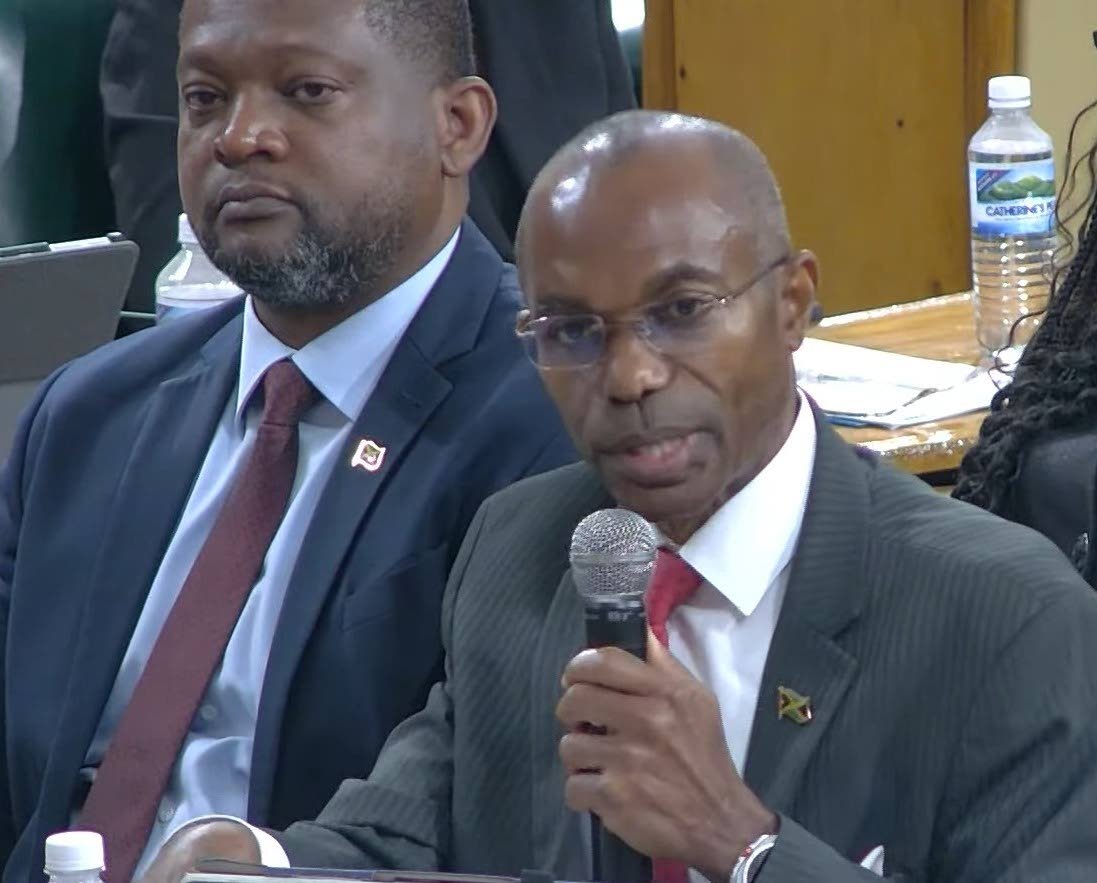
Permanent secretary in the Office of the Prime Minister Ambassador Rocky Meade (right) addresses Wednesday’s meeting of Parliament’s Public Accounts Committee as Director General in the Office of Disaster Preparedness and Emergency Management Commander Alvin Gayle looks on.
“The bottom line to the point is that the totality of the donations we got included cash and kind, and the priority was to use up the resources in kind first. So by reporting that at a certain point, only a small percentage of the donated funds were used, it doesn’t capture the fuller picture that of all the donations, including the kind… we did substantially use up the donations in kind to provide for the immediate need, and it was a part of the plan that most of the funds that were donated would be used for the more medium-term sustainable recovery, including the housing solutions, [and] that’s the context,” he said.
While acknowledging that approach, Robinson said the public had not been given sufficient information to understand why the money remained largely untouched months after the hurricane.
“It’s important to note because people did fundraisers, people went out of their way, and so if you hear eight months post a hurricane that only two per cent of the money has been used, come next hurricane, people aren’t going to be inclined to run and support a fund of this nature… So the communication on that particular issue, I believe, should have been done earlier, probably immediately after the report came out so that there was some greater understanding of what the plan was,” said Robinson.
Meade accepted that the Government could have done more to communicate its strategy, although he maintained that information had been shared through several channels.
“I certainly accept the point that if you saw a gap in communication, it means we didn’t do enough. I can assure you that communication was done, but clearly if there are persons who didn’t hear it, we didn’t do enough… I accept your point in principle, and we will do even more than we did,” said Meade.
Updating the committee on the recovery programme, Meade said the cash donations are now being used to support the modular housing initiative, including the construction of foundations and installation of utilities.
He disclosed that the Government had initially targeted the procurement of 2,500 modular units, with about 1,200 already in Jamaica for families who suffered total or near-total loss of their homes during Hurricane Melissa.


