



TJH pursues new revenue streams
TRANSJAMAICAN Highway Limited (TJH) is looking beyond its existing toll road operations, pursuing opportunities to operate the Montego Bay Perimeter Road and participate in future highway developments.
The company’s expansion strategy centres on the Government’s Montego Bay Perimeter Road Project, which is the first component of the proposed Highway 2000 Phase 2B extension linking Mandeville and Montego Bay.
“We have now begun discussions, both with the Government of Jamaica and with CHEC (China Harbour Engineering Company) about how we can participate in that project,” said Chief Executive Officer Ivan Anderson during the company’s annual general meeting on Thursday.

Company Secretary and Chief Financial Officer Susan Brown presents results on the Wiliamsfied toll plaza at the TJH AGM on Thursday at Pegasus hotel in Kingston.
The US$274-million project, being implemented by the National Road Operating and Constructing Company (NROCC) and constructed by CHEC, includes a 15.1-kilometre tolled bypass around Montego Bay, the Long Hill Bypass and upgrades to major road corridors. The Montego Bay Bypass is scheduled for completion between September and October 2026, while the Long Hill Bypass and Barnett Street works are due in January and March 2027, respectively. The bypass would provide an opportunity for interoperability with NROCC’s tolling system and allow TJH to submit an operating proposal. That project is one of several opportunities TJH is pursuing as it looks beyond its existing concession, with discussions also underway regarding the proposed North-South and East-West highway extensions.
TJH’s pursuit of new opportunities comes as it continues to strengthen its financial performance. For the year ended December 31, 2025, revenue rose 10 per cent to US$91.2 million, while net profit increased 21 per cent to US$37.9 million, supported by higher traffic volumes and lower financing costs.
“As we have more profits and our debts are paid down, we expect that the dividends will increase,” he said.
The company has already been increasing shareholder distributions. After paying dividends of US$7.5 million each in April and October 2024, TJH raised each of its semi-annual dividend payments to US$10 million in April and October 2025. The latest payment rose to US$13 million in April 2026, 30 per cent above the preceding semi-annual dividend. Anderson added that the company remains committed to the dividend policy outlined during its initial public offering, under which profits not required for operations are distributed to shareholders. The company also reported stronger-than-expected performance from the May Pen-to-Williamsfield leg of Highway 2000, which TJH began operating on December 27, 2025. The segment generated US$3.5 million of revenue in the first quarter of 2026, exceeding the company’s forecast of US$2.3 million by 52 per cent and accounting for 12 per cent of group revenue during the period.
“The forecast anticipated that the majority of the traffic will come from the shorter leg; however, what we’re seeing is persons are coming on to the highway and staying on for the full journey and that is translating in the revenue results you’re seeing today,” said Company Secretary and Chief Financial Officer Susan Brown.
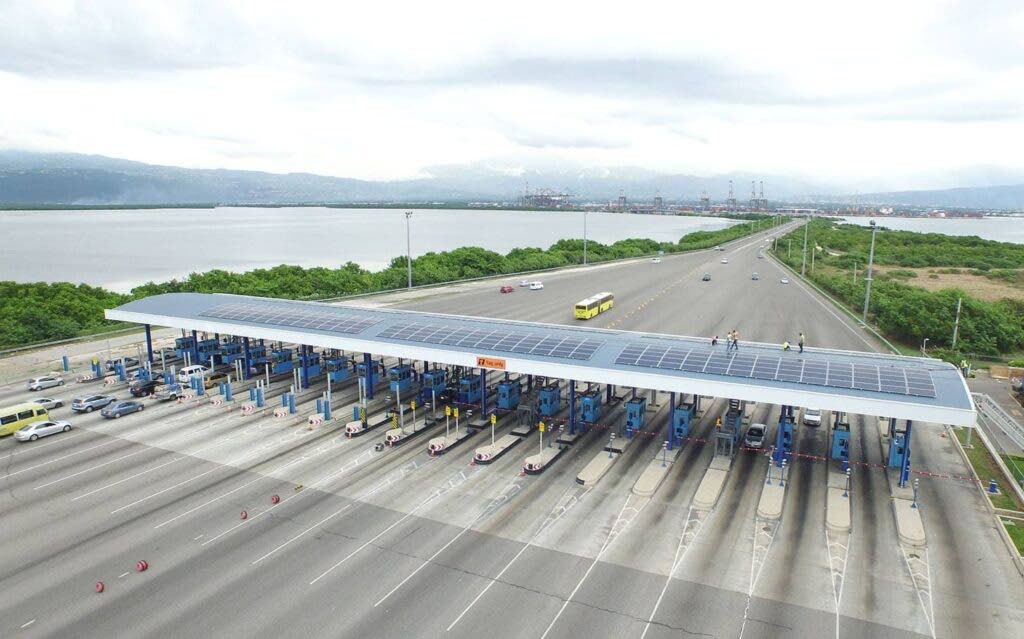
The Portmore Toll Plaza, where nearly 80 per cent of motorists travelling during peak periods now use T-Tag, according to TransJamaican Highway Limited. The company is targeting 60 per cent T-Tag adoption across its network by year-end and 80 per cent by 2028 or 2029..
The CEO also outlined plans to accelerate adoption of the company’s electronic toll payment system, T-Tag, as part of efforts to improve traffic flow and reduce congestion. He said TJH is targeting 80 per cent T-Tag usage by 2028 or 2029, up from 56 per cent at the end of June, after ending 2025 at 49 per cent. The company is aiming to reach 60 per cent by the end of 2026. Ahead of the new cash toll rates taking effect on August 1, he urged motorists to switch to T-Tag, noting that T-Tag rates will remain unchanged until October 31, 90 days after the new cash rates take effect. T-Tag users also continue to benefit from lower toll rates than motorists paying cash. He added that adoption is already high during peak periods on the Portmore leg of Highway 2000.
“Almost 80 per cent of those using the toll during peak periods on the Portmore toll leg are using T-Tags,” he said. “In 2025, we had two million fewer people in our manual lanes. That means fewer delays and more time saved.”
Meanwhile, the company is also in discussions with the Government on renewing its highway concession well before the current term expires in 2036. The concession agreement includes an option to extend the term by a further 35 years. An earlier renewal, Anderson said, would allow TJH to plan investments in future highway projects with greater certainty while supporting its long-term growth strategy.
TransJamaican Highway Limited is looking to expand beyond its existing toll road operations, pursuing opportunities to operate the Montego Bay Perimeter Road and other future highway projects.


