



New trafficking threat
Jamaican law enforcement agencies confirm ‘cyber factories’ are now operating locally
THE growing international threat dubbed cyber factories — where human trafficking victims are held captive to commit online fraud — has made its way to Jamaica.
Minister of National Security and Peace Dr Horace Chang on Friday confirmed Jamaican law enforcement agencies have detected cyber factories operating in the island and are moving quickly to seal the breach.
According to Chang, the Jamaican authorities are fully equipped to prevent this illicit operation from expanding.
Born in Southeast Asia cyber factories, or scam compounds as they are sometimes called, represent an industrial-scale crime economy that turns jobseekers into human trafficking victims, who are then forced to commit various cybercrimes.
According to the International Organisation for Migration (IOM), victims from more than 80 countries are being trafficked to work in these online scam centres.
The revelation of Jamaica being added to that list of countries came on Friday during a ‘Conversations on Trafficking’ staged by the Office of the National Rapporteur on Trafficking (ONRTIP) at the Courtyard by Mariott Hotel in New Kingston to mark World Day Against Trafficking in Persons 2026.
As panellists discussed the rapid expansion of multi-billion-dollar modern slavery networks across Asia, it was confirmed that similar scam-compound cases have now been detected in Jamaica.
When questioned about the domestic prevalence of these human trafficking rings, Chang told the
Jamaica Observer that while their mere presence on the island poses a clear threat, the issue is not widespread and remains under strict monitoring by the relevant authorities.
“We have some good people working quietly and effectively between the various security agencies… MOCA [Major Organised Crime and Anti-Corruption Agency], the Jamaican Constabulary Force, and the JDF [Jamaica Defence Force]. They work together, and we collaborate with our international partners because cybercrime has no boundaries and therefore you can track and find them in this region,” said Chang.
“So it’s not yet as big a threat risk as it is in Southeast Asia, but it’s something that requires continuous monitoring, continuous work, and it means also keeping our own personnel trained and in place at all times,” added Chang.
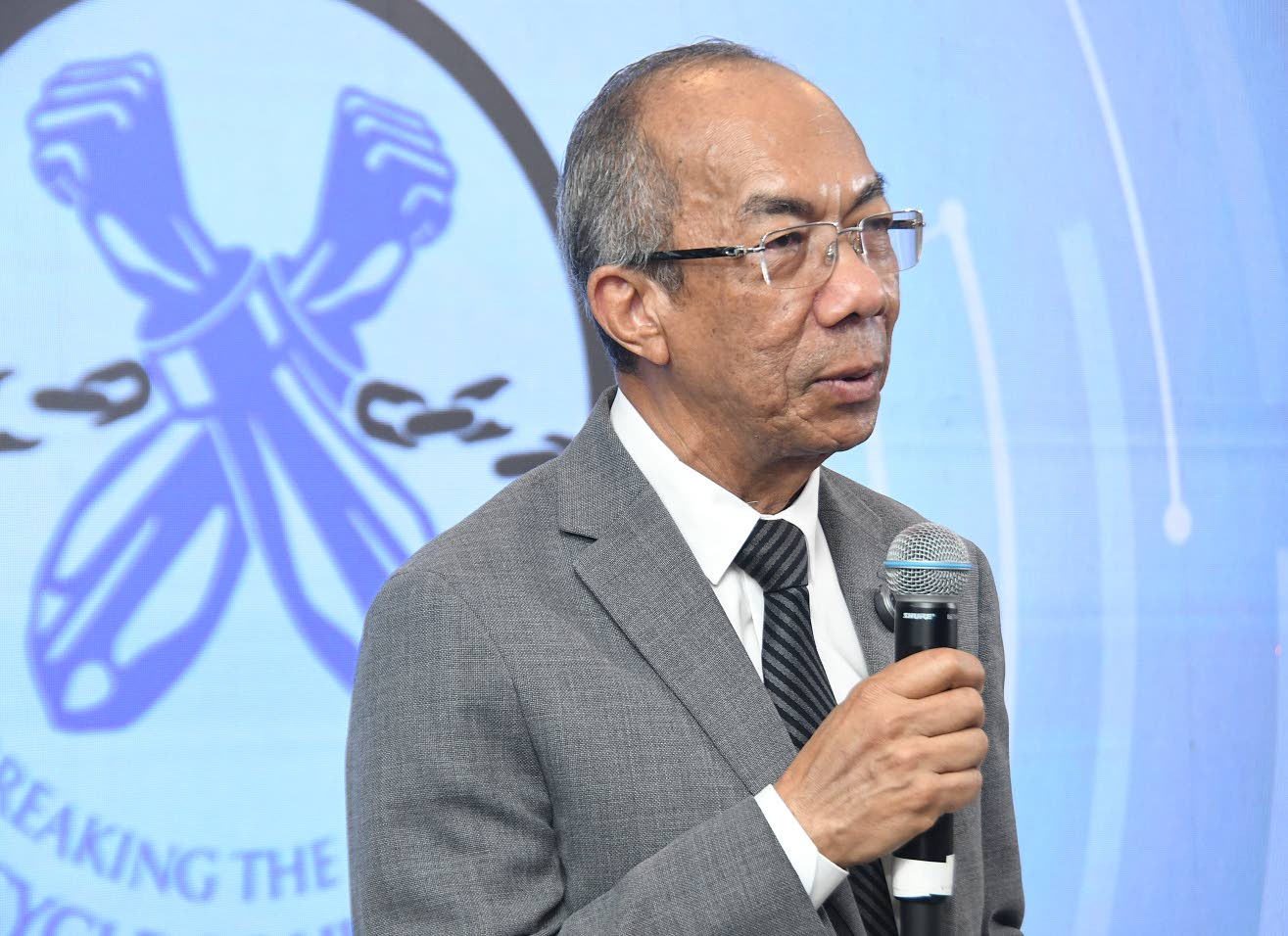
Deputy Prime Minister & Minister of National Security Dr Horace Chang, delivering his address at the ‘Conversations on Trafficking’ event planned by the Office of the National Rapporteur on Trafficking (ONTRIP) held at the Courtyard by Mariott Hotel in New Kingston on Friday. Naphtali Junior
The security and peace minister argued that, while robust law enforcement deterrence is essential, he also has confidence in public education initiatives such as the ‘Conversations on Trafficking’ forum and other Government-led initiatives that arm citizens with information needed to recognise and avoid these traps.
He further noted that a critical method for keeping human traffickers at bay is for people to actively report suspicious digital activity to law enforcement, rather than simply blocking the accounts when they are detected.
“So, part of what we are hoping is to use… maybe not so much the security, but just to sensitise a wider population so that they will know when to report to the security agencies, in particular the police and MOCA, which are on the front line,” said Chang.
“Tell the parents, ‘Mommy, look at this, look at that,’ to alert somebody else. Show a teacher what this is saying… We need to get that because our team, though limited in numbers and size, are capable and have confidence. Once they get the information, we can work at it. But it’s a rapidly evolving area, especially with artificial intelligence coming up. But we’ll keep working on it,” Chang added.
Meanwhile, event panellist and MOCA Senior Special Agent Shereese Smith told the
Observer that, while extensive data does not exist on who is most vulnerable to these illicit schemes in Jamaica, international monitoring by the agency reveals that women seeking employment are among the primary targets.
“You fall victim to a job offer, you visit this place thinking you’re going to receive a modelling job. But once you land at this location they take your travel documents, you owe them money, you’re in debt now for bringing you there,” she explained.
“And so, you are now required to work for that person. So, they control your movement, they control your finances, they control your communication, and you’re in this space… you are now committing some other crime for these individuals… And when we say they control you, a lot of them is like an armed controller, you know, in terrible conditions with other victims under violence,” she added.
Smith told the Observer that MOCA is currently monitoring the issue and working hard at containing human trafficking and fraud schemes across Jamaica. She urged citizens to report suspicious activity and to use the cyber space with greater awareness and caution.
“If you see this specific agency saying, ‘recruiting, send us your passport, we will cover your flight, your stay, this, your that’, if it is the name is an actual company, reach out to the company itself instead of speaking through that social media platform, just try to verify as much as possible. Or if it’s something that’s suspicious, report it and we will try to get it taken down,” said Smith.


