



Appeal court orders FTC to revisit Supreme Ventures probe
THE Court of Appeal has ordered the Fair Trading Commission (FTC) to reconsider its investigation into Supreme Ventures Limited (SVL), ruling that the regulator did not give the lottery company and its gaming subsidiary a fair opportunity to answer allegations that they had abused a dominant market position.
The decision leaves the allegations unresolved and raises questions about a related enforcement lawsuit against SVL and Prime Sports (Jamaica) Limited, now Supreme Ventures Gaming Limited.
The FTC alleges that the companies terminated or threatened to terminate agreements with retailers that also distributed competitors’ games, restricting rivals’ access to an established network and increasing their costs.
It also alleges that SVL’s application to offer Cash Pot payouts of up to 50 to one could have discouraged potential competitors from entering the lottery market.
In its 2024 lawsuit, the regulator is asking the Supreme Court to declare that the conduct breached the Fair Competition Act, impose a penalty of up to $5 million for each contravention and restrain any conduct found to be unlawful. The case was stayed after the court described the disputed FTC report as a “cornerstone” of the action.
The Court of Appeal’s July 31 ruling did not determine whether SVL and its subsidiary engaged in anti-competitive conduct. The judges declined to declare their actions lawful, saying that such a finding should follow a thorough investigation and report.
The court ordered the FTC to disclose the material on which it relied and relevant information in its possession that could assist the companies, unless it provides a valid reason for withholding it.
The companies must then be allowed to respond before the FTC reconsiders the matter and either amends its report or prepares a fresh one.
The court set aside the May 2023 orders of the Supreme Court judge who had upheld the FTC’s revised findings. It did not expressly quash either the original or revised report, although it said deficiencies in the investigation undermined their reliability.
The appeal court also found that the Supreme Court judge had not properly considered evidence submitted by SVL and its subsidiary when assessing conclusions reached on an incomplete investigative record.
The FTC said it needed to consult its lawyers before answering Jamaica Observer questions about the judgment and the future of its lawsuit. It had not provided a substantive response up to press time.
SVL executive chairman Gary Peart described the ruling as “groundbreaking” and said it established a new standard for FTC investigations.
“The ruling is groundbreaking; it sets a new standard for how the FTC has to conduct its future investigations,” Peart said in written responses to Business Observer.
He declined to speculate about the commission’s next move, saying: “SVL cannot speak about what the FTC may or may not do.”
SVL was Jamaica’s sole lottery operator for more than two decades before Mahoe Gaming Enterprises Limited and Goodwill Gaming Enterprises Limited entered the market in February 2021.
The FTC’s investigation cited 48 retailer agreements terminated within two weeks of Mahoe beginning operations. It concluded that SVL had strategically terminated or threatened to terminate agreements with retailers dealing with competing operators.
The investigation followed a complaint from Moneypost Enterprise Limited, which alleged that its agreement was terminated after it entered an arrangement with a new lottery operator. The FTC also received complaints from three other retailers.
Peart denied that SVL used its network to impede competitors. He said the company did not know how many of the 48 terminated retailers had agreements with competing operators, but said several SVL retailers carried competitors’ terminals at the time and that some still do.
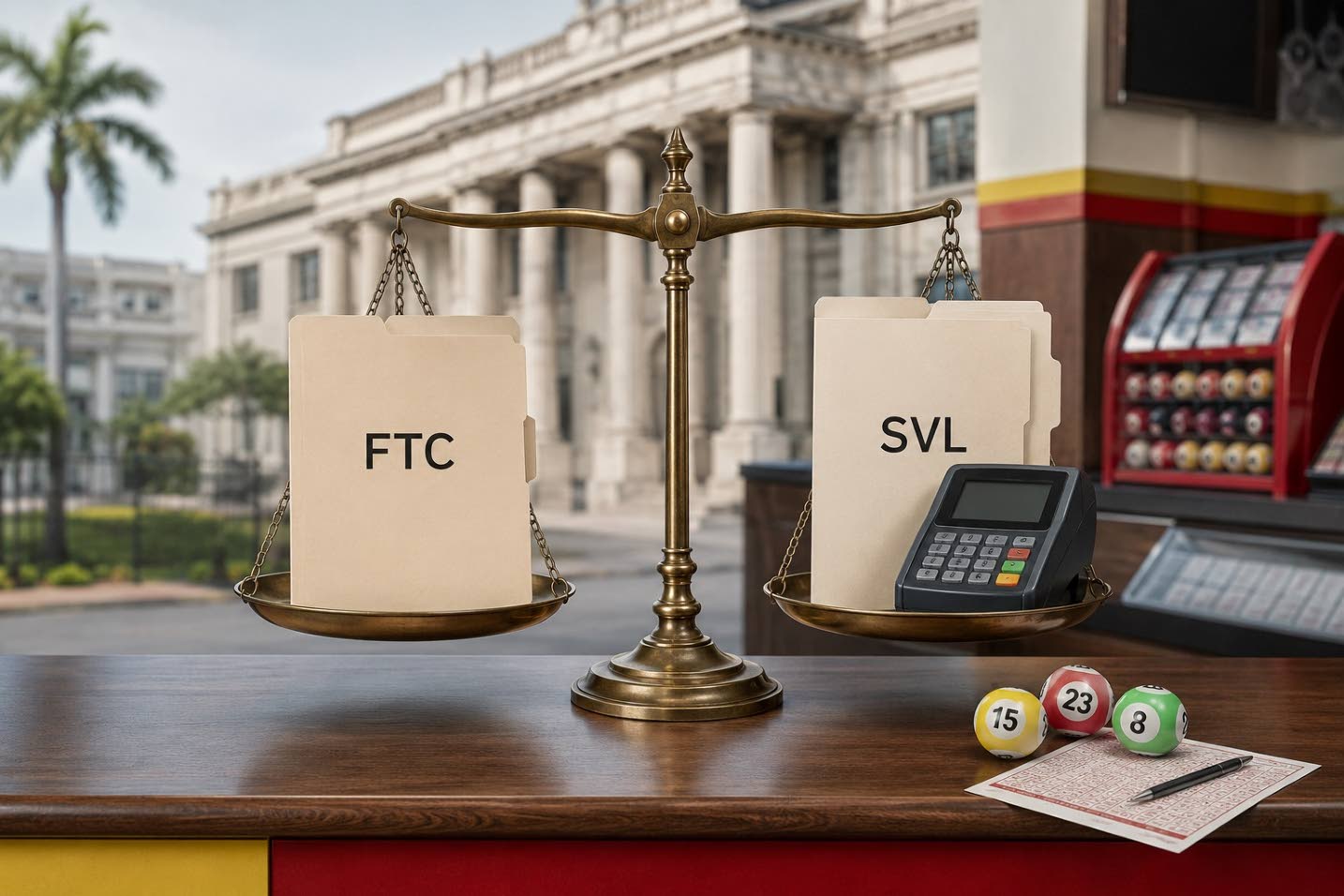
The Court of Appeal has ordered the Fair Trading Commission to reconsider its investigation into Supreme Ventures Limited and its gaming subsidiary after finding that the companies were not given a fair opportunity to answer two central allegations. The court did not determine whether the companies breached competition law. (Photo: AI-generated )
Citing an unidentified study estimating that Jamaica has approximately 30,000 shops, Peart said SVL had terminals at about 1,400 locations, or fewer than five per cent of that total. He questioned how the company could have abused a dominant position when other locations were available.
The estimate covers shops generally and does not measure SVL’s share of active lottery outlets or lottery ticket sales. Peart did not provide those figures.
Under the Fair Competition Act, dominance depends on whether an enterprise has sufficient economic strength to operate without effective constraints from existing or potential competitors. Holding a dominant position is not itself unlawful; the issue is whether that position was abused.
SVL has said the terminations formed part of a wider realignment of its distribution channels involving mobile agents, online games and applications, rather than retaliation against retailers dealing with rivals.
The Court of Appeal neither accepted nor rejected that explanation, finding that SVL’s evidence had not been adequately investigated or evaluated.
The second allegation concerns SVL’s application to offer Cash Pot payouts of up to 50 to one, which the Betting, Gaming and Lotteries Commission (BGLC) rejected.
In correspondence that prompted the FTC investigation, the BGLC warned that a well-resourced operator could sustain unprofitable payouts in an attempt to push a rival from the market. The FTC said seeking approval for such payouts could discourage potential competitors from entering.
SVL disputed that analysis, arguing that profitability should be judged over the medium to long term rather than from isolated results. Peart declined to disclose the company’s financial analysis, saying that doing so could prejudice its defence if the FTC continues the case.
The Court of Appeal did not decide whether applying for the higher payout could constitute a breach of the Act.
The procedural dispute centred on what the FTC disclosed during its investigation. In August 2021 the regulator told SVL that it was investigating a possible breach of sections 19–21 of the Act and requested information about retailer agreements terminated between 2015 and June 2021.
The court said that notice did not tell SVL that the FTC was specifically examining whether agreements had been terminated because retailers were dealing with competitors. When it considered SVL’s information insufficient, the FTC sought further material from the BGLC instead of identifying the gaps and allowing SVL to respond.
SVL was also not told that the 50-to-one application formed part of the investigation. The judges said those omissions impaired the companies’ ability to decide whether to exercise their statutory right to request a hearing.
The FTC’s February 2022 report incorrectly stated that SVL had received approval for the higher payout. It corrected the error in June but maintained that the companies’ conduct was likely to impede competition and breach the Act.
The appeal court said the correction and evidence later presented in court could not cure the failure to give SVL an opportunity to answer the allegations before the findings were published.
The FTC argued that it was investigating rather than adjudicating and could not impose penalties. The court agreed that sanctions required Supreme Court proceedings but said the regulator was still required to act fairly because its published findings could support enforcement action and cause reputational harm.
The appeal was allowed, the matter returned to the FTC and costs awarded to SVL and Prime Sports.
Unless the ruling is stayed or overturned, the FTC must reconsider the matter in accordance with the court’s directions. The allegations remain undecided, and the commission has not said how it will proceed with its enforcement lawsuit.


