



NOT TRUE!
CCJ president fires back at critics, condemns leak of confidential material
Caribbean Court of Justice (CCJ) President Justice Winston Anderson on Friday broke his silence on allegations surrounding his leadership of the regional body, describing as “entirely unfounded and untrue” suggestions that he interfered with the composition of panels and sought to influence judgments.
At the same time he characterised the disclosure of a series of e-mail between himself and colleague judges to the
Sunday Express newspaper in Trinidad and Tobago “as the most troubling aspect of this entire episode”, and condemned, “in the strongest possible terms, the unauthorised disclosure and publication of confidential material relating to the internal deliberations and confidential correspondence of the court”.
According to Justice Anderson, “such disclosures and their publication are wholly unacceptable and strike at one of the fundamental principles upon which every independent judiciary depends”.
“It erodes trust in the sanctity of judicial deliberations and judicial collegiality. It erodes public trust and confidence in the Third Branch, and it does untold harm to the people we are sworn to serve and betrays the trust and confidence placed in us,” the CCJ president stated.
The Sunday Express had reported that in the e-mail exchanges, a majority of the judges accused Justice Anderson of governing the regional court in an “authoritarian” and “dictatorial” manner.
The complaints, as reported by the newspaper, range from accusations of Justice Anderson unilaterally imposing a judicial dress code to allegations of “panel fixing” and attempts to influence the outcome of cases.
Addressing the allegations further, Justice Anderson said, “Perhaps the most serious wound is the suggestion that panels of the court have been constituted or altered in order to secure a particular outcome in a case.
“Such an allegation strikes at the very heart of judicial independence and public confidence in the administration of justice. It therefore warrants a clear and direct response. The allegation is wholly untrue. No judge of this court can or should be restrained from expressing his or her judicial views, or from deciding any matter according to his or her independent assessment of the law and the evidence,” Justice Anderson stated.
He said that it was “with particular concern” that he “noted suggestions in the public domain” that he has sought to influence the outcome of cases before the court.
“Those allegations are entirely unfounded and untrue,” Justice Anderson declared while explaining that a little known fact is that, “in the original jurisdiction of the court, no dissenting judgments are published”. However, the CCJ president maintained that, “the principle of unanimity is a standard practice in international courts exercising jurisdiction of this type”.
“The suggestion that judicial views were suppressed, or that any judge was directed to reach a particular conclusion, is therefore wholly without foundation. Throughout my judicial career, both as a judge and now as president, I have regarded judicial independence as inviolable. It is a principle that I have consistently defended and will continue to defend,” Justice Anderson said.
Detailing the constitution of panels within the court, the CCJ president pointed out that “the inferential leap required to elevate the issue of Bench attire to an allegation of panel-fixing is irresponsible, intellectually dishonest, injudicious and, quite simply, malevolent!”
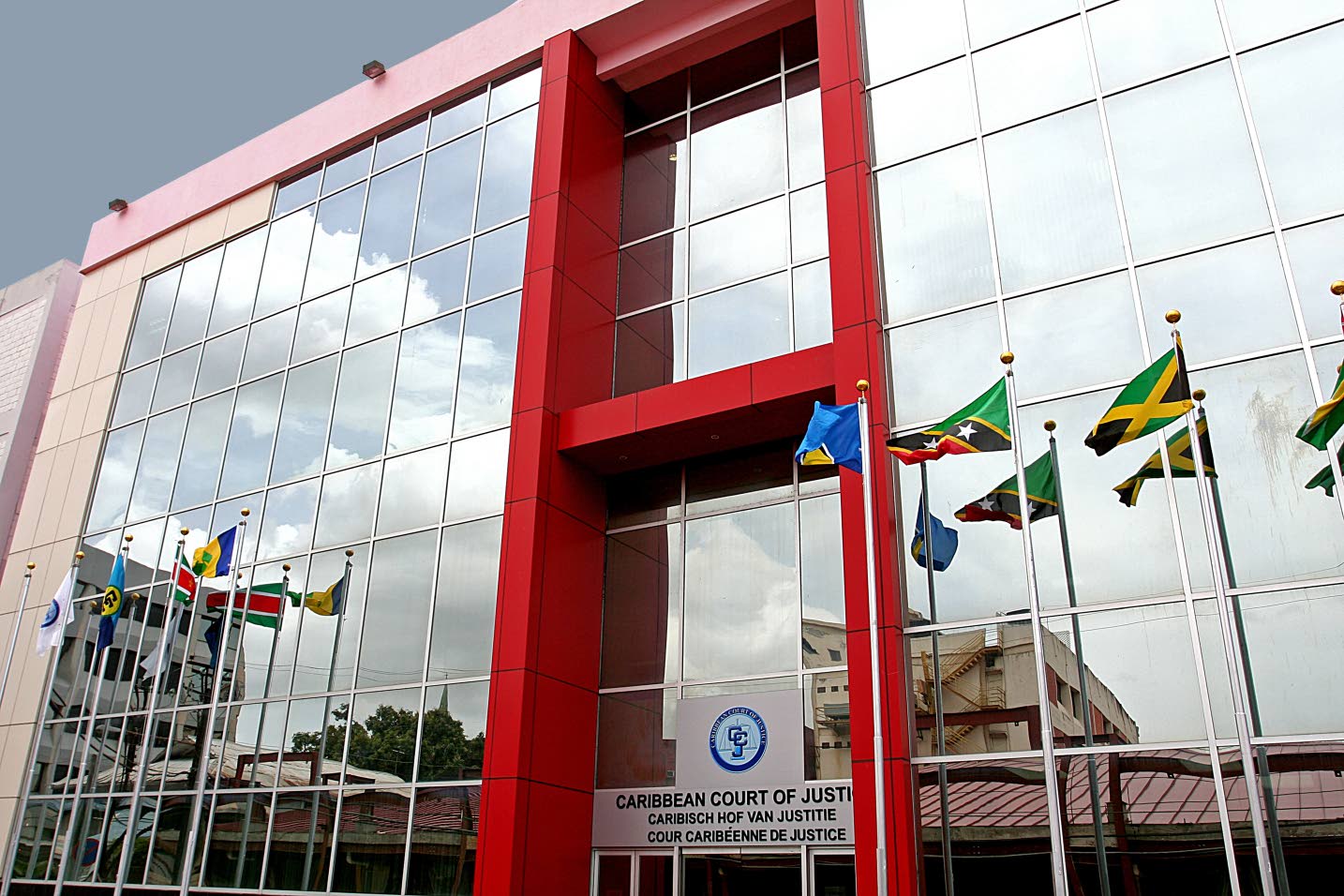
Caribbean Court of Justice building in Trinidad.
“Accordingly, I reject entirely the suggestion that panels of this court have been constituted or altered to secure predetermined outcomes. Such allegations are unsupported by the facts, inconsistent with the court’s long-established practices, and contrary to the principles upon which this court has operated since its establishment,” Justice Anderson stated.
He however said, in putting that matter to rest going forward, “every judge of the court will be required to sit on every panel, unless the judge opts out for a legitimate reason and is excused”.
Responding to reports that he had taken a high-handed approach in deciding on the judicial dress code, the CCJ president provided the background to that development. He conceded that while he “may have approached the matter of the handling of the issue of the dress code too strongly”, he did so because he “regarded it as an institutional issue concerning the appearance, consistency and tone of the court, rather than a question directed at any individual judge”.
Said Justice Anderson: “The CCJ is the apex court for a diverse Caribbean region and population. Dress codes set by the CCJ will have implications for all courts of member states as well as for the region. The idea of individual judges adopting their own interpretation of national or traditional dress would seem to be at odds with the very concept of a Caribbean court.”
He added that “if it is the view of the region that national dress is appropriate for judges to wear on the Bench, the inevitable question of what is ‘national dress’ in a Caribbean context of diversity must be determined”.
“This must be determined by the people of the region and toward this end I propose to engage all national courts in this consultation,” Justice Anderson said further.
Addressing commentary about his meetings and discussions with the president and leader of the Opposition of Guyana regarding the prolonged acting appointments of the chancellor and chief justice of that country, Justice Anderson made it clear that he had “no personal interest or preference in who is appointed” to both positions.
“My concern has always and only been confined to the constitutional principle that the judiciary should be headed by substantively appointed office holders enjoying the full constitutional protections intended by the framers of the constitution,” Justice Anderson insisted. He said while in retrospect he believed “another course would have been much better” his actions were fed only by his concern about “the preservation of judicial independence and the constitutional integrity of the Guyanese judiciary”.
“Those considerations alone informed my actions and comments. They were not motivated by any political or other preference, personal interest, or any desire to intervene in the domestic affairs of Guyana beyond what I regarded as my responsibility as president of the final appellate court for that jurisdiction to ensure constitutional protection of the judiciary,” Justice Anderson said.
On Wednesday, the heads of judiciary of Barbados, The Bahamas, Belize, Guyana, the Eastern Caribbean Supreme Court, Jamaica, and Trinidad and Tobago — which subscribe to the original and/or appellate jurisdictions of the CCJ — in a media release said, while they “do not consider it appropriate to comment upon the merits of statements or allegations attributed to individual judges, nor upon matters arising within the internal deliberative or administrative processes of the court”, they were gravely concerned “about the breach of confidentiality which resulted in the disclosure of what appear to be internal communications”.
Said the heads of the judiciary: “We remain confident in the Caribbean Court of Justice as a vital regional judicial institution and in the commitment of its judges to the principles which underpin the administration of justice throughout the Caribbean”.


