



Jamaica joins global talks on drought resilience in Mongolia
More than three billion people affected by water shortage worldwide each year
DELEGATES from 196 countries, including Jamaica, have gathered in Ulaanbaatar, Mongolia, for the 17th session of the Conference of the Parties (COP17) to the United Nations Convention to Combat Desertification (UNCCD).
Over the next two weeks, governments, financial institutions, businesses, scientists and civil society will work to advance practical solutions, forge new partnerships and mobilise investment for land restoration and drought resilience, while negotiate decisions on drought, rangelands, agricultural lands and soils, resource mobilisation, private-sector engagement and the convention’s future strategic direction.
Jamaica is being represented by head of delegation, minister of state in the Ministry of Labour and Social Security Donovan Williams — who is scheduled to arrive at the conference on Friday — and Patrick Watson, senior director for hazard mitigation and risk management in the Ministry of Local Government and Community Development.
The decisions, partnerships and initiatives launched at UNCCD COP17 are expected to strengthen international cooperation on sustainable land management, land restoration and drought resilience over the coming years, at a time when countries are facing increasing pressure from land degradation, water scarcity and climate change.
Land degradation and drought are estimated to cost the global economy nearly US$900 billion every year and already affect up to 40 per cent of the world’s land and 3.2 billion people.
Droughts have increased by almost one-third since 2000 and now generate at least US$300 billion in annual losses.
As the first of the three Rio Convention COPs taking place in 2026 — ahead of the biodiversity and climate conferences — COP17 provides an opportunity to strengthen cooperation across the Rio Conventions and accelerate practical action on land degradation, biodiversity loss, climate change, food and water security, and water resilience.
In welcoming delegates prime minister of Mongolia Nyam-Osoryn Uchral said: “The greatest change we want to see from COP17 is a shift from talk to action, from targets to implementation, and from commitments to measurable results. Mongolia therefore calls for tangible progress at this conference.
“First, let us address land, climate and biodiversity not as separate issues, but as interconnected challenges. Second, let us increase investment in land restoration and take cooperation between governments, international financial institutions and the private sector to a new level.”
He added: “Third, let us make drought resilience not only an environmental policy issue, but a core part of development policy. Fourth, let us place the knowledge and participation of rangeland users, herders and local communities at the centre of global land management policy.
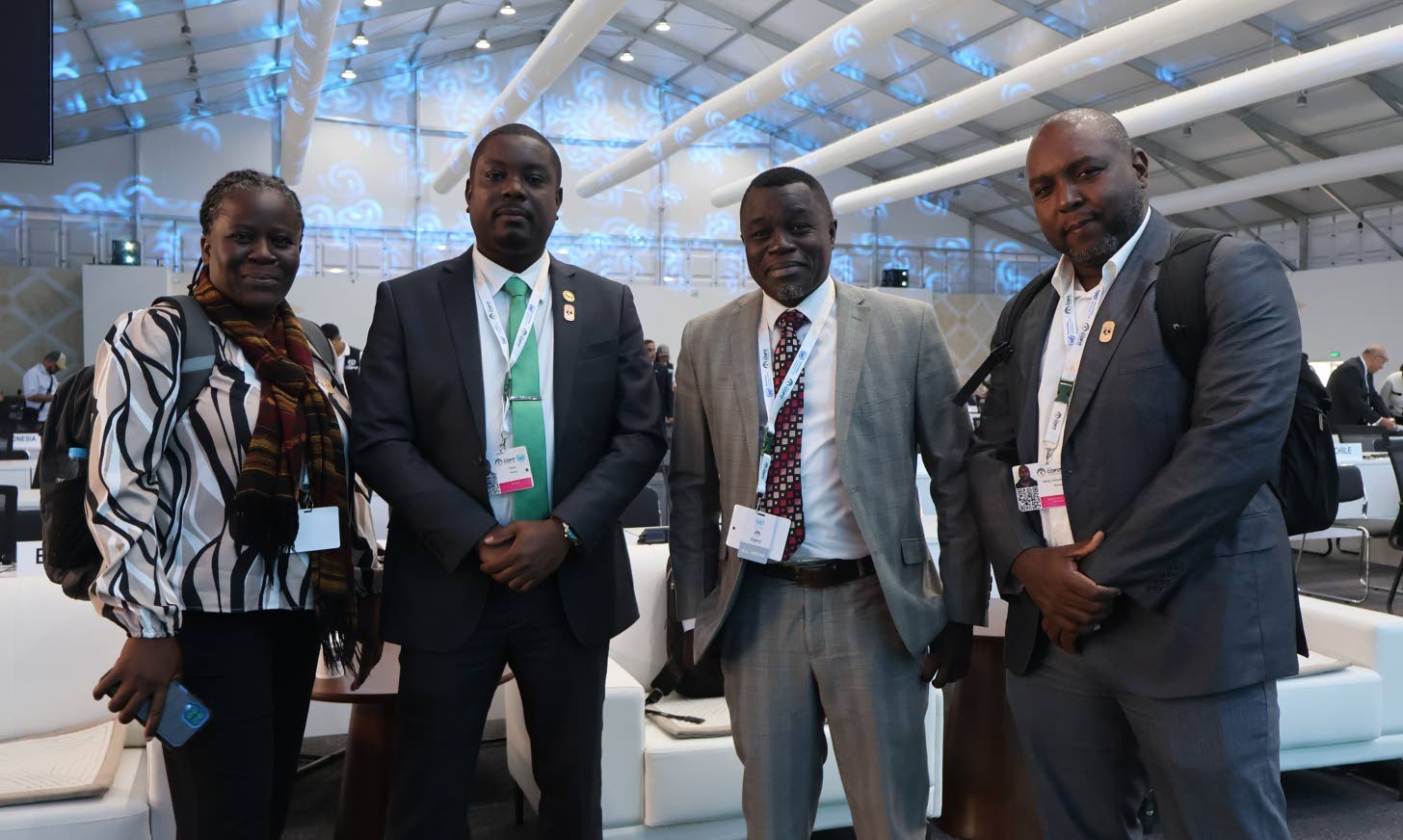
One of Jamaica’s representatives to the 17th session of the Conference of the Parties (COP17) to the United Nations Convention to Combat Desertification (UNCCD) Patrick Watson (second right) is joined by (from left) Sophia Henry, science and technology correspondent from St Vincent and the Grenadines; Dr Ronen Francis, executive director of the Partnership Initiative for Sustainable Land Management; and Karomo Browne, who was elected vice-president of the CRIC (Committee for the Review of the Implementation of the Convention) Bureau at COP17, now taking place in Ulaanbaatar, Mongolia.
“Fifth, let us turn science, technology and innovation into practical solutions and real investment. Sixth, let us work together to create the enabling conditions to turn commitments into measurable results.”
Building on the progress made at COP16 in Riyadh, governments at COP17 will continue discussions on a global policy framework on drought while strengthening the practical tools, partnerships and financing mechanisms needed to help countries turn drought plans into action. Parties will discuss measures to strengthen preparedness, early warning systems, vulnerability assessments and international cooperation.
More than 70 countries have now developed national drought plans, compared with only three in 2013, reflecting growing recognition that drought must be managed proactively rather than only once it becomes a humanitarian and economic crisis.
COP17 will also feature new tools and partnerships to help countries strengthen drought preparedness and resilience, including announcements related to the Riyadh Global Drought Resilience Partnership, the Drought Resilience Investment Facility, and the International Drought Resilience Observatory as well as other related programmes and projects.
Mobilising greater public and private investment for land restoration and drought resilience will be one of the defining priorities of COP17.
An estimated US$355 billion is needed every year to combat land degradation and drought, yet current investment stands at only around US$77 billion, leaving an annual financing gap of US$278 billion.
Despite depending heavily on healthy land and reliable water supplies, the private sector currently provides only around six per cent of global land restoration and drought resilience finance. Public resources alone are unlikely to close the gap, highlighting the need to strengthen collaboration between governments, development banks, businesses and investors.
COP17 will explore how to unlock new sources of finance, strengthen incentives for sustainable land management, reduce investment risks and better align public and private investment with land restoration and drought resilience goals through discussions and examining new tools to leverage the existing pledges at the regional and national levels.
The conference will illustrate progress on initiatives such as Business4Land, which aims to strengthen private sector engagement and partnerships for land restoration and drought resilience.


