



New ethics code coming for real estate sector
THE Real Estate Board (REB) is preparing to rewrite the ethical rules governing Jamaica’s real estate industry, with a new Code of Ethical Conduct
being developed to respond to a market that has changed significantly since the existing rules were introduced in 1998.
Digital property marketing, more complex transactions, changing investment activity, and heightened consumer expectations are among the developments prompting the regulator to revisit the 28-year-old framework.
According to the REB, the review could result in clearer standards covering how properties are advertised and represented, what information is disclosed to consumers, conflicts of interest, professional competence, and the relationships between real estate professionals and the parties involved in transactions.
“The existing Code of Ethics Regulations date from 1998. Over the past almost three decades the real estate market has evolved considerably, including changes in the nature and complexity of transactions, digital marketing and communication, investment activity, consumer expectations, professional practice, and the broader compliance environment,” Dr Tina Beale, senior director/principal of the Real Estate Training Institute/Real Estate Board, told the Jamaica Observer.
“The board therefore considers this an appropriate time to undertake a comprehensive review and modernisation of the ethical framework.”
The existing rules already address professional conduct, competence, client money, conflicts of interest, advertising, disclosure and fair treatment. But the REB now wants to determine whether those provisions remain sufficiently comprehensive and clear for the way property business is conducted today.
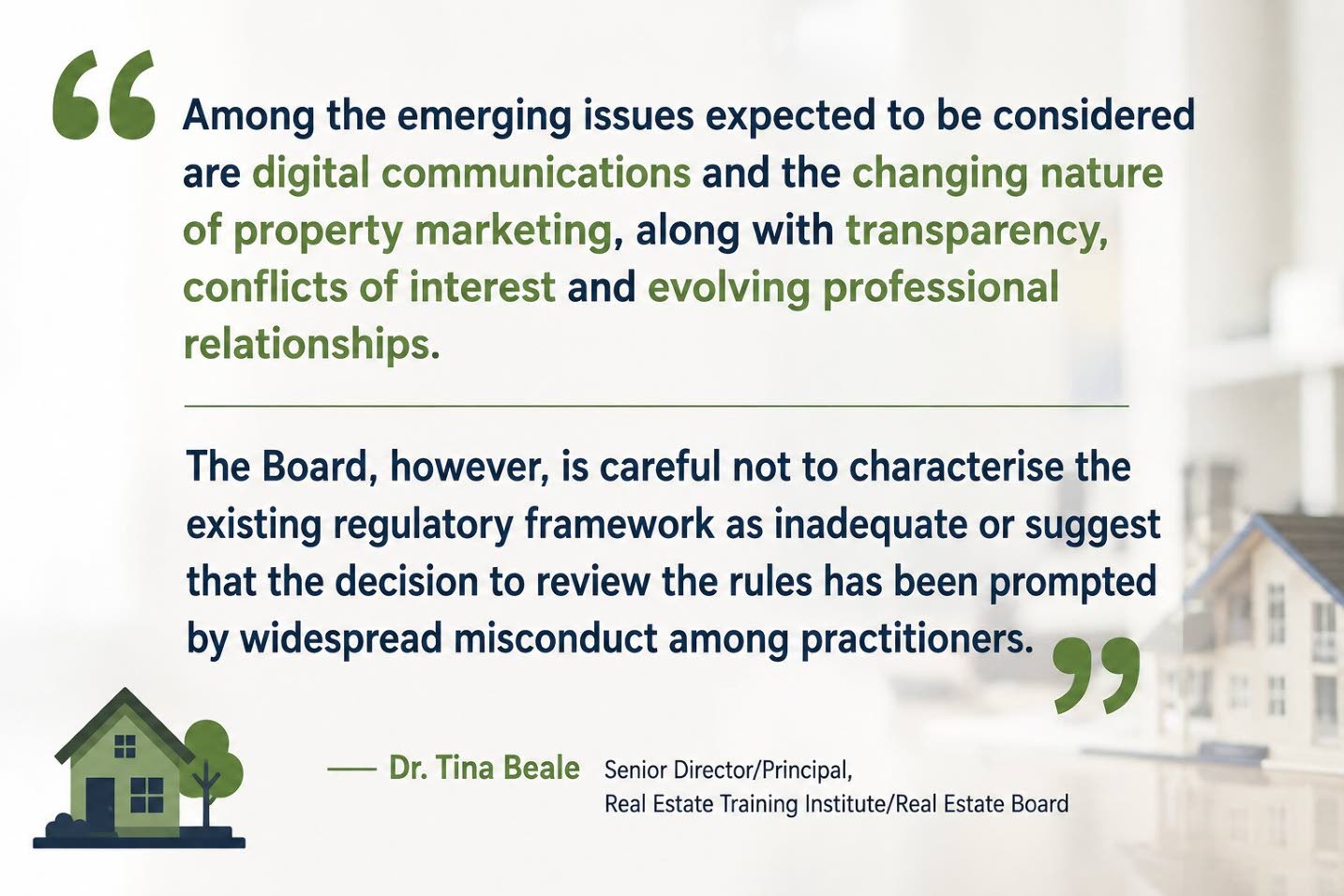
Among the emerging issues expected to be considered are digital communications and the changing nature of property marketing, along with transparency, conflicts of interest, and evolving professional relationships.
The board, however, is careful not to characterise the existing regulatory framework as inadequate or suggest that the decision to review the rules has been prompted by widespread misconduct among practitioners.
“The board would not wish to prejudge the outcome of the review or characterise the regulatory framework as being deficient. There are many practitioners who operate professionally and ethically,” Beale said.
“Instead, we recognise that regulation must evolve as markets evolve.”
She added that the exercise could eventually have implications for the information consumers receive when buying, selling or investing in property, and how clearly real estate professionals disclose their role and interests in a transaction.
Consumer protection, she said, will be a central consideration.
“This could include ensuring that consumers receive accurate and material information, understand the capacity in which a practitioner is acting, are informed of relevant conflicts, and have greater confidence that their interests are being handled professionally and transparently,” Dr Beale told Sunday Finance.
The proposed code is not intended simply to repeat requirements already contained in the Real Estate (Dealers and Developers) Act, its regulations, or existing professional standards.
Instead, the REB wants to develop a contemporary framework that translates broader legal and professional obligations into clearer standards of ethical conduct that practitioners can understand, apply, and to which they can be held accountable.
Exactly how that accountability will work has not yet been determined.
Dr Beale said the enforcement framework will depend on the legal form and authority under which the new code is ultimately adopted. She added that any enforcement or disciplinary measures would have to be consistent with the Real Estate (Dealers and Developers) Act and other applicable laws.
“Where legislative or regulatory amendments are required to give particular provisions effect, those would have to proceed through the appropriate legal and policy processes,” she said.
The first step, however, is assembling the group who will develop the new framework.
The REB recently invited expressions of interest for a five-member panel comprising a chairperson; three industry representatives; and an independent, public interest representative.
Once the panel is appointed it will begin developing the draft code before moving into stakeholder consultations and the subsequent process required for adoption and implementation.
The REB has not yet set a timeline for completing the exercise, saying further information will be provided once the panel has been constituted and its work programme established. It also said it would disclose the status of applications for the panel once the selection process is concluded.
Consumers could also get an opportunity to contribute before the rules are finalised. In addition to having an independent publicinterest representative on the panel, the REB said it will consider wider stakeholder and public consultation before the final framework is adopted.
The board said it ultimately wants ethical standards to become part of the culture of real estate practice in Jamaica as the industry continues to develop.
“The success of the initiative should ultimately be measured not simply by whether a code is adopted but by whether it results in improved understanding and compliance among practitioners, stronger consistency in professional conduct, better consumer experiences, and greater public confidence in the sector,” Dr Beale said.


