



A teachable moment
Dear Editor,
The story of Cooper’s Pen in Trelawny serves as a poignant micro-study of Jamaica’s broader challenges with land tenure, coastal development, and social equity.
Situated along the island’s rapidly developing northern corridor near Falmouth, this modest community has found itself at the nexus of a decades-long dispute involving informal settlers, private developers, state authorities, and local representatives. What began as a local struggle for shelter has evolved into a persistent legal, economic, and moral dilemma that underscores the friction between historical occupation and modern commercial growth.
At the heart of the Cooper’s Pen saga is the pervasive issue of informal land tenure in Jamaica. For generations, working-class families settled on coastal parcels of land, building homes and establishing community roots without formal legal titles. Historically, much of this land was considered low-value scrubland or an agricultural buffer zone. However, as Jamaica’s tourism footprint expanded eastward from Montego Bay towards Falmouth, the economic value of beachfront and highway-adjacent properties in Trelawny exploded. Overnight, land previously ignored by commercial interests became high-value real estate earmarked for resort developments, highway expansions, and commercial ventures.
This dramatic shift in land value inevitably sparked conflict. Private landowners and government bodies seeking to use or sell the parcels moved to assert legal ownership, often issuing eviction notices or demolishing structures to clear disputed areas. Conversely, long-term residents argued that decades of uninterrupted possession, open occupation, and investments in their homes granted them moral and legal claims under adverse possession principles. High-profile demolitions and police interventions over the years triggered fierce public protests, road blockades, and legal challenges, transforming Cooper’s Pen into a symbol of grass-roots resistance against perceived systemic displacement.
The unfolding situation at Cooper’s Pen in Trelawny is more than a land dispute, it is a moment that challenges Jamaica to examine how we balance development, justice, and human dignity. The demolition of homes in the early hours of the morning — an operation that left families disoriented, traumatised, and suddenly homeless — has rightly stirred national concern. It has also raised serious questions about the role and posture of the police when private enforcement intersects with vulnerable communities.
The Jamaica Observer’s readership is accustomed to deeper reflection, and Cooper’s Pen demands exactly that. This is not simply about whether a landowner possesses a title or whether residents overstayed their tenure; it is about how the State shows up when citizens — regardless of their legal standing — face displacement, uncertainty, and fear.
The presence of police officers at the demolition site has become a focal point of public debate. Even when acting within the law, the symbolism of armed officers standing over families losing their homes is powerful and painful. In a democratic society, policing must be more than the exercise of legal authority; it must be perceived as embodying legitimacy, restraint, and humanity. When operations appear rushed, opaque, or indifferent to the welfare of children and the elderly, they weaken public trust and undermine decades of work invested in community policing and partnership.
Several issues deserve urgent national attention:
• The timing and manner of the operation contradict best practices in eviction management. Predawn demolitions, without visible social service support, create unnecessary trauma and heighten security risks.
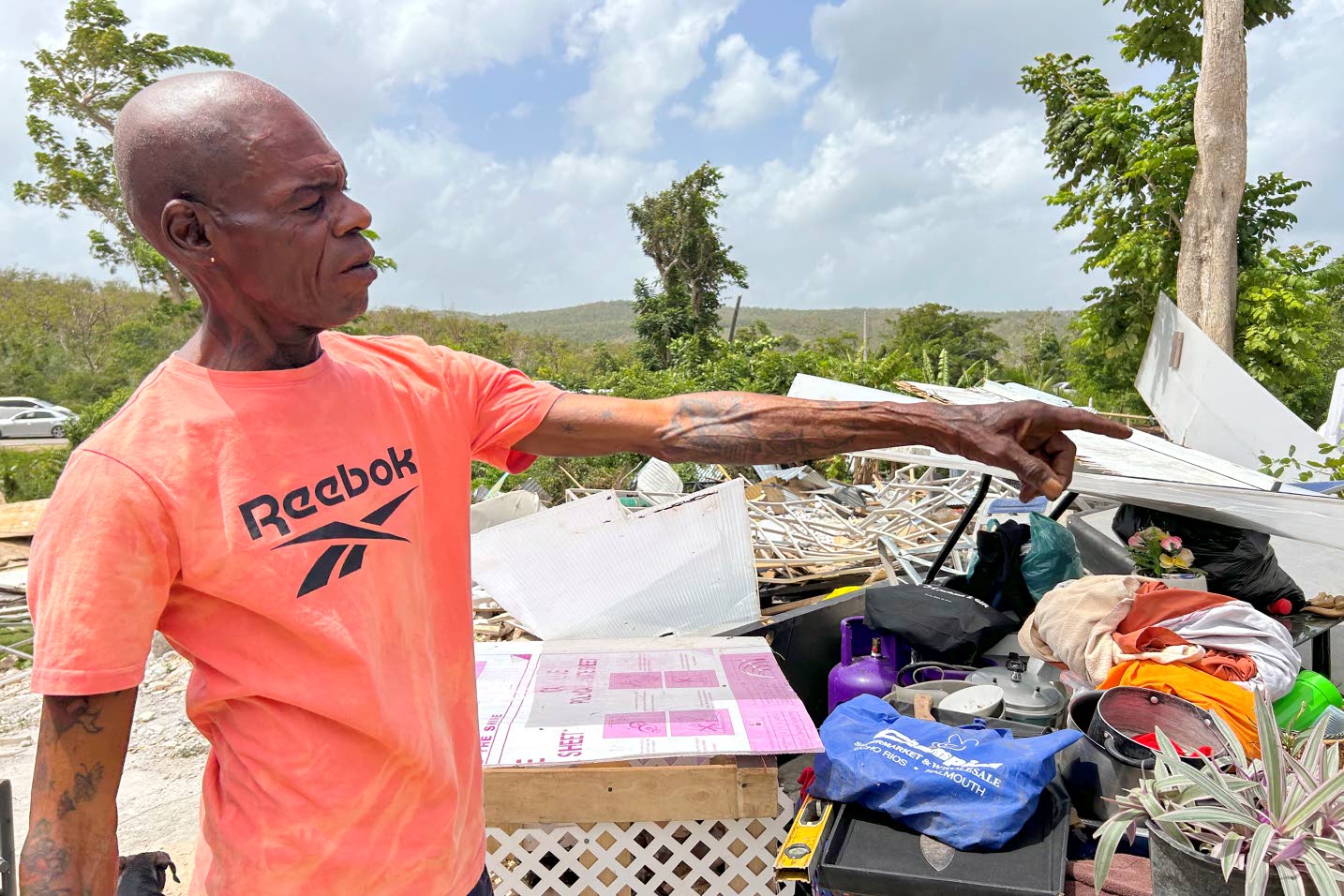
Desmond Donagal pointing to furniture from his demolished home in Coopers Pen, Trelawny, recently. (Photo: Horace Hines)
• The legal basis for the enforcement action remains contested. Transparency is essential — not only for the residents, but for the credibility of the institutions involved.
• The police must be guided by clear national protocols when supporting private enforcement. Their role is not merely to prevent disorder but to ensure that constitutional rights, humanitarian safeguards, and professional standards are upheld.
• The absence of a coordinated, rights-based eviction framework leaves both citizens and officers exposed to criticism, confusion, and operational risk.
Cooper’s Pen should, therefore, be treated as a teachable moment. Jamaica needs a national eviction and demolition protocol that mandates daylight operations, advance notice, social service presence, and structured police engagement. Such a framework would protect the vulnerable, guide officers, and prevent future incidents from becoming flashpoints of national distress.
The police remain one of the most critical institutions in our democracy. Their legitimacy is strengthened not only by enforcing the law, but by demonstrating fairness, compassion, and respect for human dignity, especially when operations intersect with people experiencing poverty, the elderly, and the voiceless.
Cooper’s Pen must not be remembered solely for its destruction; it should be remembered as the moment Jamaica recommitted itself to humane governance, transparent enforcement, and modern policing standards.
Dormah B Harrison
Retired assistant commissioner of police
dormahh@gmail.com


