



Beyond the cheque, how will you pay?
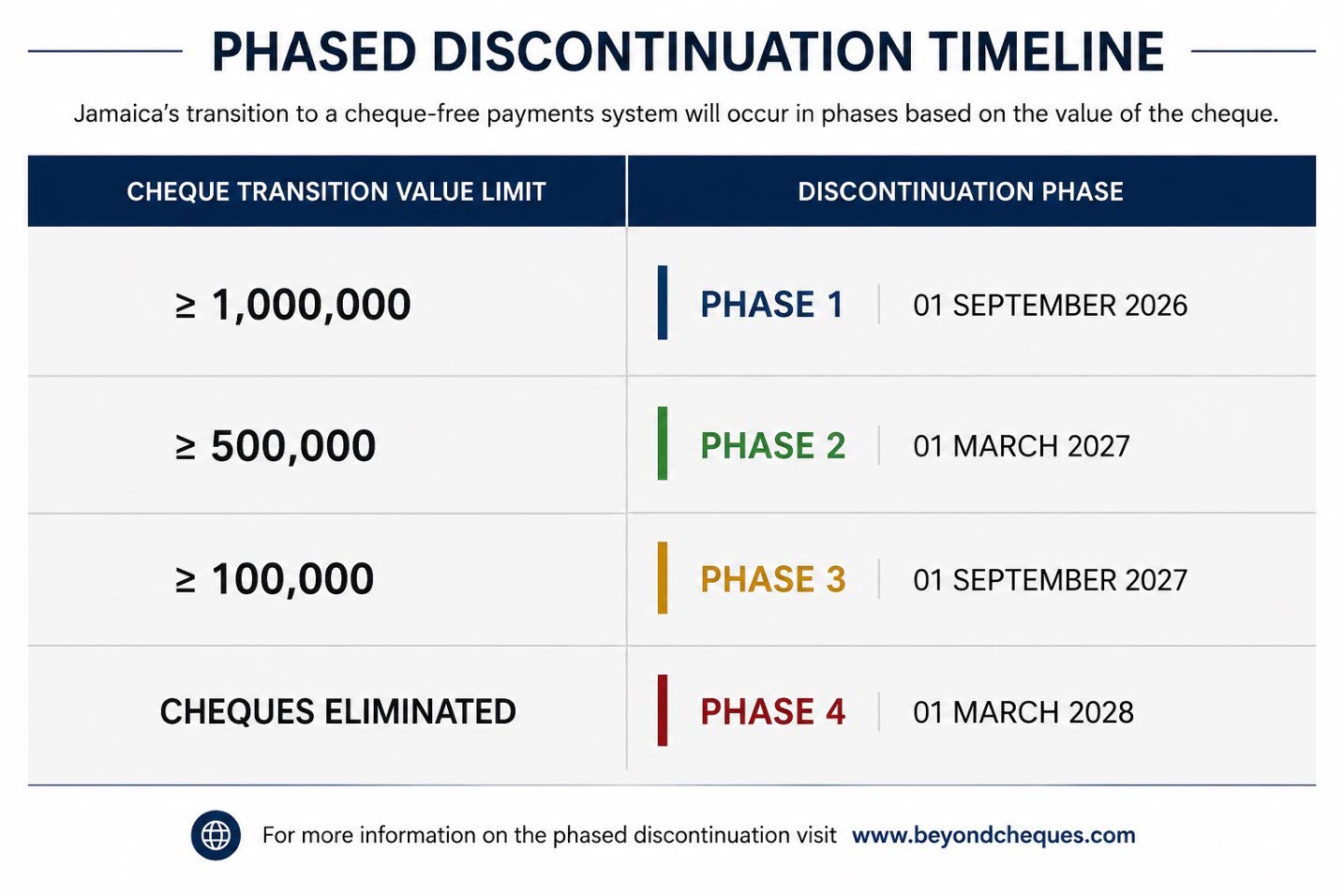
The countdown to a cheque-free Jamaica has begun, and customers will increasingly have to navigate a wider range of electronic payment options as the paper-based system is phased out.
For customers already using banking and digital payment services, the transition may mean choosing between Automated Clearing House (ACH) transfers, Real Time Gross Settlement (RTGS), bank transfers, debit and prepaid cards, digital wallets, and other approved payment services.
“The best option depends on the amount, urgency, purpose, and whether the recipient has a bank account,” the Jamaica Bankers Association (JBA) says in its frequently asked questions (FAQs) on the Beyond Cheques website.
For high-value payments between different banks, RTGS is expected to play a particularly important role. The JBA identifies it as “the principal alternative” for payments of $1 million or more, while transactions between accounts at the same institution may be processed internally.
However, customers making larger transfers will also need to consider their bank’s transaction limits and whether higher limits or advance registration are required. RTGS allows large-value Jamaican-dollar payments to be settled individually in real time rather than processed in batches. The cost of RTGS also varies by bank and according to how the transaction is initiated.
Scotiabank, for example, charges $236.90 for an RTGS transfer through its online banking platform, compared with $1,536.15 for an outgoing RTGS transfer initiated in a branch. NCB’s customer fee guide, effective September 1, 2026, lists RTGS at $240 per incoming or outgoing transaction. ACH, meanwhile, is intended for routine electronic payments and is processed in batches, while standing orders and direct debits can be used for recurring transactions. But access to those alternatives is not universal. For people without bank accounts, smartphones, or reliable Internet access, the transition could be more complicated.
“Depending on availability, options may include a Simplified Due Diligence (SDD) bank account, an authorised digital wallet, a prepaid card, or an approved cash-disbursement or remittance service through which the recipient can collect funds after identification checks,” the JBA says in its Beyond Cheques FAQs.
An SDD account is described as a lower-risk account intended to make account opening more accessible while still meeting legal identification requirements. The JBA notes, however, that documentation, transaction limits, and product names vary by bank. For those without a bank account, moving to electronic payments does not necessarily mean conducting transactions online.
“Speak with your bank early so that you can choose a channel that works for your circumstances,” the JBA says.
The JBA also points to options such as branch-assisted transfers, automated banking machines where available, standing orders, and authorised providers or prepaid products. The issue is not limited to people who need to send money. A customer may have a bank account and access to electronic payments, but the person receiving the money may not.
Moving away from paper payments, however, does not eliminate payment fraud. The JBA warns that electronic payments can still expose customers to phishing, impersonation, malware, account takeover, and false payment instructions. It advises customers to verify beneficiaries, use secure devices and trusted networks, enable transaction alerts, and review their accounts regularly. Customers should also retain receipts, confirmation numbers, and payment references. The JBA notes that a screenshot showing that a payment was initiated does not necessarily mean the recipient has received the funds. If money is sent to the wrong account, customers should contact their bank immediately. Recovery is not guaranteed, making it particularly important to verify account details before sending a payment.


