



Protecting the public purse
Williams seeks new fiscal anchor amid rising public sector wage costs
With the latest public sector wage deal signed, Finance Minister Fayval Williams is already looking towards the next one, calling for a new fiscal rule to govern wage negotiations before the country is forced into another difficult choice between workers’ demands and the limits of the public purse.
Williams made the call Thursday as the Government and the Jamaica Confederation of Trade Unions (JCTU) formally signed a three-year heads of agreement covering the period April 1, 2025 to March 31, 2028.
Under the agreement, public sector workers will receive a one-off, tax-free payment of $80,000 for the first year, followed by five per cent salary increases in each of the two succeeding years, along with the 2.5 per cent annual increment.
But Williams used the occasion to look beyond the agreement, arguing that Jamaica needs to establish a clear fiscal limit for future public sector wage negotiations rather than repeatedly confronting the question of affordability at the bargaining table.
Until 2023, she noted, the law capped the public sector wage bill at nine per cent of gross domestic product (GDP). That provision was subsequently repealed because the Government’s compensation restructuring had changed what was counted as wages, making the old measure unsuitable.
Three years later, Williams said, there is still no replacement rule.
“I do not believe, as I sit here this afternoon, that that serves well to anyone in this room. Without an anchor, every negotiation starts from zero. Every round becomes an argument about whether there is money at all, rather than a discussion around how to divide an envelope that both sides can see,” she said.
Williams is proposing that the Government and unions agree on such an anchor before the next wage round begins, rather than attempting to settle the issue while negotiations are already under way.
She said the objective would not be to impose a figure unilaterally, but to establish a framework that gives both sides a clearer understanding of what the country can afford.
“What I’m putting on the table is a principle and an invitation. Let us settle this together before the next round, rather than during it,” she added.
The minister’s push comes as the Government faces a heavier wage burden and a weakened fiscal position following Hurricane Melissa which ravaged sections of the island on October 28, 2025.
The World Bank and Inter-American Development Bank had estimated the physical damage from the Category 5 hurricane at US$8.8 billion, equivalent to about 41 per cent of GDP. When lost output was included, the assessment by the Economic Commission for Latin America and the Caribbean and the Planning Institute of Jamaica put the total impact at close to 57 per cent of GDP.
The damage has come at a time when the Government is already under pressure from weaker revenues and higher expenditure. Williams said tax revenues fell below projections last year and Jamaica is running a deficit which is expected to continue over the medium term.
More significantly for the wage negotiations, she said compensation of employees now accounts for close to 13.5 per cent of GDP, while wages are projected to consume 54.4 per cent of tax collections by the end of the 2026-27 fiscal year, up from 44.9 per cent four years ago.
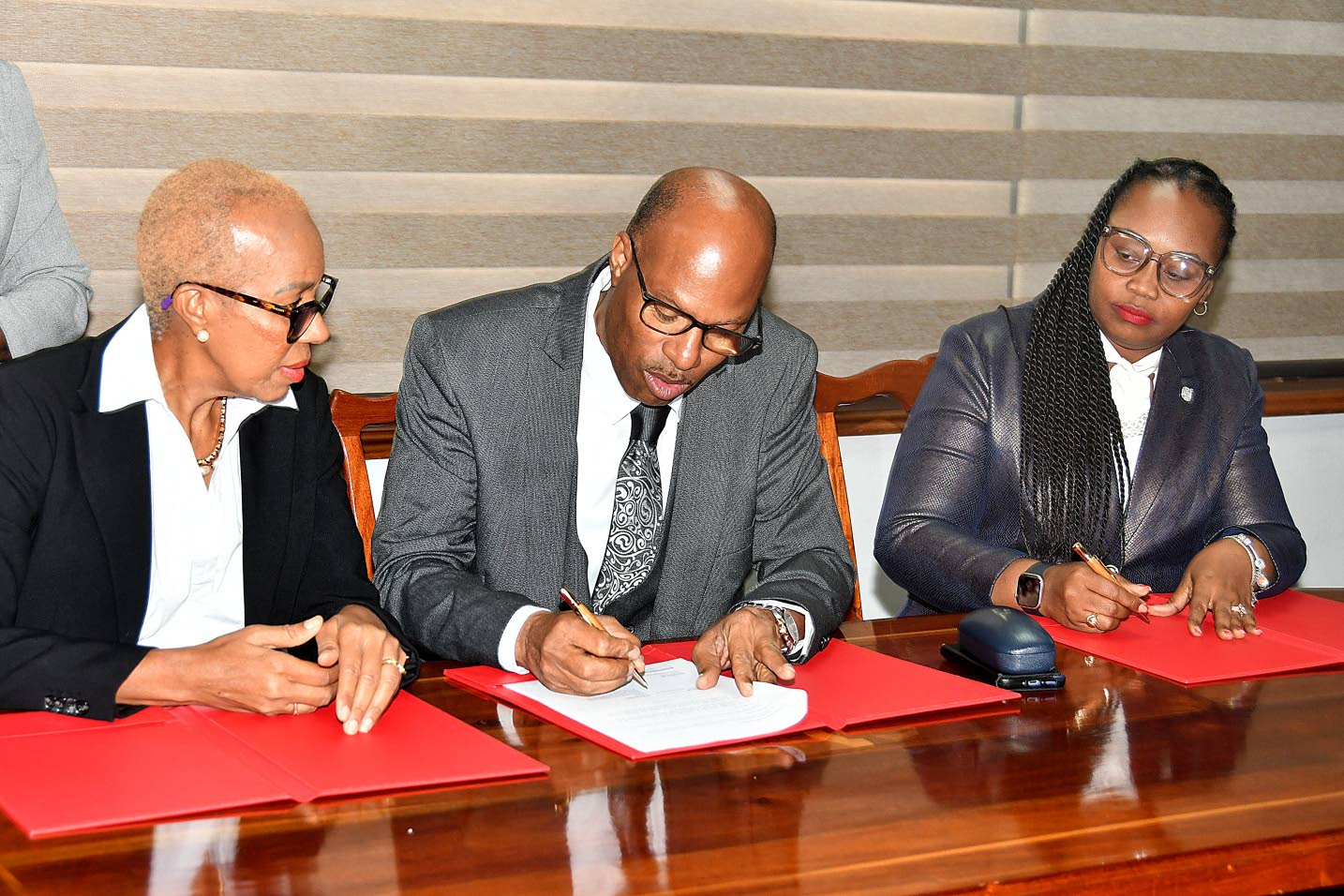
Finance Minister Fayval Williams (left) looks on as Jamaica Confederation of Trade Unions (JCTU) President St Patrice Ennis (centre) signs the three-year wage agreement, while Jamaica Civil Service Association (JCSA) President Techa Clarke-Griffiths looks on during Thursday’s signing ceremony. (Photo: Garfield Robinson)
That rising share of tax revenue is central to Williams’s argument for a new fiscal anchor.
“When a country takes a hit of this magnitude, the conventional response is a wage freeze. That is what the textbook says. It is what has happened to this country before, and it is what has happened in many countries in our position, and I have to say to you, there are voices — serious, well-intentioned voices — who told me that was the only responsible course,” she revealed.
Williams stressed that the Government did not take that route, saying there would be no wage freeze, layoffs or deferral of amounts already owed under the agreement.
But she acknowledged that the decision comes with a price.
“This was a deliberate decision, and I want to be honest that it was not a costless one. It means that other things that we wanted to do will move more slowly. It means our debt-to-GDP target is longer. We accepted that because a public service that cannot pay its bills at home cannot be asked to hold a country together in a crisis,” she explained.
Williams cautioned that the wage increases should not be viewed as a complete answer to the rising cost of living, and was careful not to present the settlement as a dramatic improvement in workers’ living standards.
With the current agreement running until March 2028, Williams wants the Government and unions to begin addressing the fiscal framework for the next round well before negotiations start.
She said the absence of a fiscal anchor creates uncertainty for both sides and can increase the risk that a future economic shock could result in harsher measures.
“When the next shock comes, the adjustment could arise on something that we do not want. And usually when you look around the world, when you have adjustments in economy… if there are no fiscal rules, governments tend to reach for wage freeze,” she said.
Williams said she wanted the issue discussed jointly with the unions, noting that the Independent Fiscal Commission had formally recommended the restoration of such a rule twice.
She stopped short of proposing a specific percentage or ceiling, saying any number would first have to be worked out with both sides.
She also argued that the three-year agreement provides some breathing room to do so, saying the Government should return to the table well before the current deal expires.
“Looking forward, this agreement runs to March 2028, and I am delighted, and I want to acknowledge the unions for agreeing to a three-year period, and I want to say to them, well before the next one starts, we should be back at the table so that we don’t have to keep extending beyond the time that it should go,” she said.


