



Uniform rush, fewer hands
Dressmakers, tailors retreat from individual orders as labour shortages and low pay pressure the garment trade
School uniforms are rolling off sewing machines across Jamaica this week as parents rush to get children ready for the new school year, but finding a dressmaker or tailor willing to take on the work is increasingly becoming a challenge.
Some experienced dressmakers and tailors say they have stopped taking individual uniform orders altogether, frustrated by the last-minute rush, uncollected garments, constant alterations and difficulty finding workers to help them through what is traditionally one of the busiest periods of the year.
The Jamaica Observer caught up with Miss Campbell, who, for about 10 years, took on individual school-uniform orders and sometimes hired as many as five women to help her get through the workload. These days, she has largely moved away from that side of the business and now concentrates on school contracts, which allow her to begin production months before September and work at a pace she can better manage.
“At my age, I have to slow down and find ways to reduce stress. I have two schools that I’m working with now and I start doing uniforms from January, February, and they take them in batches up to August for the next school year,” she said.
That is a far cry from what Campbell experienced when parents came directly to her.
“Sometimes two weeks before school opens, the parents will come at 10 o’clock at night and sit and wait because they want to ensure it gets done. They will come Saturday, Sunday, Monday, Tuesday, every day of the week at any time,” she recalled.
“And then the phone wouldn’t stop ringing. It was exhausting. I remember when I used to do big groups and I would sew for hundreds of parents. Lord Jesus, we spent more time attending to parents than we got to sew.”
The problem was not only the number of customers.
Campbell told Sunday Finance that the cost of bringing in extra help also added up quickly. When production ran late into the night, she had to think about meals, transportation and the welfare of the women she had hired.
“When we’re done sewing, I would have to hire taxi to carry them home and I also have to buy them lunch. And the money that they’re telling me that they want to assist me with the trimmings, and so on, I can’t pay them that. The light bill alone eats through most of what I earn,” she said.
“So it’s not as simple as just sewing. There’s a lot of back-end work that goes into it.”
Cynthia Duncan’s journey through the garment industry mirrors Campbell’s in many ways, but after nearly four decades in the trade, she says frustration with what the sector has become has left her seriously considering putting those skills aside and starting over in a different career.
The 55-year-old garment worker, who entered the industry at 17, closed her dressmaking business and returned to factory work after years of dealing with some of the same frustrations Campbell described.
Duncan’s experience spans boutique dressmaking, factory production and Jamaica’s old Garmex and free-zone operations, including factories run by Chinese investors.
When she was taking individual uniform orders, she said, parents often waited until the second-to-last week before school reopened and then arrived wanting several uniforms at once.
“They will come saying they want five uniforms and I have to tell them no, you can’t get five. I can give you two or one for orientation and then they can come back for the rest,” Duncan told Sunday Finance. The problem, she said, was that some never came back when expected.

Greater Portmore High School is among the institutions sourcing uniforms from local suppliers and making them available directly to parents, a system the school says helps maintain consistency in colour and design while also making purchases more convenient. (Photo: Karl McLarty)
“After you make the first uniform you don’t see them again until it wash out, done and the next school year starts. Or you see them couple months after, you will finish the remaining three and you don’t see them until four or five months after or the next September,”she recalled.
Alterations created another layer of work, while some parents paid deposits but never collected the finished garments.
“Sometimes people will pay down half of the money but they don’t come back for it. And then I end up having this whole heap of inventory,” Duncan said.
For an independent dressmaker, that can mean time already spent cutting and sewing, fabric already purchased and garments made to the measurements of a particular child sitting around with no guarantee they can easily be sold to someone else.
Duncan said the frustration eventually became too much.
Meanwhile, Drew, a tailor based in St Catherine, also told Sunday Finance that he had grown frustrated with the industry and exited the business more than a decade ago.
“I left it and started buying and selling clothes in downtown Kingston before taking my business to the countryside where I can get a better price for the same piece of clothing item. I also sell a lot of footwear…I travel and purchase slippers, and so on, and doing that helped me to earn much more money than sewing and is way less stressful,” he recalled.
The retreat by some skilled workers from individual uniform jobs is happening at the same time the wider garment industry is struggling to find enough people to do the work.
In responses to questions from Sunday Finance, HEART/NSTA Trust said garment-sector employers have been reporting difficulty recruiting and retaining skilled and semi-skilled workers, including people for sewing, cutting, finishing and trimming.
Employers are also telling the training agency that some workers who enter the industry lack the practical workplace experience needed to perform efficiently, maintain quality, and work with limited supervision.
Even after moving towards school contracts and cutting back on individual customers, Campbell still needs help at times. But finding it has become extremely difficult.
“I can’t even get somebody to help me with the handwork,” she said, referring to jobs such as trimming. “And if I do find someone, they want more money than I’m getting for the job.”
She has tried training younger workers herself.
“I remember even last year, or the year before, the first set of girls that I got was through HEART. And I got five girls, I think, and they were with me for some time,” she recalled.
“And then, eventually, everybody gone on their own. As you teach them to use the machine, they’re gone. So you don’t get the benefit of that retaining of the skills… It’s hard.”
Figures supplied to Sunday Finance by HEART show enrolment in garment and fashion-related programmes has fallen sharply from the levels recorded a decade ago.
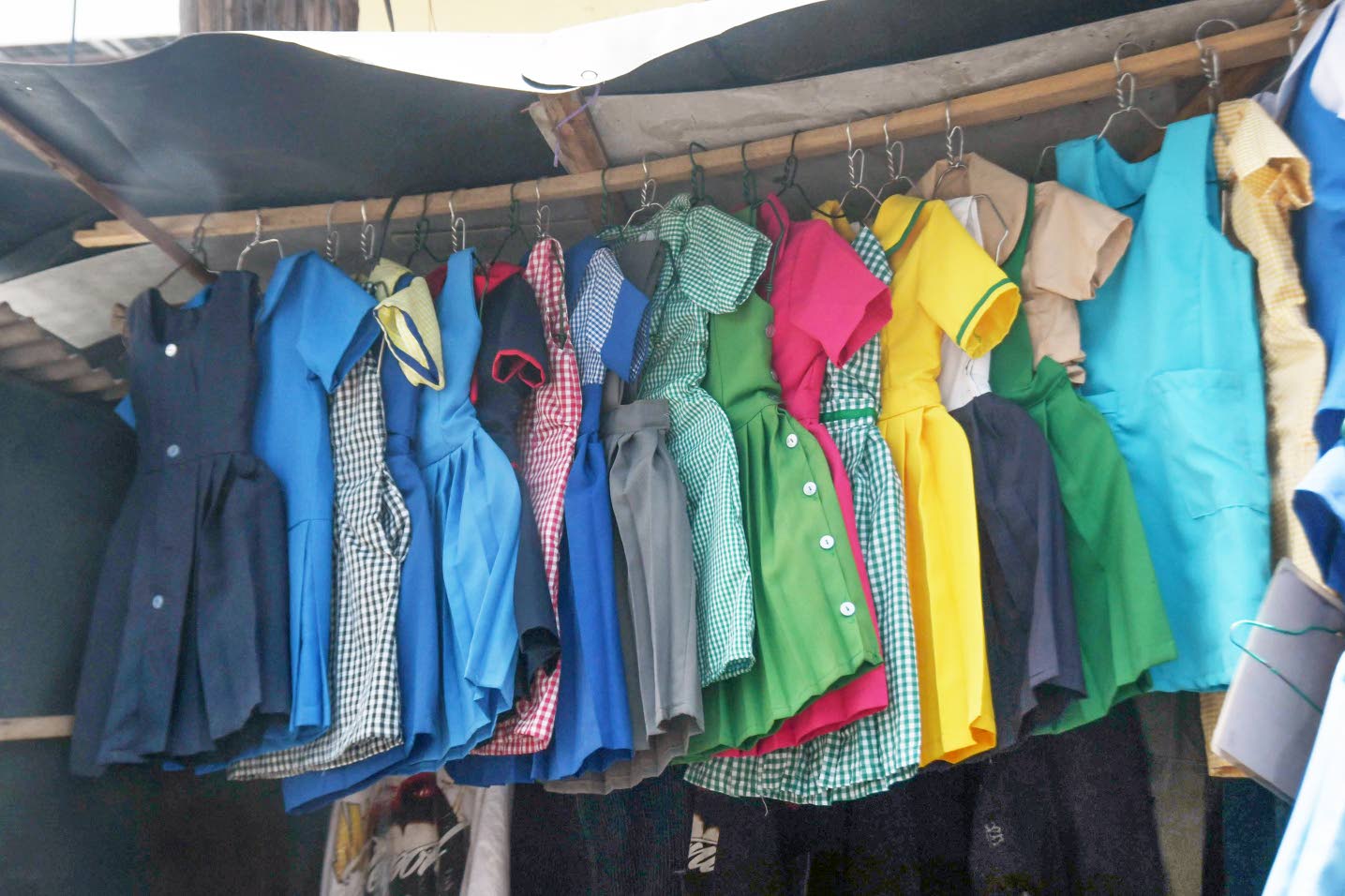
School uniforms traditionally made by community dressmakers and tailors are displayed for sale in downtown Kingston ahead of the new school year. Checks by the Jamaica Observer suggest fewer vendors are now carrying these locally made uniforms, as ready-made and school-supplied options take a larger share of the market.
Enrolment in garment and fashion-related programmes stood at 489 in fiscal year 2015 and peaked at 557 the following year. By FY2020, the number had fallen to 437, then to 338 in FY2021, 100 in FY2022 and just 70 in FY2023.
There has been some recovery since then, with enrolment moving to 82 in FY2024, 112 in FY2025 and 113 in FY2026, but participation remains well below the levels recorded before 2021. HEART had recorded another 41 enrolments for the current financial year up to August 10.
The decline is also being felt at HEART’s Garmex Academy, where the agency said programmes that once typically accommodated two groups per intake, in addition to the Machine Operator short course, are now generally running with one group per intake.
HEART is careful, however, not to reduce the problem to young Jamaicans simply abandoning sewing.
People aged 17 to 24 remain the largest age group entering garment and fashion-related programmes, it said. Of the 41 people enrolled so far this financial year, 15 are in that age bracket. One more person is in the 25-29 age group, meaning that approximately 39 per cent of those enrolled to date are under 30.
“The challenge, therefore, is not simply the absence of young people from garment-related training, but the need to attract a larger number of young people into the sector and sustain their interest in these career pathways,” HEART said.
The agency said feedback from industry suggests that wages and working conditions are part of the problem.
Perceived earning potential and compensation compared with other sectors, the physical demands associated with some garment-production environments and the lure of jobs offering better career progression are among the factors believed to be shaping workers’ choices.
HEART also pointed to perceptions of tailoring and dressmaking as traditional or informal occupations rather than modern careers, despite the wider possibilities now available across garment manufacturing, fashion, technology and entrepreneurship.
Duncan has strong views on the pay. She alleges that some locally owned garment factories operate piece-rate systems under which workers receive very little for each school uniform they help produce.
“But the problem is that many of those factories will pay their workers $360 to $400 for one complete uniform, and this is happening up to today, currently,” she told Sunday Finance. “I can show my payslips to prove how cruel many of these factories are.”
Duncan said that amount can then be spread across different stages of production, including cutting, overlocking, hemming and button work. She believes what finally reaches the individual worker is far too low compared with the price at which the uniform is sold.
“So out of that $360 per piece, $30 goes to the serger operator, $15 for the person that does the hemming, $15 for the button tacker, the person who cuts the garment gets $50. So when they take out all of that, I would go home with $250 per piece,” she said.Two hundred and fifty Jamaican dollars per uniform completed!” she reiterated.
“And then what hurts us as the worker even more is when we see how much the uniforms are being retailed for, $3,000, $3,500, shirts $2,500,” she said. “So its not that we don’t want to sew, we love our craft, but its a very lonely path to take and people just give up.”
Duncan said the pressure to increase output can become intense.
“Sometimes I have to do 50, 70, all 100 pieces per day just to make a money. For a day you can’t do less than 10 pieces… and I have to carry home pieces of the job, like the epaulettes, turning them at home so that when I go to work I can move faster,” she said.
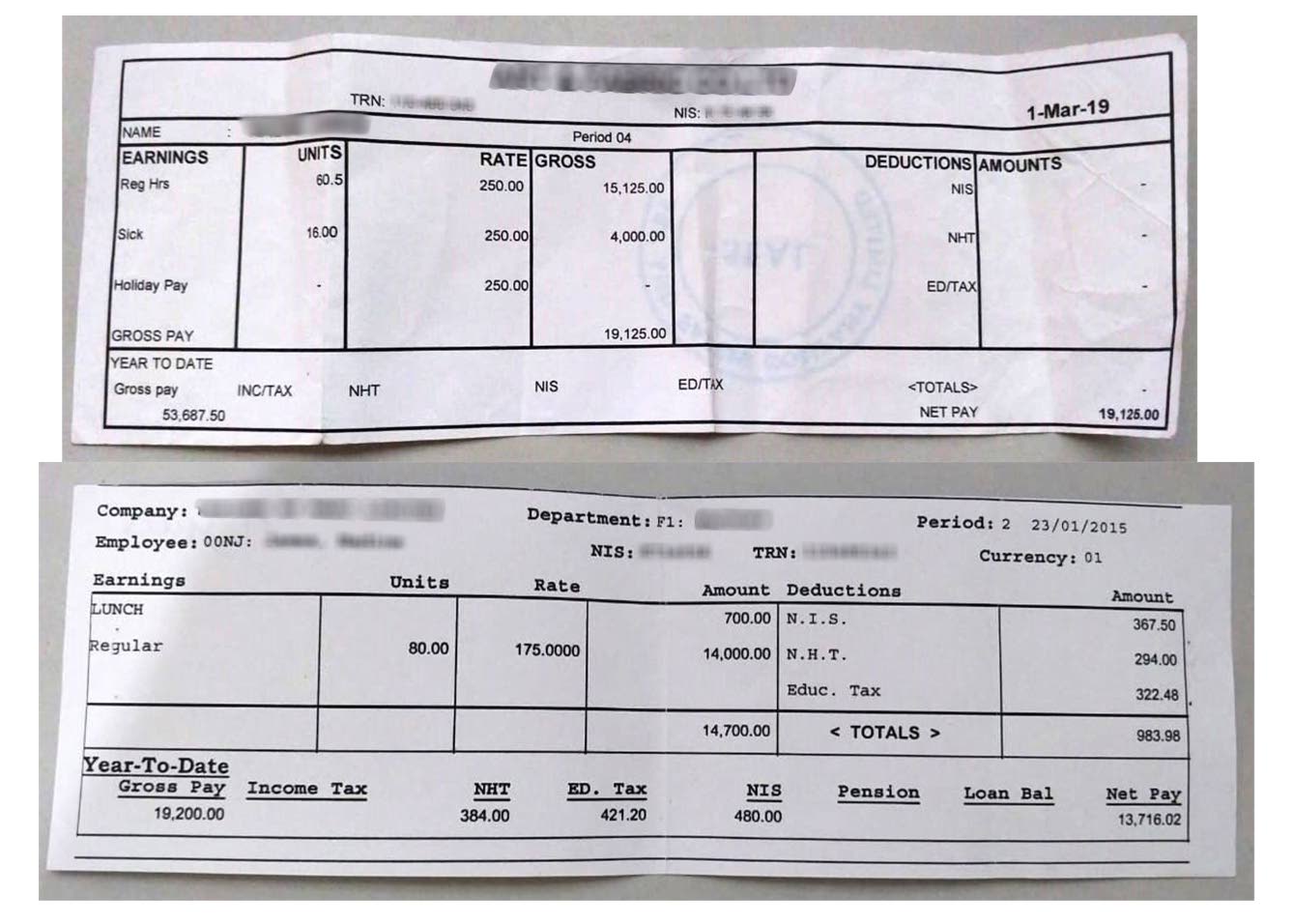
Payslips provided by garment worker Cynthia Duncan show a piece rate of $175 per unit in 2015 and $250 per unit in 2019, supporting her account of the low returns she says workers can receive in the industry. Based on the movement in Jamaica’s Consumer Price Index, the $250 rate would need to be about $380 today simply to retain roughly the same purchasing power.
“So you find that you have to reach work a little earlier or you work through your lunch time to get the numbers that you want. But by the time you are through for the day you are so tired you don’t even have strength to look at the children,” Duncan continued.
She said one factory she left was still trying to get her to return as recently as last week because of the pressure surrounding back-to-school production.
Duncan compares that experience with some of the Chinese-operated factories where she worked during Jamaica’s free-zone manufacturing period.
Those operations were also driven by output, but she said the production systems and incentives were different.
“So [at] Garmex factory, you work for pieces but you don’t sew anything else but that piece. So, for example, if you’re joining the side of a skirt, you do nothing else but join the side of the skirts. If you’re on hemming, the same thing applies. They count the number of pieces you do at the end of the day,” she said.
“You have a basic pay and if you sew more than your basic pay, you get more money. If you sew under your basic pay, you only get the basic amount. Then they had a system, if you come to work early you’d get a bonus and if you come to work every day of the week you also get bonus, so the workers used to love that.”
Those extras mattered, she said.
“So we used to save those little extras. That’s what we used to throw partner and set aside for back to school and health emergencies. So we were able to survive.”
Duncan also remembers those factories having equipment and attachments designed to make individual production tasks faster and more precise.
“In the Chinese factories, their equipment are so effective and efficient,” she said, listing specialised feet for zippers, edge stitching and different seam widths.
“In many of the Jamaican-owned companies, is the one machine foot you have to use to do everything. Chinese factories — all the zipper foot, edge stitch foot, quarter-inch stitch foot and half-inch stitch foot. Local-owned companies don’t have those kinda things, is you have to use your eyes and guide you.”
HEART says that wider question of productivity cannot be separated from Jamaica’s ability to rebuild garment manufacturing.
The training agency told Sunday Finance that training alone will not make local production competitive. Production costs, technology, financing, access to raw materials and the strength of the local supply chain will also have to be addressed.
Further, it said its own training programmes are being adjusted as the industry changes.
“The most current NVQ-qualification plan offered at the Garmex location is fashion design and technology level 2 programme, which represents an evolution from more traditional and basic garment-manufacturing programmes,” HEART/NSTA Trust said.
“There has also been increased attention in acquiring technology resources that support training, particularly in areas such as pattern making, cutting and digitisation. These resources allow trainees to develop competencies that are increasingly relevant to modern garment production and help bridge the gap between traditional garment-construction techniques and contemporary industry practices,” the training institution continued.
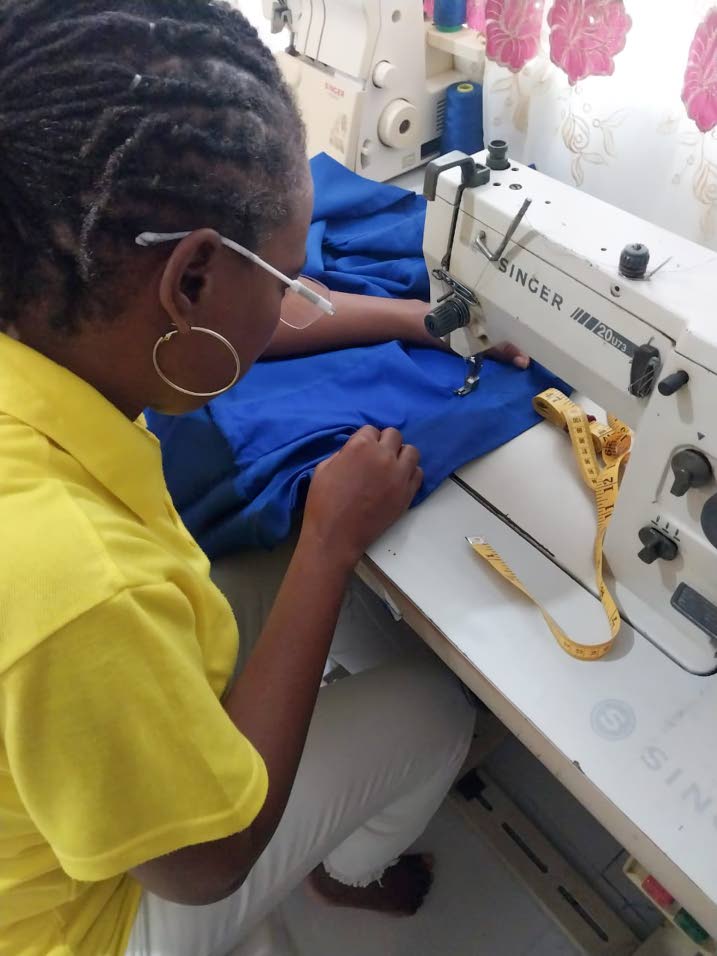
Garment worker Cynthia Duncan, who has spent nearly four decades in the industry, says low piece rates, long hours and the difficulty of making the work pay have left her questioning how much longer she wants to remain in the trade.
That push towards modern production is taking place as the school-uniform business itself changes.
More schools are recommending, and in some cases requiring, students to purchase uniforms directly from them. At schools such as Cedar Grove Academy, Edith Dalton James and Meadowbrook High, distinctive colours and patterns can also mean parents have little choice but to buy from the school or its designated manufacturer. And oftentimes, the cost to have the item ready-made may run 10 per cent to 50 per cent more than getting it made by a community dressmaker or tailor, based on checks made by the Jamaica Observer.
At Greater Portmore High School, parents can buy a range of uniforms directly through the school, with two local suppliers producing the garments. The school’s secretary Caroline Robbins told Sunday Finance that the arrangement developed partly out of the school’s efforts to maintain consistency.
In the past, parents sourced their own material and had uniforms made independently. But Robbins said when students returned in September, the school could end up with several different shades of blue.
“What we realised is that in having the parents go out and source the material, in September, when it’s back to school, we have four or five different shades of blue,” Robbins said.
About three years ago, the school moved towards supplying uniforms for students in grades seven to nine, including tunics and shirts carrying embroidered crests.
The problem also extended to the way some uniforms were made. Greater Portmore’s tunic is supposed to carry four box pleats.
“One of the problems we also had with the persons making their uniforms or getting them out is we have four box pleats,” Robbins said. “Sometimes they go to the dressmakers and when they come to school September morning, you see them have eight pleats or six pleats.
“So in order to really get the uniformity, that’s one of the reasons why schools basically opt to have the uniforms here.”
Convenience also became part of the equation. Greater Portmore once tried sending parents directly to one of its suppliers, but Robbins said many complained that it was easier for them to buy uniforms at the school than travel from Portmore into Kingston.
The school therefore returned to keeping a range of sizes on campus. The orders can be sizeable.
Robbins said Greater Portmore sometimes orders more than 1,000 pieces for a school year, using enrolment numbers and buying patterns to estimate how much stock it will need. Some parents buy several shirts or tunics at a time.
Imported ready-made uniforms are also competing with garments made by local dressmakers and tailors. Checks made by the Jamaica Observer at Joseph’s — a clothing retailer — found khaki pants retailing for $3,000, regardless of the size, compared with about $1,500 quoted by some tailors to make the item, including the material.
HEART believes uniforms could remain one of the areas where local producers have room to compete.
The agency said manufacturers may find more success focusing on flexibility, quality, customisation and responsiveness rather than trying to compete directly with large overseas producers solely on price. Uniforms, customised garments, fashion design, specialised products and smaller-batch production were among the areas identified.
“Ultimately, rebuilding a sustainable garment-manufacturing sector will require collaboration among government, HEART/NSTA Trust, manufacturers, retailers, training institutions and other industry stakeholders. The objective should be to create an environment in which local producers can compete and grow, businesses can access appropriately skilled workers, and young people can see garment manufacturing as a viable and modern career pathway,” the training institution said.


