



Holness urges Commonwealth shield against threat to democracy
OCHO RIOS, St Ann — Prime Minister Dr Andrew Holness has urged parliamentarians across the Commonwealth to craft a regional response to what he has described as a serious threat to democracy by those who use technology to spread misinformation and deliberately destroy reputations.
“No longer can we treat this epidemic as merely the cost of doing political business. It is a threat to the democracy of our countries,” he warned Monday night.
Holness was addressed the opening ceremony for the 48th Regional Conference of the Commonwealth Parliamentary Association’s (CPA) Caribbean, Americas and Atlantic (CAA) Region. The event was held at Moon Palace Jamaica in Ocho Rios.
The week-long conference is being held under the theme “Strengthening Parliaments in the Digital Age”.
Holness told participants that the speed and reach of digital information are creating a new challenge for democratic societies, making it increasingly difficult for citizens to distinguish falsehoods from material that has been manufactured or deliberately manipulated.
“We are entering an age in which seeing is no longer believing, and that means that you are entering an age where the public trust is far more difficult to garner, which means that it is far more difficult to manage democracy. And that represents a profound challenge for democratic societies, because democracy ultimately requires a shared basis of fact. If citizens can no longer confidently distinguish authentic information from manufactured information, trust becomes harder to sustain,” the prime minister said.
Against that background, he called for the issue to receive attention at the regional parliamentary level.
“I urge the CPA to deliberate on this matter,” Holness charged.
“We may have different populations, resources, and constitutional arrangements, but we face the same challenges: cyber threats across borders, digital platforms across borders as well, artificial intelligence that crosses borders as well, and disinformation crosses borders as well,” he added.
Holness acknowledged the tension between tackling harmful online content and protecting freedom of expression.
“For many Caribbean countries, we consider ourselves liberal democracy, and nothing should ever be done to fetter free speech. But we do take note of some of our European countries — and some of our North American colleagues — [that] have long come to the conclusion that the information that is being traded can be damaging and threatening to their democracy. And they have found ways — even [in combatting] things such as radicalisation, hate speech — to properly legislate… misinformation trading that is a threat to the democracy,” he said.
“Every day in our Caribbean societies, our democracy is being threatened by falsehood, misinformation, deliberate campaigns to assassinate characters. There has to be a standard for the veracity of information that is so easily available to our populations,” he added.
Holness also placed information security within the broader responsibility of protecting democratic institutions, saying Parliament’s systems, communications, records and data must be secured.
“Cybersecurity can no longer be regarded simply as a technical matter to be left to the information technology department; it is now part of democratic resilience,” he insisted.
He argued that the use of artificial intelligence and automated systems in public decision-making should also be transparent, with citizens able to understand their impact and know who remains accountable for the final decision.
Holness said the digital transformation of Parliament should extend beyond simply converting paper-based systems to digital ones.
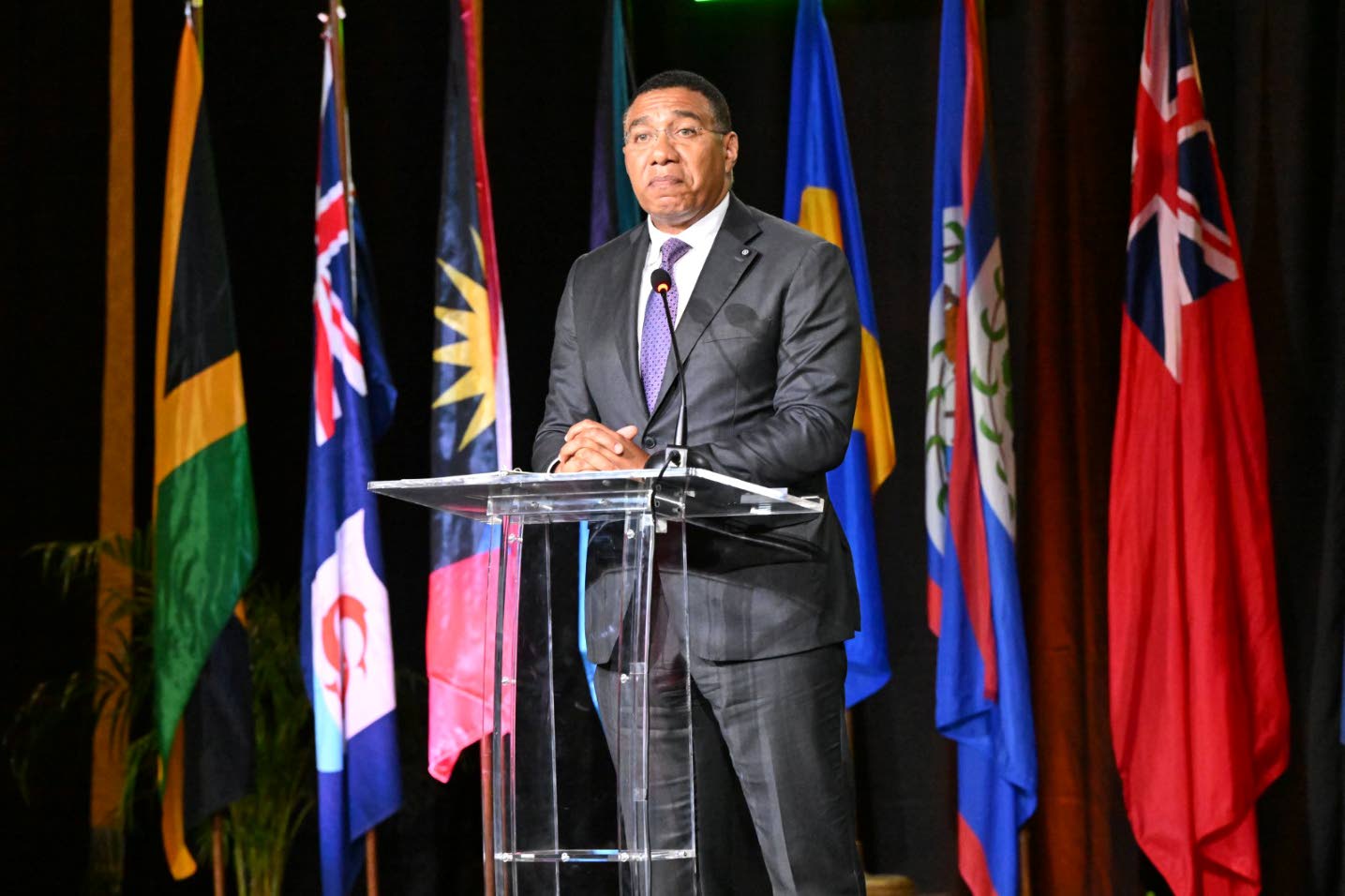
Prime Minister Dr Andrew Holness delivering the keynote address during Monday night’s opening ceremony for the 48th Regional Conference of the Commonwealth Parliamentary Association; Caribbean, Americas and Atlantic Region at Moon Palace Jamaica in Ocho Rios.
“The question is not whether technology will affect parliamentary democracy. It already has. The question is whether our institutions will shape that transformation deliberately and not merely react to it,” he stressed.
The prime minister noted that technology has the potential to make parliamentary proceedings more accessible, improve communication with constituents, strengthen legislative research and committee work, and expand access to parliamentary records. But he cautioned that technological progress must not come at the expense of representative government.
“There is a fundamental principle that must serve as our north star through this transformation. It is that technology must remain the servant of democracy, not its master,” he said.
Holness said democratic decision-making involves considerations that cannot simply be reduced to calculations of speed or efficiency.
“Democracy is a constant struggle between efficiency and dignity, so the transformation that will come as a result of technology must preserve the dignity of the people. And what is this dignity? The dignity is the trust in the judgment of the people you elect. Indeed, that’s what it comes down to at the core of the democracy: The trust, the respect for the institutions to deliberate on your behalf and to feel the natural intelligence, as opposed to the artificial intelligence; that is the dignity,” he underscored.
He said Parliament must retain the authority to question the recommendations or answers produced by technology.
“The digital world is fast, but democracy requires deliberation. Technology can produce answers in seconds, but Parliament must always reserve the right to ask: Was it the right answer? Was it lawful? But the deeper question is: Was it fair? And what happens when there are competing interests? When both interests are equally determined, who makes that decision? That is where the trust comes, where we have to trust our elected representatives; and they can’t then turn to ChatGPT or Claude or any of the other artificial intelligence engines to make the decision for them — and ultimately for you,” he said.
Holness said elected officials must retain responsibility for the decisions they make.
“No algorithm can assume the constitutional responsibility of an elected representative. No technology system can replace the obligation of public officials to exercise judgment and to explain their decisions to the people,” he emphasised.
He also stressed the need to build the capacity of those working within parliamentary institutions.
“Artificial intelligence cannot replace the human factor. And we must invest in people, in our parliamentarians, in our clerks, researchers and administrative staff; they must be able to confidently use new technology. Digital transformation ultimately depends not on the sophistication of the hardware and software we purchase, but on the capability of the people and the institutions to use,” he said.
Holness reserved special attention for young and youth parliamentarians, saying their familiarity with technology would influence the future development of Parliament.
“What we leave to them must be strong institutions that, yes, can be renewed by technology. But they must never lose the true essence of the democracy, of the representation, of the deliberation, of the scrutiny, and of the guarantee of the public’s trust,” he cautioned.
Holness said the ultimate objective should be stronger democratic institutions rather than simply more technologically advanced ones.
“Our objective, therefore, should not simply be to create our digital parliaments, it should be to use the opportunities of the digital age to create stronger democracies, and those entrusted with public power must still be prepared to stand before the people and explain how that power was exercised,” he argued.
Holness, who congratulated Speaker of the House of Representatives Juliet Holness on her chairmanship of the CPA CAA Region, welcomed delegates to Jamaica and encouraged them to use the conference to examine how technology can strengthen democracy while protecting its fundamental principles.


