



Moving beyond injury
UHWI Physiotherapy Department helping patients take back their lives
FOR many Jamaicans, physiotherapy may bring to mind patients recovering from accident-related injuries. But University Hospital of the West Indies (UHWI) is seeking to broaden that understanding, highlighting the various services offered to help patients regain independence in their everyday lives.
On September 7, the UHWI Physiotherapy Department will showcase its services during Open Day when the public will be able to tour the facility, interact with physiotherapists, and learn more about the range of treatments available.
“We have mainly patients with back pain, and joint pain… that would be our leading management. Then we mainly look at broken bones, people who have been in accidents, multiple types of accidents like slip and fall, but that’s not all we do,” said Dr Dionne Danvers-Bennett, director of the department.
According to her, the unit treats a wide range of medical conditions, varying from orthopaedic rehabilitation to adult and paediatric neuro-rehabilitation, sports medicine, and even burn care management. However, she noted that the hospital could not yet handle severe burn cases.
“We also work with women who are pregnant and prepare them for childbirth…those are called Lamaze classes. For people who have pelvic inflammatory disease, we treat that too, and that’s a special branch of physiotherapy that we offer. There’s ergonomics as well, which is for people who are taught how to function properly at work after an injury. If, for instance, they had a back injury and they’re returning to duty, we would evaluate their station at work and make recommendations for modification,” noted Danvers-Bennett.
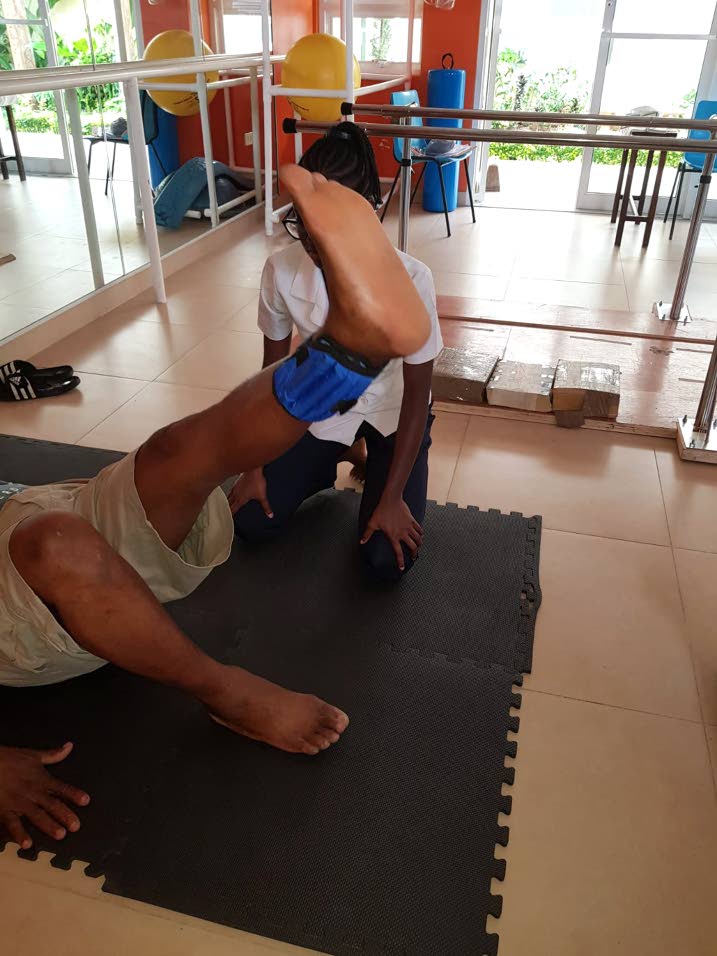
A patient at University Hospital of the West Indies Physiotherapy Department receives strength training on his leg.
That service, she pointed out, is also offered for homes, telling the Jamaica Observer that members of the team assist with the retrofitting process.
“So if you’re now confined to a wheelchair, we would have to come to your house, measure the width of the door, the incline of the ramp for you to access in and out of your house. We also look at modification of your bathroom to ensure that the rails are there for you to be able to function and do your activities of daily living,” she explained.
Another unique programme highlighted by Danvers-Bennett was the department’s cardio rehab programme, provided to patients who have undergone coronary artery bypass grafts, which is a procedure that restores blood flow to the heart by using a healthy blood vessel from another part of the body to detour around a blocked or narrowed coronary artery.
“The programme is designed to work with the patients from day one post-op when they’re in the intensive care unit (ICU). We then work with the patients for six weeks to three months, and we take them through the entire rehabilitation process,” she said, adding that rehab is structured in terms of the type of lifestyle that the patient previously led.
“So if you were an athlete, then your programme is going to be very specific to get you to running again. If you were a musician, of course, we have to get you to be strong enough so that you can sing and your lungs are strong enough to manage. If you were sedentary, we, of course, try to ensure that we improve your quality of life so that you can function. So that’s an intense programme that we take our patients through,” said Danvers-Bennett.
The medical doctor further noted that the department played a crucial role helping COVID-19 patients recover outside of the traditional treatment of being placed on ventilators.
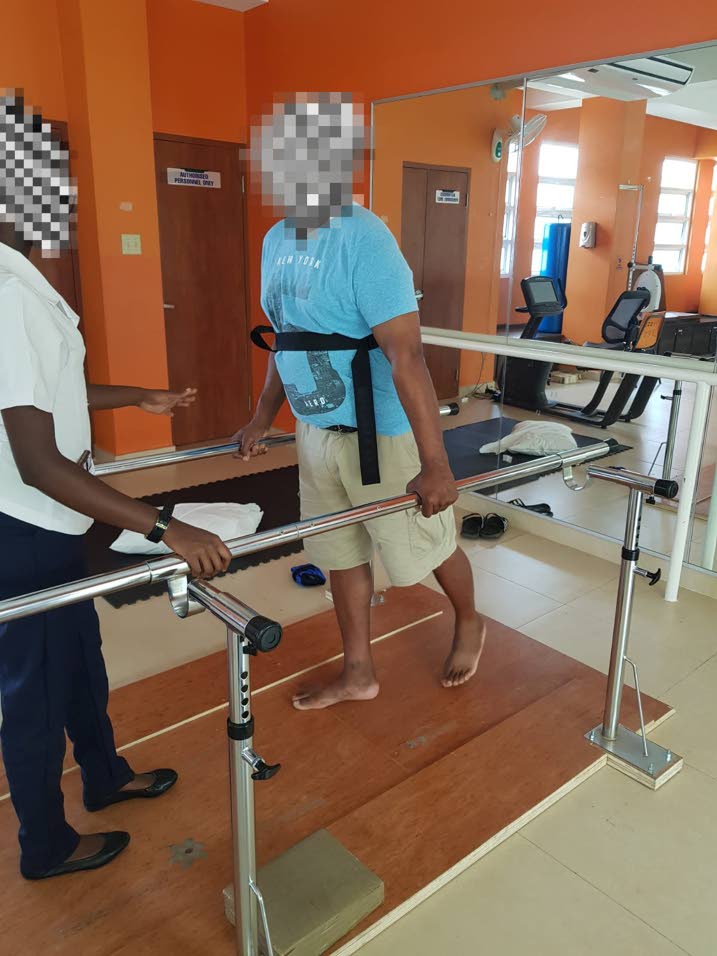
A patient learns to walk again during a session at University Hospital of the West Indies’ Physiotherapy Department.
Danvers-Bennett explained that through cardio-respiratory treatments, like pruning, patients were able to expectorate excess mucus by lying on their belly while a physiotherapist uses his/her hands or a mechanical vibrator to encourage the lungs’ expulsion of built-up secretion.
As for future projects, she detailed a tele-rehabilitation draft which has been submitted for approval, with the intention for implementation in early 2027.
“This is to target patients who are either in the intermediate phase of their rehabilitation or for patients who are limited by transport or family support to access our physical facility. This will ensure that all of our population benefits, and it is also a practice widely done in developed countries. Community-based rehabilitation has benefited our department because it acts as a triage in reducing wait time and patients’ condition may improve, subsequently reducing their visits to the hospital,” she said.
The department, which also trains student physiotherapists from across the Caribbean, has extended its services to accept all patients, even those not admitted to UHWI.
“I would like for Jamaicans to know that if your surgery is done here, that your rehabilitation can be done at the university hospital. Although you have to pay to access the services, because I know that’s the biggest issue that a lot of people have, we still do not turn away anyone. You can walk in from Monday to Friday between 8:00 am and 4:00 pm, and you will have interaction with physiotherapists, occupational therapists, speech therapists, who can answer your questions and ensure that your experience at the hospital is pleasant,” said Danvers-Bennett.


