



Fear factor
Wary public servants move slowly and cause red tape, says Holness
In a blunt admission during Tuesday’s launch of Jamaica’s reconstruction watchdog, Prime Minister Dr Andrew Holness said the fear of parliamentary scrutiny that follows procurement decisions has become part of the reason public servants are reluctant to move quickly.
This is an issue the Jamaica Reconstruction and Resilience Oversight Committee (JAMRROC) is now expected to help confront through independent, real-time accountability.
Holness said the answer was not to remove scrutiny, but to make it possible for Government to comply with the rules while moving at the speed demanded by the country’s recovery.
Speaking during the official launch of JAMRROC at Jamaica House in St Andrew, Holness said the Government has to confront what he described as a culture within the public sector, with officials overly cautious about taking decisions because of the consequences of getting the process wrong.
He said that caution was having real consequences for people waiting on the Government to deliver, particularly in the aftermath of Hurricane Melissa which ravaged sections of the country last year on October 28.
“No one wants to go to Parliament and face the PAAC (Public Administration and Appropriations Committee) that will say you did not follow procedure. Or get a report from the Auditor General that writes you up. No public servant wants that smear against their name, and so they are not going to be moving any faster than what the process allows them to. But the people are still there waiting, and that’s the reality,” noted Holness.
He said Jamaica’s existing procurement framework was not designed to accommodate the speed and scale required for the National Reconstruction and Resilience Authority (NaRRA), which was established to take on the extraordinary reconstruction workload rather than simply adding it to the responsibilities of existing ministries and agencies.
But the prime minister stressed that faster execution cannot mean weaker oversight.
“We have too often treated speed and accountability as though they were mutually exclusive. They are not. We can move quickly and still follow rules. We can demand results and still insist on transparency. We can empower people to make decisions by holding them accountable for those decisions. Jamaicans should not be afraid of our own capacity to execute,” he insisted.
Holness said the Government therefore intends to reform administrative and procurement processes where necessary, including reducing steps that may no longer be relevant, while maintaining safeguards governing the use of public resources.
He was also at pains to reject any suggestion that NaRRA had been created to escape conventional public accountability.
NaRRA will still be required to maintain proper accounts and audited financial statements, while the Auditor General will have access to its records. Its reports and financial statements will also be subject to parliamentary scrutiny, and approved reconstruction and resilience initiatives are to be placed on a public register.
The prime minister said, however, that those mechanisms alone do not provide the continuous public visibility required for a reconstruction programme of this scale.
“And that is where JAMRROC comes in. It adds independent, public-facing scrutiny. Its conclusions must be its own and its reports must reach the Jamaican people directly and unhindered,” Holness said.
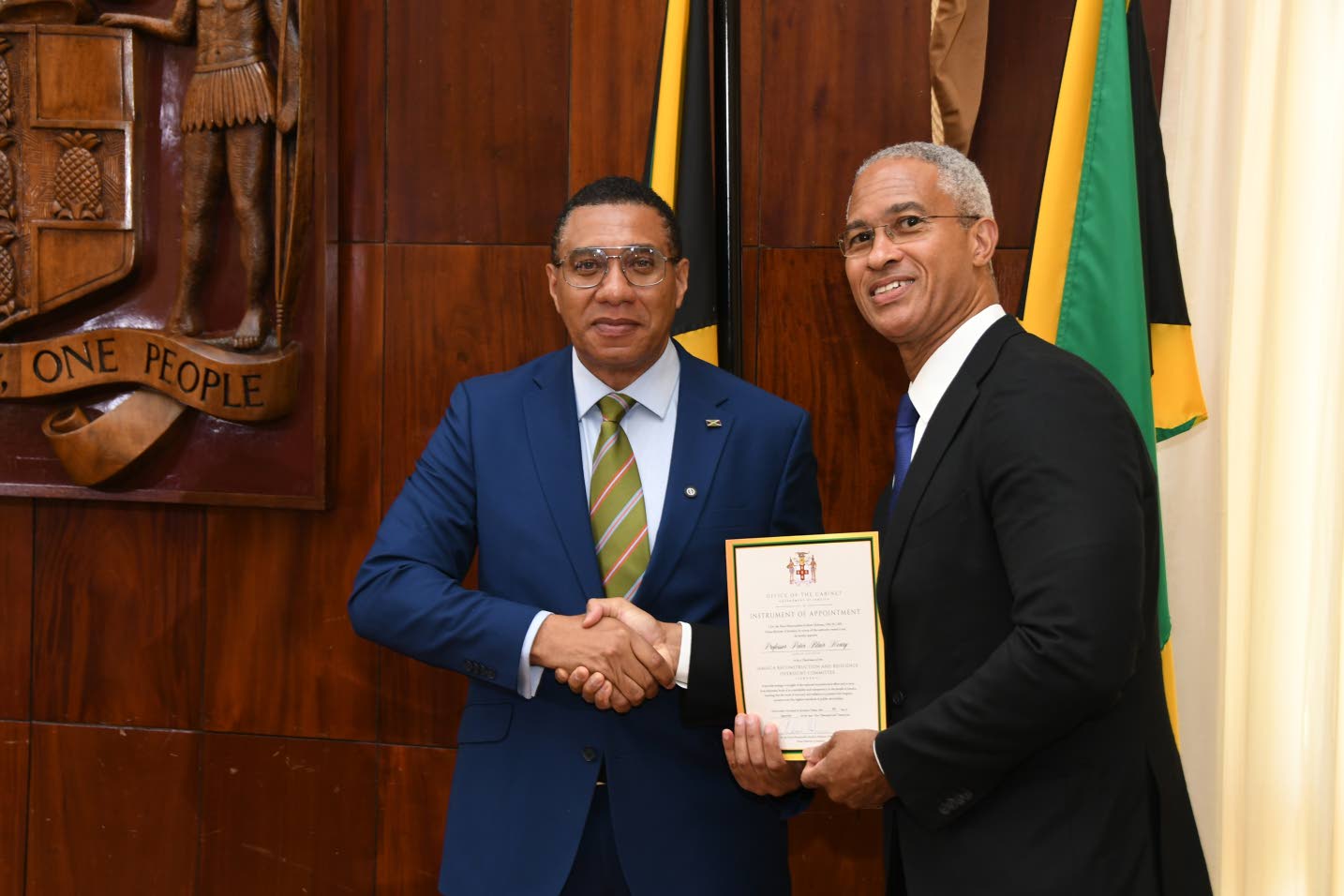
Prime Minister Dr Andrew Holness (left) presents a certificate of appointment to Professor Peter Blair Henry, chairman of the Jamaica Reconstruction and Resilience Oversight Committee (JAMRROC), during Tuesday’s official launch of the committee at Jamaica House in St Andrew.
That distinction between statutory accountability and more immediate public scrutiny is central to the role envisaged for JAMRROC by its chairman, Professor Peter Blair Henry.
Henry said the committee will advise the prime minister and Cabinet on which reconstruction projects should enter NaRRA’s fast-track process and will then observe and critically assess NaRRA’s implementation of those projects.
But he said JAMRROC’s work will not be confined to reviewing projects from a distance.
“JAMRROC will not operate in [an] ivory tower nor in isolation, but with communities and real people in mind. To enhance and facilitate doing our two major jobs, JAMRROC will work to promote greater public understanding and transparency… We want to actually meet people, hear people, and see people to see how the analysis that we’re doing, which is based on facts and information, relates to people’s real experience. It’s very important to have that texture, to bring that into the analysis and to share that perspective with the decision makers,” Henry explained.
He said JAMRROC is planning quarterly reports on the reconstruction portfolio, but those reports will be supplemented by material designed to make complex issues understandable to ordinary Jamaicans.
Henry cited the need to explain concepts such as “maximising the resilience-adjusted economic and social return” in language that people can readily understand.
He said the committee also wants to establish a common factual basis for public discussion about the country’s reconstruction.
“People are entitled to their own opinions, but they are not entitled to their own facts. So there will be one set of facts for private and public review and debate on the progress of this important national project. With that goal in mind, I will be the sole public spokesperson for JAMRROC,” he declared.
For NaRRA Chief Executive Officer Ambassador Antony Anderson, the transparency drive will be important not only for accountability but also for maintaining public confidence in the reconstruction programme.
“Accountability and transparency will be embedded in the DNA of NaRRA. We’re a public body, and over time those of us who’ve been in the public service for a while have seen the development of an extensive network of accountability processes that we go through,” he pointed out.
He said JAMRROC’s independent composition would give it the freedom to challenge the reconstruction process where necessary, while also providing an authoritative voice when the work is being done properly.
Anderson also warned that public cynicism and misinformation could undermine confidence in the reconstruction effort, particularly if Jamaicans are not able to clearly see what is being done and why.
During the launch, members of JAMRROC were formally named. In addition to Henry serving as chairman, the committee includes Senator Keith Duncan, the Government representative; Patrick Hylton, president of the Private Sector Organisation of Jamaica (PSOJ); Helene Davis Whyte, representing the National Partnership Council and organised labour; Pastor Glen Samuels, representing Western Jamaica; Dr Christopher Burgess, an engineer and climate scientist; and Professor Dale Webber, an academic and climate-change specialist.


