



Rock Solid at full tilt
Drought drives tank maker to capacity as it plans new products, possible relocation
Rock Solid Plastics Limited is running at maximum production capacity as prolonged dry conditions drive strong demand for water storage, but the manufacturer is already moving to diversify the business ahead of an eventual easing in tank sales.
Managing director and founding partner Andrew Simpson said the five-and-a-half-year-old company is now producing between 140 and 150 water tanks daily, up from roughly 10 per day when it started operations during the COVID-19 pandemic.
The company operates on a two-shift system and, Simpson said, is currently down for only about 29 hours each week as it tries to keep pace with demand.
“Because of the drought, we are currently at maximum capacity,” Simpson told the
Jamaica Observer during a tour of the company’s manufacturing plant at 9C Ashenheim Road in St Andrew.
At the centre of that output is Rock Solid’s rotational moulding system, which Simpson believes gives the company an edge in the local market.
The process uses high-density polyethylene, which is loaded into a mould before moving into an oven where the plastic is heated for about 15 to 20 minutes. The rotating mould forms the tank before it moves through two cooling stages and is removed as a finished product.
Simpson was particularly proud of the company’s oven-based system, contrasting it with the open-flame technology he said is still used by some competitors.
“We use an oven to produce our water tanks,” he said, arguing that the system gives Rock Solid greater consistency and energy efficiency.
“When you bake the chicken, you get a more consistent chicken. So we are baking because we use an oven,” Simpson said.
He added that the same system gives Rock Solid greater flexibility to manufacture other products by changing moulds, an advantage that is becoming increasingly important as the company looks beyond water tanks.
“This is a more modern way of rotamoulding, rotational moulding. And it allows us to make a much wider variety of products outside of just water tanks,” Simpson said.
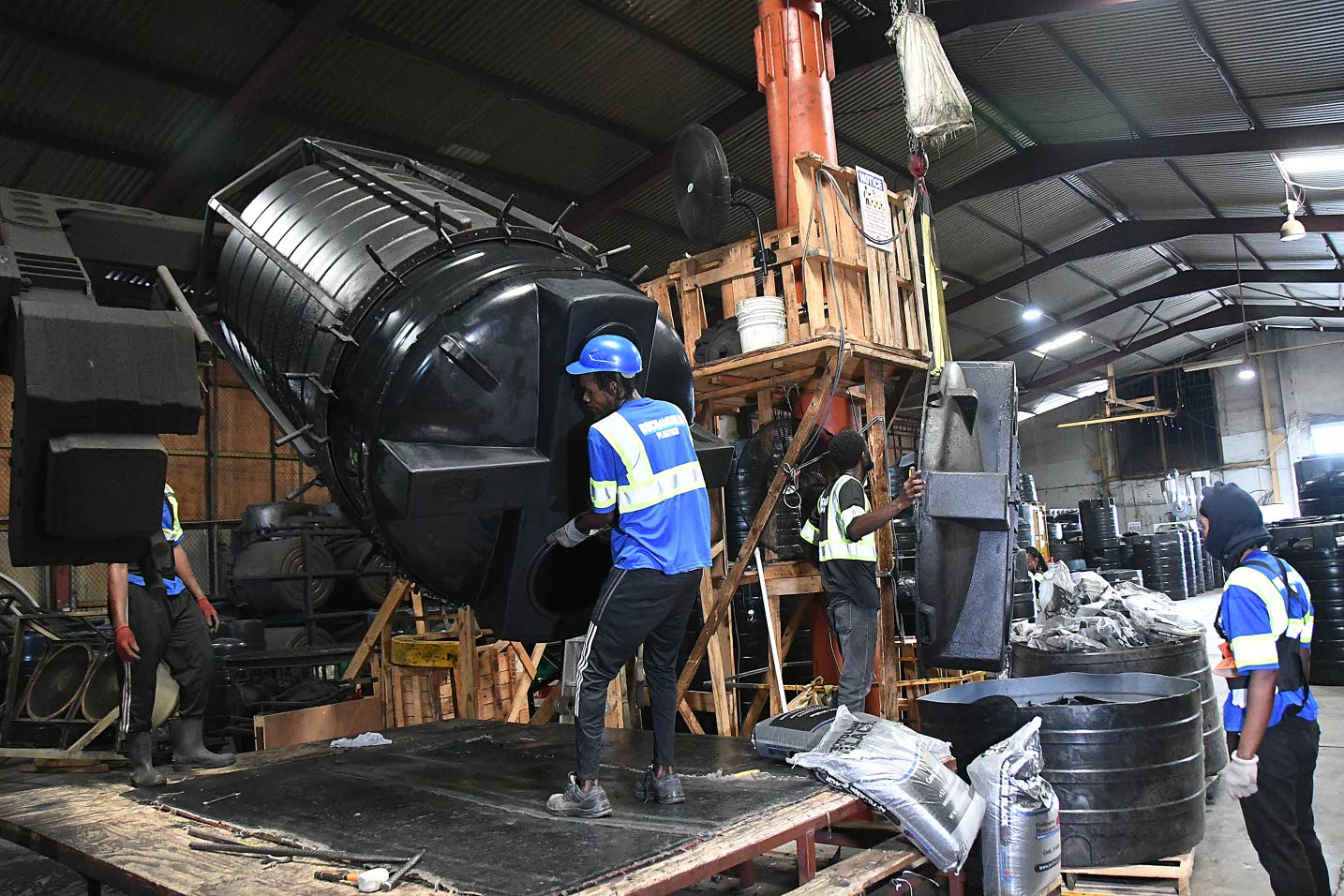
A Rock Solid Plastics employee removes a newly moulded water tank from the company’s rotational moulding system at its Ashenheim Road plant in St Andrew. The process uses heat and rotation to form the tanks before they move through a cooling stage.
Rock Solid currently employs between 30 and 40 people and manufactures tanks ranging from 200 gallons to 2,500 gallons, along with a growing line of other rotationally moulded plastic products.
The company’s strongest demand is now coming from rural Jamaica, particularly Westmoreland and St James, where householders and farmers account for much of its business. Its 650-gallon and 1,000-gallon tanks are its two biggest sellers.
But Simpson is not banking on the present pace of water tank demand continuing indefinitely.
“With every drought, there is rainfall behind it. With every rainfall, there is another cycle behind it,” he said.
“We don’t expect water tanks to be at this level in perpetuity.”
Water tanks currently account for about 95 per cent of Rock Solid’s revenues, giving the company a strong incentive to broaden its product base while demand remains high.
Slimline water tanks for apartments, small spaces
Among the products now being lined up are 110-gallon and 220-gallon slimline tanks aimed at apartment dwellers and households with limited yard space.
Simpson said the company sees growing demand for smaller storage solutions in urban areas such as Kingston, St Andrew, St Catherine and Montego Bay, where conventional water tanks may be difficult to accommodate.
“So, ultimately, each and every person wants to have the ability to store some level of water,” he told the BusinessWeek.
“For the bigger tanks, you may appreciate that there’s no way for everybody in an apartment to have a bigger tank. So, we’re looking at making like a 110-gallon tank…and a 220-gallon slimline tank as well.”
The tanks are being designed to fit through an apartment door, and Simpson estimates that the segment could eventually account for about five to 10 per cent of the overall market.
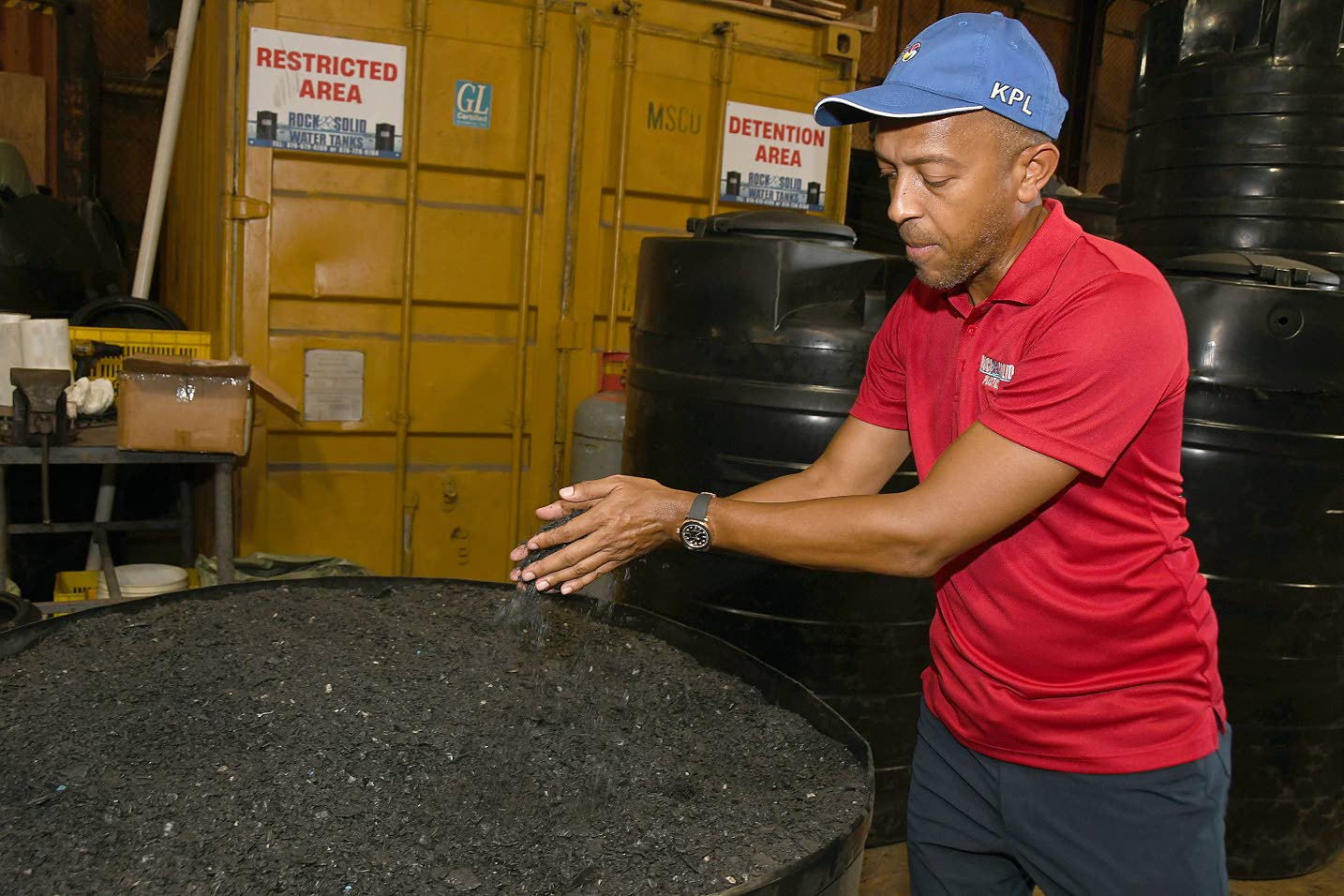
Andrew Simpson, managing director at Rock Solid Plastics, displays recycled plastic produced from old and damaged water tanks at the company’s Ashenheim Road plant. The material is ground and reused in non-loading products such as planters, garbage bins and manhole enclosures.
The company is also preparing to add septic tanks, grease traps and other products, while continuing to expand its existing range of plastic manhole enclosures, planters and garbage bins.
Simpson said the diversification is intended to smooth earnings when demand for large water tanks slows.
“The other product is really just for diversity…and for diversified market. So, it makes your revenues more robust,” he said.
Rock Solid is also looking at pushing the lifespan of its main product further.
The company currently offers what Simpson said is a 12-year warranty on its tanks, but is preparing a product with a warranty of between 25 and 30 years. Its manufacturing system allows it to produce tanks with up to four layers.
Despite its rapid expansion, the company has largely funded its growth organically and Simpson said major new equipment is not immediately required for several of the products now being considered. In some cases, Rock Solid only needs to add new moulds to its existing rotational moulding system.
The privately held company is also keeping the capital markets in sight.
Asked whether Rock Solid would eventually consider listing on the Jamaica Stock Exchange, Simpson said: “Eventually.”
For now, however, he said the company remains in an aggressive growth phase.
Where it started
The business itself grew out of Simpson’s experience in agriculture.
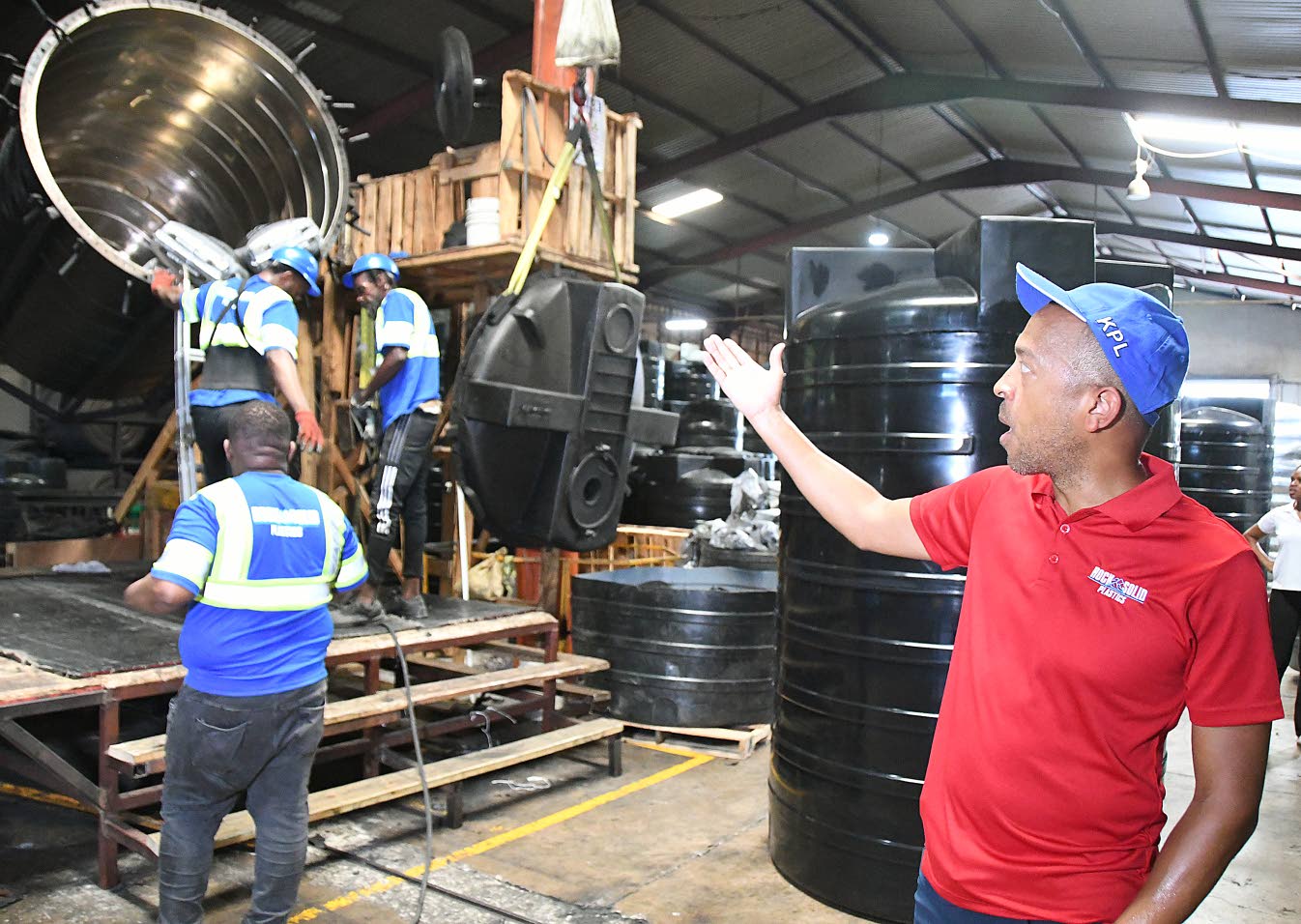
Rock Solid Plastics Managing Director Andrew Simpson explains the tank manufacturing process as employees load high-density polyethylene raw material into a mould at the company’s Ashenheim Road plant.
A former national champion young farmer, Simpson said he became interested in water tank manufacturing after repeatedly facing long waits to source tanks for agricultural use.
“I dedicated the best part of my 20s and 30s to agriculture,” he said.
“The whole concept of water storage and specifically plastic water tanks came from my days of farming where I realised that on many occasions, wanting to purchase a water tank and you had to wait two, three weeks to get the tank, which I found to be unacceptable at the time.”
Rock Solid started during the pandemic with only a handful of employees and initially produced largely 650-gallon tanks.
“We started out making probably only 650s. Probably making 10 tanks a day,” Simpson recalled.
The company has since built a much larger operation, with Simpson estimating that Rock Solid now controls roughly 30 to 40 per cent of Jamaica’s water tank market, though that figure is the company’s own estimate and was not independently verified.
Simpson said the company has also participated in government water-storage programmes, including a tender for part of a 10,000-tank procurement.
Rock Solid is now beginning to confront another problem created by its growth: Space.
The company leases a roughly 14,000-square-foot building at Ashenheim Road, with another approximately 4,000 square feet outside, but Simpson said the operation could use four to five times that amount.
The company has been exploring additional storage as well as the possibility of eventually relocating some manufacturing outside Kingston.
“Manufacturing is outgrowing Kingston. And Kingston is outgrowing manufacturing,” Simpson told the BusinessWeek. “The cost per square foot to lease in Kingston is just becoming more and more not feasible.”
St Catherine is among the areas being considered, particularly given that many of the company’s employees live there. Simpson is also involved in a development on Old Harbour Road that could potentially accommodate future operations, although he stressed that no relocation decision has been taken by the company’s board.
(Photo: Karl Mclarty)
A move could also open the door for Rock Solid to bring more renewable energy into its operations.
The company’s rotational moulding furnace is powered predominantly by liquefied petroleum gas, while its motors run on electricity supplied by Jamaica Public Service. Simpson said Rock Solid has explored solar, but indicated that such an investment would make more sense at a future permanent location.
“We have explored solar solutions, but that will more than likely come with our new home,” he said.
One option under consideration is a hybrid model under which manufacturing could eventually move while Ashenheim Road remains a distribution point for the Kingston and St Andrew market.
At the same time, Rock Solid is eyeing exports, although Simpson said the economics make large water tanks difficult to ship.
“As you may appreciate, that’s exporting a lot of air,” he said.
Instead, the company is looking more closely at exporting smaller products including planters, garbage bins and some septic tank solutions, initially within the Caribbean.
North America is also on the radar, particularly Florida, where Simpson already has an export channel through another business.
Rock Solid is also incorporating recycled plastic into some of its non-load-bearing products.
Damaged tanks are ground and pulverised and the material reused in products such as planters, garbage bins and manhole enclosures. The recycled material is not used in water tanks because of the pressure requirements. Simpson said the process can cost the company more than using virgin raw material.
“We actually make no money off of this. It actually probably costs us a little bit more than what virgin raw material costs us, but it’s recycling,” he said.


